
Ellison falls out of the top 10 as Oracle sinks to a 34-month low
Investor doubts about Big Tech's AI spending boom just knocked Oracle's cofounder out of the billionaire top 10 and pushed the stock to its lowest level in nearly three years.
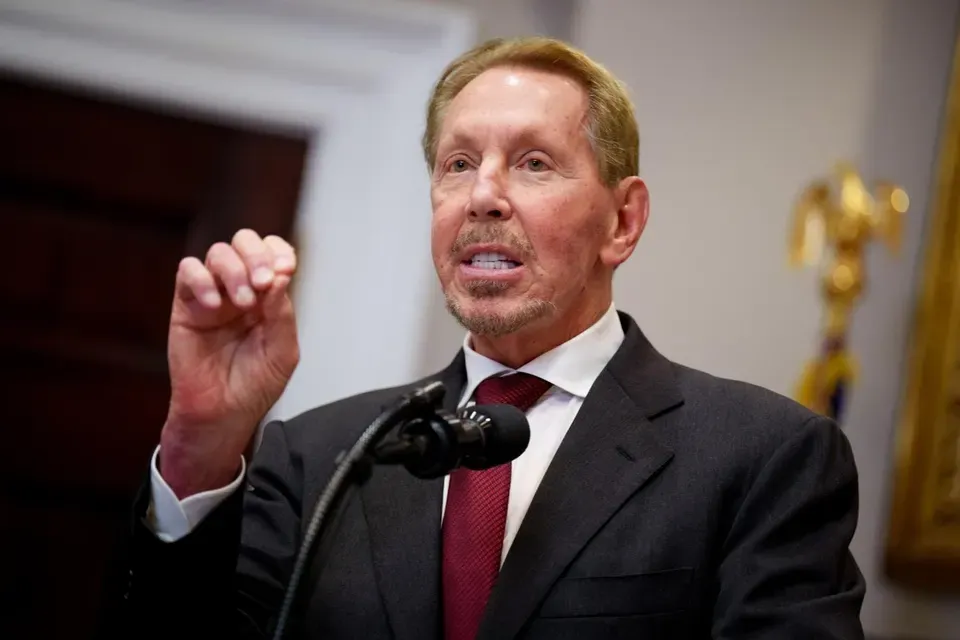
Larry Ellison has dropped out of the top 10 of the billionaire ranking after Oracle shares hit a 34-month low, driven by investor concern over the massive artificial intelligence spending boom among Big Tech's largest companies. For executives, the slide is a live stress test of what happens when a growth story is built on a concentrated set of AI-spending customers and a founder's wealth is tied to a single ticker.
Larry Ellison is out of the top 10 of the billionaire ranking, and the reason is visible on a stock chart. Oracle shares have fallen to a 34-month low, their weakest level in nearly three years, as investors turn on the massive artificial intelligence spending boom being run by Big Tech's largest companies. For Ellison, Oracle's cofounder, those are not two separate stories. They are one: his fortune is concentrated in the company he built, and that company has become one of the market's cleanest ways to bet on, or against, the AI buildout. When the trade sours, the ranking moves. The exit from the top 10 is the scoreboard. The 34-month low is the mechanism.
The trigger, per the reporting, is investor concern around a massive boom in AI spending from Big Tech's top companies. Read that carefully, because the anxiety is not that AI spending is small. It is that the spending is enormous, concentrated among a handful of buyers, and still short of a proven payoff. That combination turns every company with revenue tied to the buildout into a high-beta proxy for the whole trade. Suppliers capture the upside when capital expenditure expands and absorb the multiple compression when investors start asking when the returns actually show up. Oracle, having leaned hard into cloud infrastructure as its growth story, sits directly in that blast radius.
For context on how a database company ended up here: Oracle built its franchise on enterprise software licenses, then spent recent years repositioning around cloud infrastructure to catch the migration of corporate workloads off owned servers and into rented compute. That pivot made the AI boom a natural tailwind, because training and running large models requires exactly the kind of capacity cloud providers sell. It also made Oracle's growth narrative dependent on the spending plans of a small set of very large customers, historically the hyperscalers that build out data centers at scale. Concentration cuts both ways. It produces spectacular growth optics in an upcycle and a violent re-rating when the buyers blink.
The billionaire math is simpler than the market math. Rankings of the ultra-wealthy are recalculated against public share prices, so a founder whose net worth is mostly one ticker is effectively marked to market every day. Ellison's position near the top of that list was a function of Oracle's valuation, not a separate achievement, and a slide of this kind removes him from the top 10 without him selling a share. For founders and controlling shareholders, that is the practical lesson of concentrated ownership: the same position that compounds wealth in a bull run transmits drawdowns with no diversification buffer. Boards at founder-led companies typically see this show up twice, once in the share price and once in the personal balance sheet of the person setting strategy.
The deeper story is a shift in what investors are pricing. For most of the AI cycle, the question was who wins. Now it is who pays, and on what timeline. That reframing hits hardest on companies whose valuations embed an assumption of uninterrupted hyperscaler spending. When the concern is the size of the boom rather than its existence, the market is not forecasting a collapse. It is repricing duration, pushing out the date at which today's spending converts into tomorrow's earnings, and demanding a discount for the wait. Companies that sell picks and shovels to the AI miners feel that first.
What to watch next is less about Oracle's press releases and more about its customers' capital budgets. Guidance from the largest AI spenders on data center construction and compute commitments sets the ceiling on how much demand flows to infrastructure suppliers, and any hint of digestion rather than acceleration will be read as a warning across the group. Oracle's own disclosure on cloud bookings, and how quickly contracted backlog converts to revenue, is the company-specific test. A single quarter rarely settles the argument, but it can widen or narrow the gap between perception and fundamentals fast.
The strategic stakes extend well past one stock. AI exposure has become a valuation asset and a valuation liability at the same time, and the transition between the two can happen in weeks. CFOs who have leaned on AI language to justify capex and multiples should assume investors will now ask for the payback schedule in the same breath. Boards should stress-test what happens to their equity story if the biggest AI spenders slow down, and how much of the growth plan depends on a handful of buyers. Ellison's drop out of the top 10 is a vivid headline. The durable lesson is about concentration: of a fortune, of a customer base, and of a market's faith in a spending cycle that has not yet proved its returns.
This story's Key Insights and Take-aways are locked.
Create a free account to unlock Executive Actions for one credit.
Register to UnlockAlways free for Executives Club members. Join the Club
More in Business

S&P 500 Enters Correction, Down 10% From Its High on AI Worries
The index's slide past the 10 percent line is a symbolic verdict on investor mood, and the AI trade that powered the rally is now the thing testing it.

Dow and S&P 500 enter correction as Nasdaq logs worst week since 2020
All 11 S&P 500 sectors fell more than 1% in the same week for the first time since April 2025, a breadth signal that matters more than any single index level.

Chip stocks lose $2.3 trillion in a week, worst run in 25 years
A $2.3 trillion weekly wipeout in semiconductors is forcing every board with an AI story to ask whether it owns a thesis or just a crowded trade.