

Equal AI raises $30M as its AI call assistant hits 1M monthly users
The $30M round is backing an AI phone agent that promises to remove call bottlenecks for Indians, now at scale.
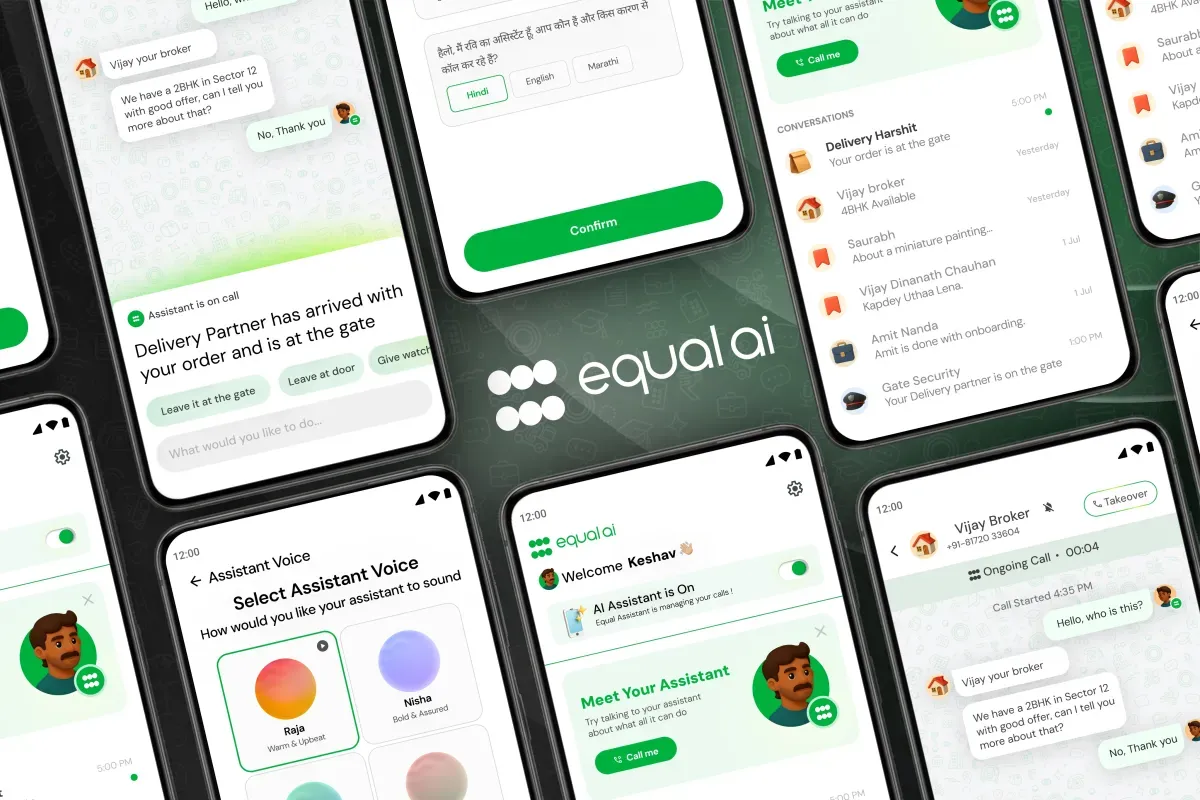
Equal AI, a provider of an AI-powered call assistant, announced it has raised $30M and that the product now has over a million monthly active users. For decision-makers, that combination signals both demand and the risk trade-off in building AI infrastructure for regulated, high-friction telecom workflows.
Equal AI just closed a $30M raise and used it to spotlight a metric that is getting harder to fake: its AI-powered call assistant now has over a million monthly active users. In practical terms, that means this is not just an AI demo that performs well in quiet lab conditions. It is handling enough real conversations at enough cadence to become a habit.
So what is the bet? Equal AI positions its call assistant as screening calls so Indians do not have to. The underlying promise is straightforward, but the environment is not. Phone calls are still one of the most common ways people and businesses interact in India, and call screening is where time goes to die. If AI can reliably filter, route, or triage those calls, the payoff is immediate for users who answer fewer unwanted calls and for organizations that convert more of the calls they do receive.
A $30M round for a call-screening business also tells a familiar story to investors and operators: this category lives or dies on distribution plus operational reliability. It is tempting to think the main barrier is model quality. But in call-centric products, the model is only one component. The system has to deal with messy human inputs, varying intent, accents, and background noise, then map those signals to the right next step fast. Even small failure rates can quickly create customer churn, regulatory complaints, or reputational damage, depending on who is on the other end of the call.
That is why “monthly active users” matters. In this market, the difference between signups and ongoing usage is usually the difference between a product and an experiment. Over a million monthly active users suggests Equal AI has found a workflow people actually rely on, not a niche curiosity. For boards and exec teams, MAU is also a proxy for unit economics questions you cannot fully ignore: how expensive it is to serve those calls, what percentage resolve correctly, and how often the system needs a human fallback.
If you are tracking the Indian AI landscape, call assistants sit at the intersection of three forces. First, smartphone and telecom adoption makes phone-based experiences omnipresent. Second, labor and time costs motivate automation. Third, government and regulator attention tends to rise around anything involving communications, consumer protection, and automated decision-making. Even when the source information here is limited to Equal AI’s own claims, the sector reality is clear: the more your product touches live communications, the more compliance and user safety become part of product engineering, not legal paperwork.
Second-order, this funding signals something about competitive dynamics. Teams building AI that screens or triages calls are not just selling “AI.” They are trying to become the front door to conversations. When you become a front door, switching costs can grow fast. Organizations that route calls through your system do not want to rewire their phone flows every few months. That is good news if you are winning. It also raises the stakes: if the experience degrades, the backlash can be amplified because customers feel blocked or misunderstood at the very moment they are trying to reach someone.
There is also a structural market implication. Call handling is a distributed, multi-party process: the user, the organization, telecom providers, and often a stack of call routing and CRM tools. A call-screening assistant that gains scale can create data flywheels over time, improving intent handling and routing. That can become a strategic moat, but only if the company converts engagement into reliable performance and keeps users trusting the assistant with increasingly sensitive or important calls.
For executives at similar companies, the headline takeaway is not “AI can screen calls.” The takeaway is that a player in this category can reach over a million monthly active users while raising $30M, which implies both market pull and product endurance. That raises the competitive temperature for anyone building voice and agentic workflows: investors will look for proof in real usage, boards will ask for operational safeguards and human escalation paths, and operators will prioritize integration depth over pure model bragging.
Equal AI’s announcement, at least on the facts provided, is a clean signal: capital is backing a live product, and the product is being used at scale. In an industry full of ambitious pilots, scaling to MAU is often the hardest milestone to hit. If you are planning your own roadmap for AI assistants in communications-heavy industries, that is the benchmark to start worrying about.
This story's Key Insights and Take-aways are locked.
Create a free account to unlock Executive Actions for one credit.
Register to UnlockAlways free for Executives Club members. Join the Club
More in Technology

OpenAI says 10,000 agents cracked a 90-year math problem in 88 hours
The company's claim is audacious, but one mathematician is pushing back. Here's what it means for AI-driven discovery.
Meta still serves child sexual abuse ads on Instagram in India - BBC report
A new report following the BBC Eye investigation says the ads are still there - what it signals for every platform with a self-serve ad engine.

White House yanks 'Build the Wall' game after Tetris Company copyright warning
The administration's arcade game vanished in hours - and the takedown playbook every brand can learn from.