
Farage: PM has no mandate to edge Britain back into the EU single market
The Reform UK leader told BBC Breakfast the Prime Minister's proposed Brexit changes would move the UK towards the EU's single market, a charge that reframes technical trade fixes as a question of consent.
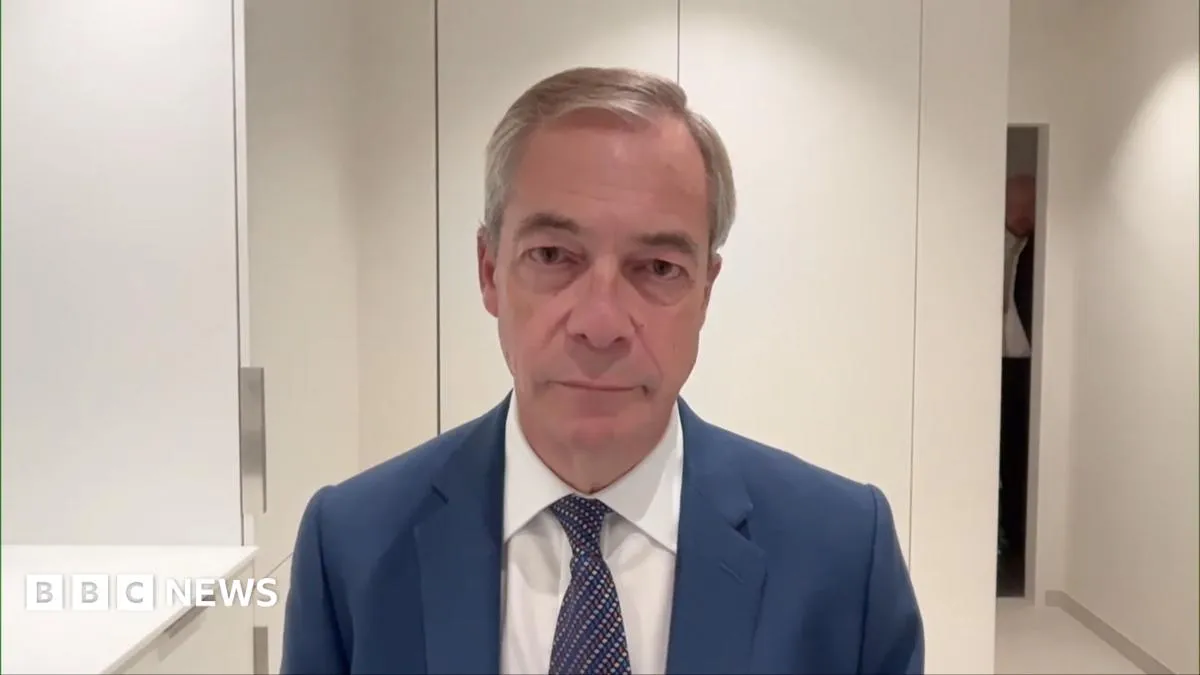
Reform UK leader Nigel Farage told BBC Breakfast that the Prime Minister has no 'democratic mandate' for the proposed Brexit changes, which he says would take steps towards reintegrating the UK into the EU's single market. The charge converts technical UK-EU cooperation into a fight about consent, narrowing the government's room to trade regulatory alignment for economic growth.
Nigel Farage, the leader of Reform UK, told BBC Breakfast that the Prime Minister has no 'democratic mandate' for the Brexit changes being proposed, and that those changes would take steps towards reintegrating the UK into the European Union's single market. That is a two-part accusation, and both parts land hard. The first is procedural: you did not ask permission, so you do not have it. The second is substantive: what you call a technical adjustment is really a directional reversal. Farage is not arguing the government has made a clerical error. He is arguing it is walking Britain back towards the arrangement it left, one agreement at a time, without ever saying so out loud.
The phrase carrying all the weight is 'single market'. Single market access is not a tariff line, it is a rulebook. In practice, membership means accepting the free movement of goods, services, capital and labour, and for goods it means aligning with EU standards while accepting that EU institutions, including the European Court of Justice, have a say in how those standards are interpreted and enforced. That is why 'reintegration' is such an effective attack line. Cutting border friction for British exporters almost always requires some measure of rule-taking, and rule-taking is precisely what Brexit's loudest advocates promised to end. The word choice is not accidental, and it is not aimed at Brussels. It is aimed at voters who remember the promise.
So what is actually being discussed? The government has framed its approach as a 'reset' with Brussels rather than a return to membership. Reported elements of that agenda have centred on areas that are technically unglamorous but economically meaningful: smoother food and farm trade, closer cooperation on carbon pricing and emissions trading, defence and security coordination, and, in some versions of the package, arrangements for young people to move between the two sides. Officials typically present these as practical fixes that reduce paperwork for exporters and importers. Critics present the same list as a ratchet, where each step lowers the political cost of the next one. Both descriptions can be true at once, which is exactly why the argument is so hard to settle.
The mandate argument is the sharpest part of Farage's intervention, because it changes the question from 'is this good policy?' to 'who authorised it?'. Brexit was settled by a referendum and then by a general election fought on delivering it, and the government's opponents argue that any material shift in the trading relationship deserves the same explicit consent. Reform UK has built a national polling and media presence well beyond its footprint in Parliament, and its leader now has a regular platform to define what counts as a betrayal. That framing has a cost: it makes routine technical agreements feel like referendum-adjacent events, and it raises the political price of every future compliance deadline.
For businesses, the practical stakes sit underneath the shouting. Exporters shipping food, chemicals, machinery and pharmaceuticals have spent years rebuilding processes around customs declarations, rules of origin, conformity assessments and duplicate testing. Every increment of alignment tends to reduce that overhead, which is why trade bodies in sectors with thin margins have generally pushed for closer cooperation. Every increment of alignment also tends to reduce the UK's ability to diverge on standards, which is the argument for holding the line. A company planning three to five years out cannot simply pick a side. It has to plan for both, because the policy could move in either direction depending on who wins the next election.
The other constraint is Brussels. The EU has consistently said market access comes with obligations, and that it will not offer the UK the benefits of membership without the associated rules, contributions and institutional oversight. That is not a negotiating tactic, it is the bloc's standard position with every third country. It means any UK request for fewer checks is, in practice, a request to accept more EU law. Farage's intervention makes that trade-off harder to sell domestically at the exact moment the government needs domestic cover to make it.
Timing sharpens all of this. The UK-EU trade agreement is scheduled for review, which gives both sides a formal window to reopen the terms of the relationship. That window is also a political calendar: any concessions agreed in it will be litigated in the press, in Parliament and probably at the next general election. Reform UK's message is designed to be waiting there. The party is not trying to stop the talks, it is trying to define them as illegitimate before they conclude, which is a cheaper and more durable strategy.
The strategic read for executives and boards is that UK-EU regulatory alignment is now a live political variable rather than a settled technical one. Companies with cross-border supply chains should model two scenarios in parallel: deeper alignment, which lowers friction and raises dependence on EU rules, and sharper divergence, which restores autonomy and raises the cost of every shipment. Boards should also treat this as a lobbying window, not a news cycle. The decisions that matter, on food and farm checks, carbon linkage, mutual recognition and mobility, will be made by officials over months. The politics Farage is running now is aimed at shaping the room those officials negotiate in.
This story's Key Insights and Take-aways are locked.
Create a free account to unlock Executive Actions for one credit.
Register to UnlockAlways free for Executives Club members. Join the Club
More in Politics

Fifth Circuit Kills Pregnant Workers' Law Over Pandemic Proxy Votes
A procedural ruling, not a policy one, has blocked a federal pregnancy-accommodation law and put every pandemic-era statute in the crosshairs ahead of an expected Supreme Court appeal.

Measles kills a Virginia child under 5, the state's first death of 2026
Virginia's health department confirmed the death but withheld the child's vaccination status, leaving schools, clinics and employers to plan around the one detail that would explain the most.

Former Brazilian President Bolsonaro Hospitalized with Intestinal Obstruction
The health status of the former far-right leader raises immediate questions about political stability and the trajectory of Brazil's conservative movement.