
Fifa's race is set: Diallo and Tashima challenge Infantino with 211 votes at stake
Two federation chiefs are the confirmed opposition to a president who has not faced a contested ballot since 2016 - and the electorate that decides it is not the public.
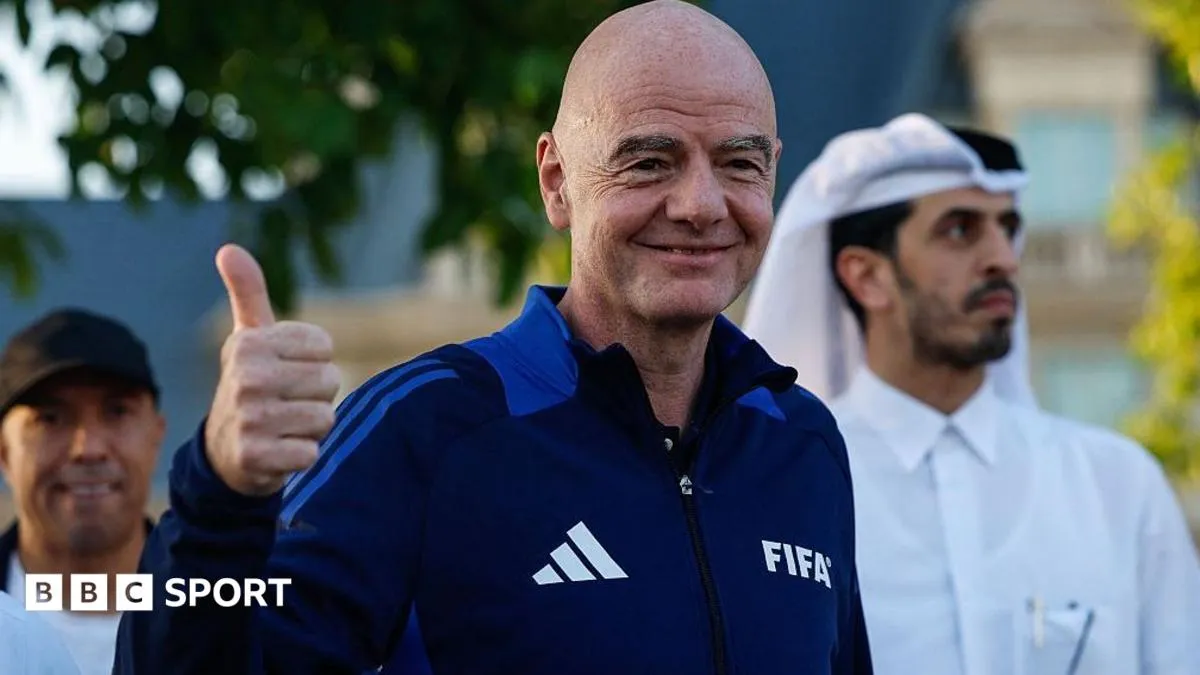
FIFA has confirmed that Philippe Diallo of the French Football Federation and Kozo Tashima of the Japan Football Association will stand against incumbent Gianni Infantino in next year's presidential election. The contest will be decided by 211 member associations rather than public campaigning, which is why the confirmation of two credible challengers may not shift an outcome that incumbency, bloc politics and control of FIFA's money have historically locked down.
FIFA has confirmed the field for next year's presidential election, and the field is three names long. Philippe Diallo, who leads the French Football Federation, and Kozo Tashima, who heads the Japan Football Association, will stand against the incumbent, Gianni Infantino, world football's governing body said. That is the entire opposition: two federation presidents against a sitting president who has held the job since 2016.
The number that actually decides this race is not three. It is 211. FIFA's presidential elections are not settled by fans, sponsors or broadcast audiences. They are settled by member associations, each holding a single vote at congress. That structure is why the confirmation of two credible federation chiefs may matter less than it first appears, and why the question BBC Sport posed, whether Infantino already feels he has won, is the right one to ask. Infantino has not faced a contested ballot since 2016, when he won a second-round vote to succeed Sepp Blatter. His later re-elections were unopposed. Challengers are news. Contested outcomes have not been.
Both challengers are insiders rather than insurgents, and that shapes how the campaign will run. Diallo runs the French federation, one of the most influential national bodies in the sport and the administrative centre of a major European league system. Tashima runs Japan's federation, a heavyweight in Asian football with a long record of involvement in the sport's governance structures. Neither is an outsider promising to torch the machine. Both are products of it, which means the contest, if it becomes one, will be fought inside committee rooms rather than in public. It also means the two candidacies span Europe and Asia, the two confederations whose backing any serious challenger would need to assemble first.
The arithmetic of a FIFA congress is a map of regional politics. Europe's UEFA bloc alone carries 55 votes; Asia, Africa and the Americas each carry dozens more. Historically, challengers who have won the presidency have done so by assembling confederation-wide coalitions rather than by picking off a handful of federations. That is the scale of the task facing Diallo and Tashima. It is not impossible. It is, on the record, extremely rare.
Incumbency at FIFA also comes with levers that are hard to replicate from outside the executive. The president's office sits on top of the tournament calendar, the distribution of development funding to member associations, and the commercial relationships that underwrite the entire operation. FIFA's revenues have grown sharply across recent cycles, powered by an expanded men's World Cup and a broadened club competition. Every one of those decisions lands as money in member associations' accounts. And member associations vote. A challenger can promise a different distribution of the same pot. The incumbent can point to the pot itself.
For either challenger to win, several things would typically need to line up at once: a confederation willing to break with the incumbent, a credible alternative offer on money and governance, and a genuine pocket of dissatisfaction among federations large enough to shift a bloc. None of that is visible in the mere confirmation of two candidacies. Confirmation is a starting gun, not a result. The mechanics that follow, from formal nominations through to the vote at congress, are where a campaign is either built or quietly abandoned.
For anyone whose business touches the sport, the practical question is not only who wins but what a contested race does to decision-making in the meantime. Broadcasters negotiating rights, sponsors structuring multi-year cycles, clubs planning around the calendar and cities weighing host bids all price in continuity. A leadership campaign introduces a stretch where long-horizon commitments get deferred, and deferral has a cost. It also creates an opening: challengers who want to be taken seriously have to publish a platform, and platforms force incumbents to defend choices that would otherwise go unexamined. That scrutiny is the real product of a contested election, whether or not the result changes.
The strategic read for executives watching from outside football is structural rather than sentimental. Incumbency, plus a bloc-based electorate, plus control of the money, is a combination that has historically been very hard to dislodge. Diallo and Tashima have earned the right to test it. Whether they can is a different question, and it will be answered by 211 votes, not by headlines.
This story's Key Insights and Take-aways are locked.
Create a free account to unlock Executive Actions for one credit.
Register to UnlockAlways free for Executives Club members. Join the Club
More in Politics

Fifth Circuit Kills Pregnant Workers' Law Over Pandemic Proxy Votes
A procedural ruling, not a policy one, has blocked a federal pregnancy-accommodation law and put every pandemic-era statute in the crosshairs ahead of an expected Supreme Court appeal.

Measles kills a Virginia child under 5, the state's first death of 2026
Virginia's health department confirmed the death but withheld the child's vaccination status, leaving schools, clinics and employers to plan around the one detail that would explain the most.

Former Brazilian President Bolsonaro Hospitalized with Intestinal Obstruction
The health status of the former far-right leader raises immediate questions about political stability and the trajectory of Brazil's conservative movement.