
For 3,000 years, Indigenous hunters drove bison off a 65-foot Texas cliff
A Rice University-led team has identified only the second bison jump ever found in the southern Plains, and radiocarbon dates show seven mass kills at the same spot across three millennia, a case study in keeping a hard-won playbook alive.
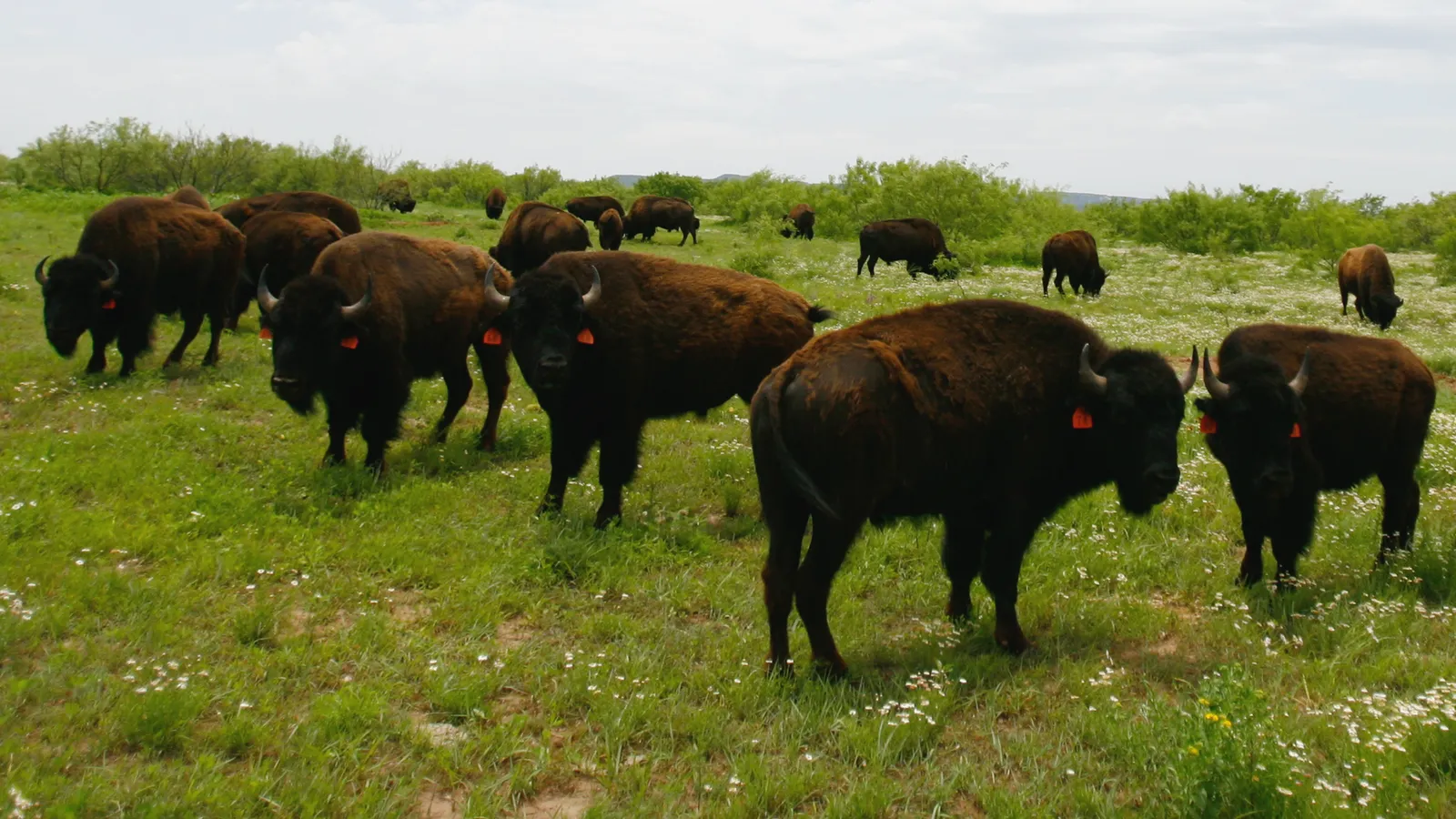
Archaeologist Gus Costa of Rice University and colleagues identified the Nighthawk bison jump in Caprock Canyons State Park in the Texas Panhandle, publishing their findings online Nov. 9 in the journal American Antiquity. The site's seven mass kills between roughly 1550 B.C. and A.D. 1550 show that a hunting technique experts had tied to the northern Plains was used in the south for 3,000 years, a rare window into how communities preserve and hand down high-stakes operational knowledge.
Roughly 65 feet above a bone bed in Caprock Canyons State Park, in the Texas Panhandle, sits a cliff spur that Indigenous hunters turned into one of the most productive killing grounds in human prehistory. Archaeologists led by Gus Costa, an archaeologist at Rice University in Houston, have identified the site as Nighthawk, only the second bison jump ever documented in the southern Plains. The evidence is blunt: hundreds of bison bones, chipped stone tools, a few arrowheads, and cut marks on bones consistent with prehistoric butchery. The clincher is geological. "The only way bison can arrive at the site is by falling from above, as the site surface is sandwiched between two cliffs," the researchers wrote in the study, published online Nov. 9 in the journal American Antiquity.
That matters because bison jumping was supposed to be a northern Plains story. Jump sites are well known across the north; before Nighthawk, only one such site had ever been found in the southern Plains. The technique itself is brutal and elegant in equal measure: hunters channeled a herd into a stampede and over an edge. Nighthawk may have been stranger still. "Instead of a stampede toward a surprise fall, Nighthawk could have operated more like 'walking the plank,'" the researchers wrote, with the cliff's natural spur shape doing the herding work. The payoff was enormous. As the team put it, "Bison jumping is an iconic, uniquely North American hunting technique that yielded some of the most productive food-getting events in the history of human hunting." The prey was no small prize either: bison are North America's largest living land mammal.
The timeline is what turns a find into a landmark. A series of radiocarbon dates revealed at least seven mass bison kills at Nighthawk spanning roughly three millennia, from about 1550 B.C. to A.D. 1550. One event, which the researchers named Kill 3, accounted for most of the bones. It most likely took place around A.D. 300 to 400 and would have required an immense labor force and precise coordination. "Bison jumping is a complicated community effort," Costa said in a statement. "Large scale bison harvests (like jumps) are exciting because they require a large group of people working together to be successful."
Here is the part that should stop you. All of the kill events at Nighthawk were at least a century apart, with an average of 500 years between jumps. That is not a habit. That is a ritual, a memory, and a curriculum. "Returning to the same place over and over again over 3,000 years shows that people had a significant connection to the Nighthawk hunting facility," Costa said. The researchers' own explanation is the most striking line in the paper: "The simplest explanation for long-lived jump facilities is that these techniques were passed down over long time spans rather than revived again and again."
What happened to the meat is a separate puzzle. In the northern Plains, archaeologists have long assumed that bison jumps were generally performed in the fall and used to provision the community for winter, with bison turned into pemmican, a shelf-stable mix of dried meat and rendered fat. Texas is not the northern Plains. It was likely too warm there for bison fat to last more than a few weeks, the researchers wrote, which undercuts the storage theory. Their alternative: southern Plains bison hunts may have been more useful for displaying power and building alliances. Same cliff, same species, different currency.
The site surfaced the way many archaeological finds do, through erosion. Bison remains began eroding from a bone bed, a place where bones naturally accumulate, underneath the roughly 65-foot-tall cliff spur. Archaeologists investigated and found the chipped stone tools and arrowheads near the bones. The bone bed's position, sandwiched between two cliffs, left only one plausible explanation for how the animals arrived there. Nighthawk now joins a very short list of southern Plains jump sites, and it is by far the longest-used.
Strip away the archaeology and the operational lesson is uncomfortable for anyone running a large organization. Nighthawk was a fixed asset with a rare use case, a capability exercised once every few centuries, and it still worked because the knowledge lived in people, not in a filing cabinet. Most companies lose the ability to execute a once-a-decade play the moment the last person who ran it walks out the door. The Nighthawk hunters kept theirs alive for 3,000 years across gaps that would have destroyed any modern succession plan. The site is in Caprock Canyons State Park, the study is in American Antiquity, and the question it leaves behind is not how they did it. It is how they remembered.
This story's Key Insights and Take-aways are locked.
Create a free account to unlock Executive Actions for one credit.
Register to UnlockAlways free for Executives Club members. Join the Club
More in Science

Europe and Japan park $2B twin probes at Mercury after eight years
BepiColombo's arrival ends an eight-year, $2 billion cruise and hands Europe and Japan a multi-year data edge on the solar system's least-studied planet.

BepiColombo becomes only the second spacecraft ever to orbit Mercury
The international mission reaches the planet closest to the sun, giving scientists a rare second set of eyes and giving operators a case study in long-horizon R&D.

COP31 stalls as countries weigh forcing a Saudi showdown on fossil fuels
Two weeks of UN climate talks in Turkey have overrun without a deal, and the decision now facing governments will shape energy costs, transition timelines and capital allocation for years.