
Google just gave Gemini the keys to your Mac, files and all
Google's latest Gemini update puts an AI agent on the Mac that can organize files, fill out forms, and run multistep workflows, and the real question is what it is allowed to touch.
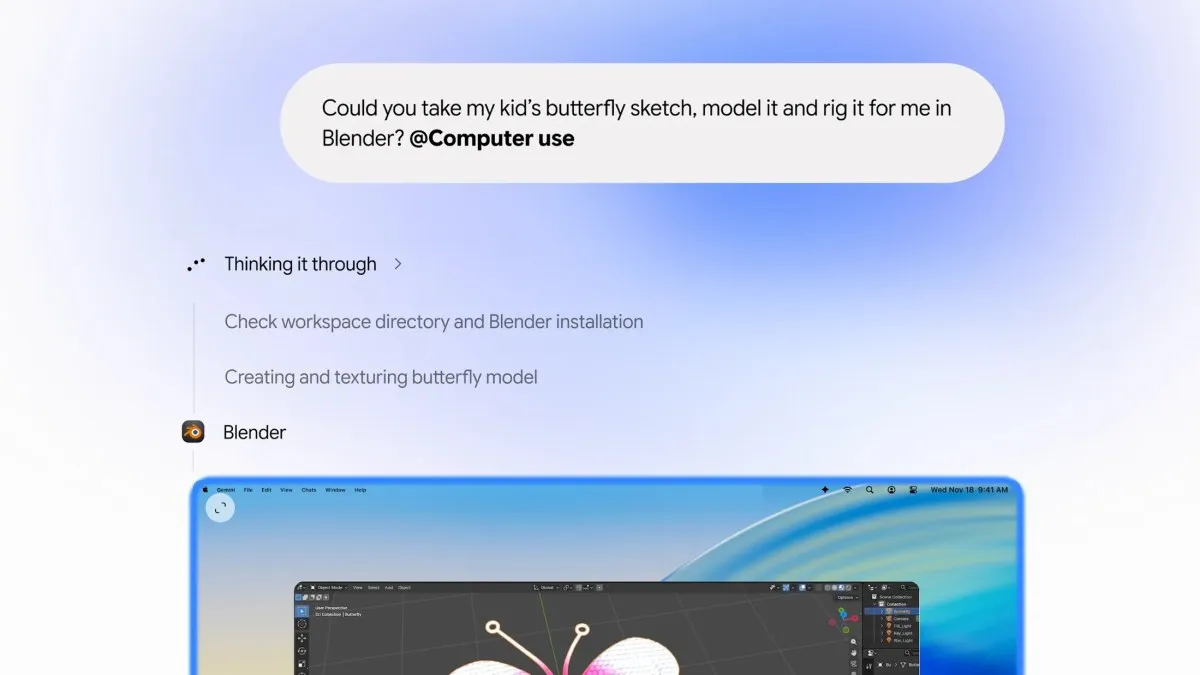
Google's latest Gemini update brings an AI agent to the Mac that can organize files, fill out forms, and tackle multistep workflows, moving the assistant from answering questions to taking actions. For executives, the consequence is that AI permissions, audit trails, and write access are about to become operational questions rather than theoretical ones.
Google's latest Gemini update hands the assistant something it has never had before: the ability to use your Mac. According to TechCrunch, the update brings an AI agent to the Mac that can organize files, fill out forms, and tackle multistep workflows. That is the entire announcement, and it is a bigger deal than it sounds. For two years the story about AI assistants has been about what they know. This one is about what they do.
The three capabilities named in the update are worth reading slowly, because each one crosses a line that chatbots historically have not. Organizing files means the agent is reading and moving the contents of a machine, not just a chat window. Filling out forms means it is typing into fields that often carry personal, financial, or legal weight. Multistep workflows means it is chaining actions together, one after another, without a human approving each step. Put those three together and the assistant stops being a text box you consult and becomes a coworker with a login.
For context, the assistant category has been stuck at the same bottleneck for years. Large language models got very good at producing plausible text, and notably worse at finishing anything that required touching a real system. The industry's answer has been the agent: software that does not just answer a question but takes the next action, then the one after that. The hard part was never the reasoning. It was the last mile, the part where the model has to reach into a file system, a browser, or a form and actually change something. Google's update is a bet that the last mile is now the product.
The choice of the Mac as the surface is not incidental. For a large share of founders, designers, developers, and creative teams, the Mac is the machine where the actual work lives: the decks, the design files, the contracts, the spreadsheets. An agent that can operate there is useful in a way that an agent confined to a browser tab is not. It also means the agent sits closer to the crown jewels. A chatbot that hallucinates a paragraph is embarrassing. An agent that misfiles a folder of signed contracts, or fills a form with the wrong entity name, is a different category of problem entirely.
That is why the interesting questions about this update are not about capability but about control. When an assistant can act on your machine, the relevant questions become: what can it see, what can it change, what gets logged, and how fast can you revoke it? Enterprises have spent the last decade building identity and access management around humans and, more recently, around service accounts. An agent that operates a laptop on a person's behalf fits neither category neatly. It is not quite the employee, and it is not quite the software. Boards that have already been asking about AI risk now have a concrete artifact to point at.
Google is also not making this move in a vacuum. The race to build agents that can actually operate a computer has become one of the most crowded and expensive contests in tech, with every major platform player and a long tail of startups chasing the same prize. The strategic logic is straightforward: whoever owns the layer where the agent runs owns the workflow, and whoever owns the workflow owns the renewal. That is why the announcement matters beyond Mac users. It is a land grab for the desktop, and the desktop is where a great deal of enterprise work still happens.
The second-order effects are where this gets interesting for operators. If an agent can fill out forms, the value of a lot of routine back office labor starts to compress. If it can organize files, the value of a clean folder taxonomy goes up, because the agent is only as good as the mess it inherits. And if it can chain multistep workflows, the bottleneck inside a lot of companies stops being the software and starts being the permission to let software act. Expect the procurement conversation to shift from which AI tool to which AI tool we are willing to give write access to.
For founders and executives, the practical takeaway is not to rush out and hand an agent the keys. It is to start asking the questions now, before the answer is decided for you. Which of your workflows are repetitive enough to hand off, and which touch data you would not want an agent to touch? Who inside the company owns the policy for what an autonomous assistant is allowed to do on a company machine? And when a vendor says its agent can use your Mac, what exactly does it mean by use? Google's update is a small sentence with a large implication: the assistant era is ending, and the agent era is starting. The companies that write their rules first will be the ones that capture the upside without the incident report.
This story's Key Insights and Take-aways are locked.
Create a free account to unlock Executive Actions for one credit.
Register to UnlockAlways free for Executives Club members. Join the Club
More in Technology

Anthropic mathematician claims Claude helped crack the Riemann hypothesis
If the proof holds, AI has toppled math's most famous open problem; if it does not, it is a case study in announcing breakthroughs before anyone verifies them.

AI's $4 Trillion Wipeout Erases Nasdaq's Gains for the Year
A brutal week took roughly $4 trillion off the AI sector and left the Nasdaq flat for the year, and the damage ran the full length of the supply chain.

Anthropic mathematician says AI proved the Riemann hypothesis. Verification will take time.
A single unverified claim from inside Anthropic now sits against more than 160 years of open mathematics, and the gap between asserting a proof and surviving peer review is the entire story.