

Google taps Bezos's Blue Origin to run AI data centers in orbit
Project Suncatcher, Google's experiment in running AI systems in space, now has a rocket partner, and the stakes run from launch economics to orbital regulation.
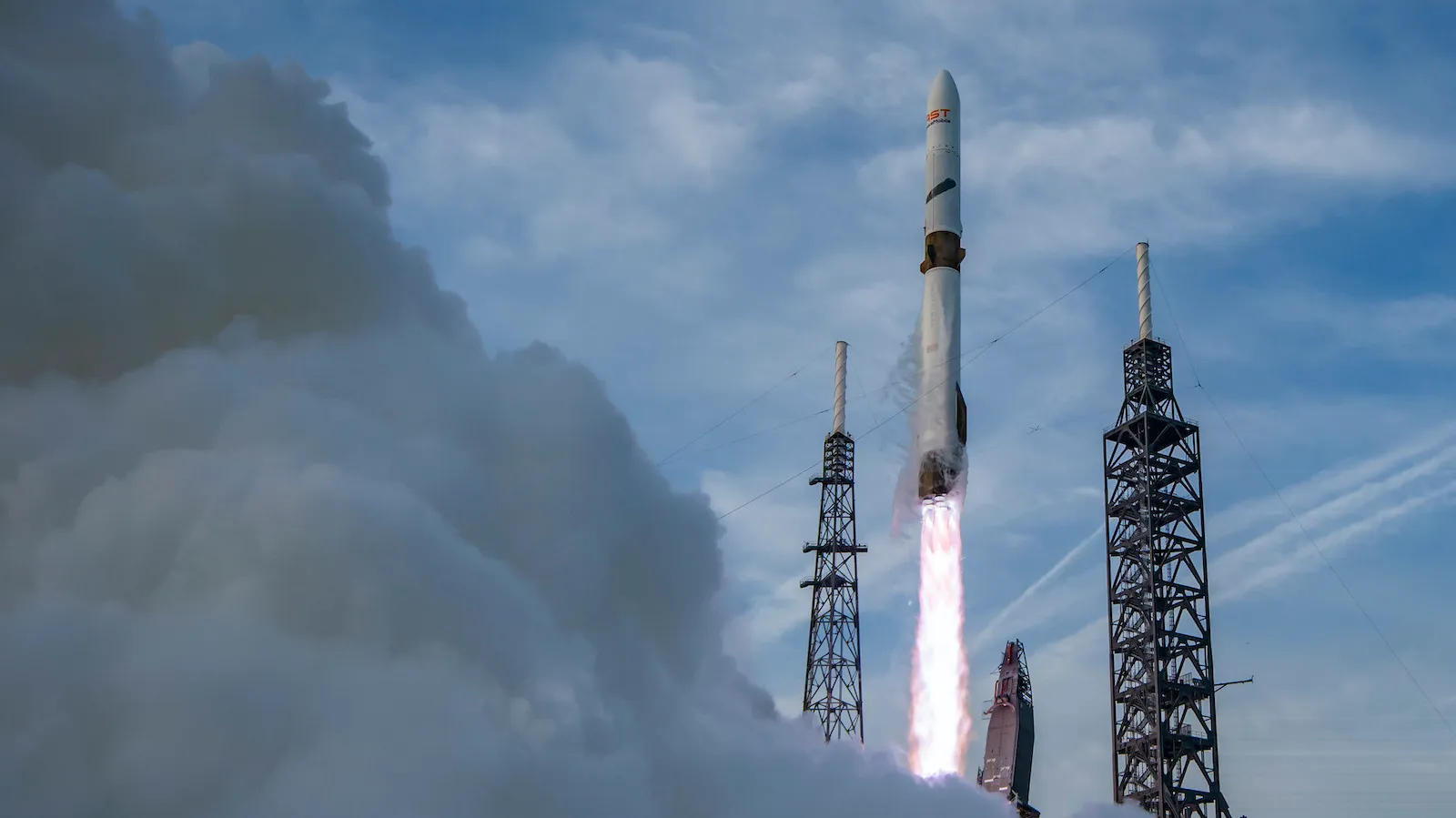
Google has signed a deal with Blue Origin to send satellite data centers into orbit as part of Project Suncatcher, an experiment aimed at running AI systems in space. For decision-makers, the deal signals that hyperscalers are now treating launch capacity and orbital real estate as strategic infrastructure rather than science fiction.
Google has signed a deal with Blue Origin to send satellite data centers into orbit, giving the search giant's most speculative infrastructure bet a named launch partner. The arrangement sits inside Project Suncatcher, which Engadget describes as an experiment aimed at running AI systems in space. That is the entire public record so far: no contract value, no launch window, no satellite count, no disclosed terms. Which is precisely why it deserves a second look. When a hyperscaler puts a rocket company on the other side of a signature, an idea has crossed from keynote slide to procurement line. Google is no longer asking whether AI can run in orbit. It is asking who will carry it there.
Strip away the science fiction and the logic is a power bill. Training and serving frontier AI models is, at bottom, a problem of electricity and heat. Terrestrial data centers compete for grid interconnection, land, water for cooling, and local permits, and in several major markets the queue to plug in has stretched out for years. Orbit offers a different bargain: solar arrays that see near-continuous sunlight, no zoning board, and the cold of space as a heat sink. The catch is everything else. Launch cost per kilogram, radiation hardening for chips, downlink bandwidth to move data back to Earth, and the small matter that no one has ever serviced a server rack hundreds of kilometers up.
Blue Origin is the tell. Founded by Jeff Bezos, the company has spent more than two decades building reusable launch vehicles, and launch is the toll booth on every orbital business case. Google is not buying rockets so much as it is buying optionality in a supply chain that has historically had very few suppliers. There is a wrinkle worth noting: Bezos also founded Amazon, which is Google's most direct competitor in cloud computing. The rocket company that could carry Google's compute into orbit sits in the same founder's universe as the cloud business Google is fighting for AI workloads. Partnerships in this layer of the stack are rarely exclusive, and rarely comfortable.
The timing is not accidental. The AI buildout has turned compute into something closer to a strategic resource than a utility. Utilities in major markets are being asked to power gigawatt-scale campuses, and some are pushing back on timelines. For context, the industry has spent years chasing efficiency gains in chips and cooling, and those gains have been real, but demand has grown faster. Space is the logical extreme of a trend already underway: move the constraint, not the workload. If power and land are the binding limits on AI capacity, then anyone who can relocate even a slice of that capacity changes the terms of the race.
Regulation is where this gets complicated fast. Satellite operators in the United States typically need spectrum and market access approvals from the FCC, and orbital slots and frequencies are coordinated internationally through the ITU, a process measured in years rather than quarters. Advanced semiconductors carry export controls. Debris mitigation rules increasingly require operators to show they can deorbit hardware at end of life. And the Outer Space Treaty framework puts liability for damage on the launching state, which means a corporate experiment in orbit is also a diplomatic exposure. None of that kills the idea. All of it shapes who can afford to try it.
The second-order effects are where boards should be paying attention. If orbital compute becomes viable even at the margins, it touches energy markets, cloud pricing, insurance underwriting for launch and on-orbit assets, and defense procurement, where resilient compute outside terrestrial jurisdiction has obvious appeal. It also creates a new dependency: a cloud provider that runs workloads in orbit depends on launch cadence the way it currently depends on chip supply. Concentration risk does not disappear when you leave the atmosphere. It just changes shape.
For peers, the read is not that space data centers are imminent. It is that Google has decided the option is worth paying for, and that the company with the deepest pockets in the room is willing to fund the boring part first, the launch contract, before the economics are proven. Rivals in cloud and AI infrastructure now face a familiar question: watch, or match. The answer will not be settled by this deal. But the next time a hyperscaler signs a launch agreement, it will not be treated as a curiosity.
This story's Key Insights and Take-aways are locked.
Create a free account to unlock Executive Actions for one credit.
Register to UnlockAlways free for Executives Club members. Join the Club
More in Technology

Anthropic mathematician claims Claude helped crack the Riemann hypothesis
If the proof holds, AI has toppled math's most famous open problem; if it does not, it is a case study in announcing breakthroughs before anyone verifies them.

AI's $4 Trillion Wipeout Erases Nasdaq's Gains for the Year
A brutal week took roughly $4 trillion off the AI sector and left the Nasdaq flat for the year, and the damage ran the full length of the supply chain.

Anthropic mathematician says AI proved the Riemann hypothesis. Verification will take time.
A single unverified claim from inside Anthropic now sits against more than 160 years of open mathematics, and the gap between asserting a proof and surviving peer review is the entire story.