
Google taps Blue Origin to launch AI data centers into orbit in 2029
The New Glenn mission puts rack-scale compute in Sun-synchronous orbit by 2029, but the economics of orbital data centers are still unproven.
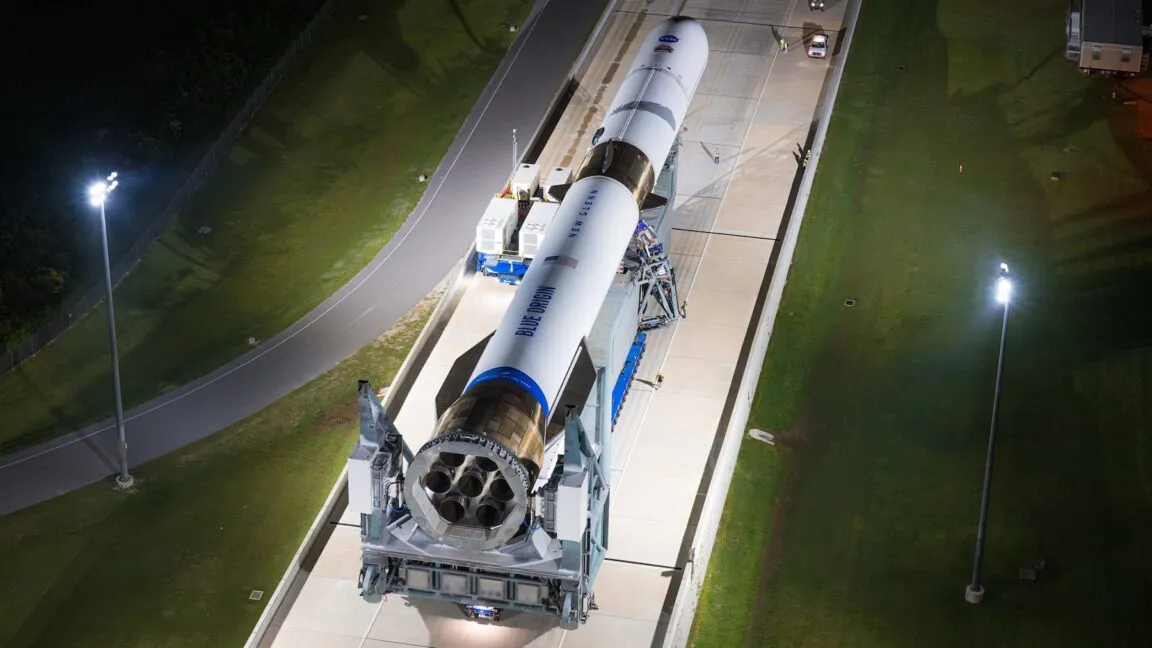
Blue Origin announced Thursday that its New Glenn rocket will launch Google's Project Suncatcher data center satellites in 2029, with each satellite carrying roughly a data center rack's worth of compute into Sun-synchronous orbit. For decision-makers, the deal is a five-year option on escaping terrestrial power, land, and permitting constraints, not a near-term product.
Blue Origin said Thursday that its New Glenn rocket will launch data center satellites for Google in 2029, the first named launch vehicle for Project Suncatcher, the search giant's effort to move computing into orbit. The satellites are designed to fly in Sun-synchronous orbit, a path that keeps them in nearly continuous sunlight, and each is built to carry computing capacity at roughly the scale of a single data center rack. Travis Beals, senior director of Project Suncatcher at Google, framed the deal in the company's announcement: "This dedicated launch with Blue Origin represents a crucial milestone on our roadmap as we expand the boundaries of what's possible for the future of compute."
The pitch is simple to state and hard to execute. Terrestrial data centers are increasingly constrained by things that are not chips: electricity supply, water for cooling, land near population centers, and the years-long queues to connect to a grid. Sun-synchronous orbit offers a workaround on paper. A satellite in that orbit sees the sun almost all the time, so it can run on solar power without batteries sized for a long night, and it needs no acreage, no water rights, and no utility interconnection study. Google disclosed about a year ago that it was working on scalable orbiting data centers and classified the effort among its research moonshots, the long-horizon bets that sit far from the revenue line.
Blue Origin's role is the piece that turns a research paper into a schedule. New Glenn is the company's large orbital rocket, and a dedicated launch means Google is buying the whole vehicle rather than sharing it with other payloads. That matters because orbital data centers are not one satellite; they are a constellation, and constellations are launched in batches. The 2029 date also sets a clock. Between now and then, Blue Origin has to demonstrate the cadence and reliability that commercial customers require, and Google has to prove that a rack of compute can survive launch, radiate heat in a vacuum, and stay useful for years without a technician on site.
Those engineering questions are where the moonshot label earns its keep. On Earth, a data center rack is cooled by air or liquid and serviced by people who can swap a failed component in minutes. In orbit, heat has to be shed by radiation, hardware has to tolerate radiation and thermal cycling, and any repair is either impossible or extraordinarily expensive. Launch costs, historically the dominant line item for anything leaving the atmosphere, have fallen sharply over the past decade but remain high enough that the economics of orbital compute depend on assumptions about how long the hardware lasts and how much work it can do per kilogram. None of that is settled.
The strategic logic, though, is easy to see from a boardroom. AI demand has turned electricity into a competitive constraint. Utilities are being asked to power gigawatt-scale campuses, communities are pushing back on land and water use, and interconnection timelines stretch years. If even a slice of training or inference workload can run above the atmosphere on continuous solar power, it becomes a hedge against the terrestrial bottleneck rather than a replacement for it. That framing explains why Google is willing to fund a launch slot five years out for a program it still calls a moonshot: the option has value even if the product never ships at scale.
The competitive read is just as important. Launch capacity is a scarce, negotiated resource, and booking a dedicated New Glenn mission signals that Google is willing to build launch relationships beyond a single provider. For Blue Origin, a marquee commercial customer is proof that New Glenn belongs in the same conversation as the rockets that currently carry most of the world's satellites. For every other hyperscaler, the question is whether orbital compute becomes a capability gap or a curiosity. The answer will not arrive in 2029; it will arrive in the test results published between now and then.
For executives and boards, the practical takeaway is to treat this as a signal about constraints, not a product announcement. The binding limits on AI infrastructure over the next decade are likely to be power, land, water, and permitting, and Google is placing a bet that at least some of that load can be moved off the grid entirely. Watch three things: whether Blue Origin hits its launch cadence, whether Google publishes performance data on rack-scale compute in orbit, and whether regulators start asking who owns and governs compute that sits above any national jurisdiction. The last one is the quiet one, and it is the one that will outlast the rocket.
This story's Key Insights and Take-aways are locked.
Create a free account to unlock Executive Actions for one credit.
Register to UnlockAlways free for Executives Club members. Join the Club
More in Technology

Anthropic mathematician claims Claude helped crack the Riemann hypothesis
If the proof holds, AI has toppled math's most famous open problem; if it does not, it is a case study in announcing breakthroughs before anyone verifies them.

AI's $4 Trillion Wipeout Erases Nasdaq's Gains for the Year
A brutal week took roughly $4 trillion off the AI sector and left the Nasdaq flat for the year, and the damage ran the full length of the supply chain.

Anthropic mathematician says AI proved the Riemann hypothesis. Verification will take time.
A single unverified claim from inside Anthropic now sits against more than 160 years of open mathematics, and the gap between asserting a proof and surviving peer review is the entire story.