
GTA VI's launch is spawning a content economy built on watching, not playing
Livestreams, social clips and high-volume content farms are scaling around the year's biggest game launch, as millions tune in to watch others play.
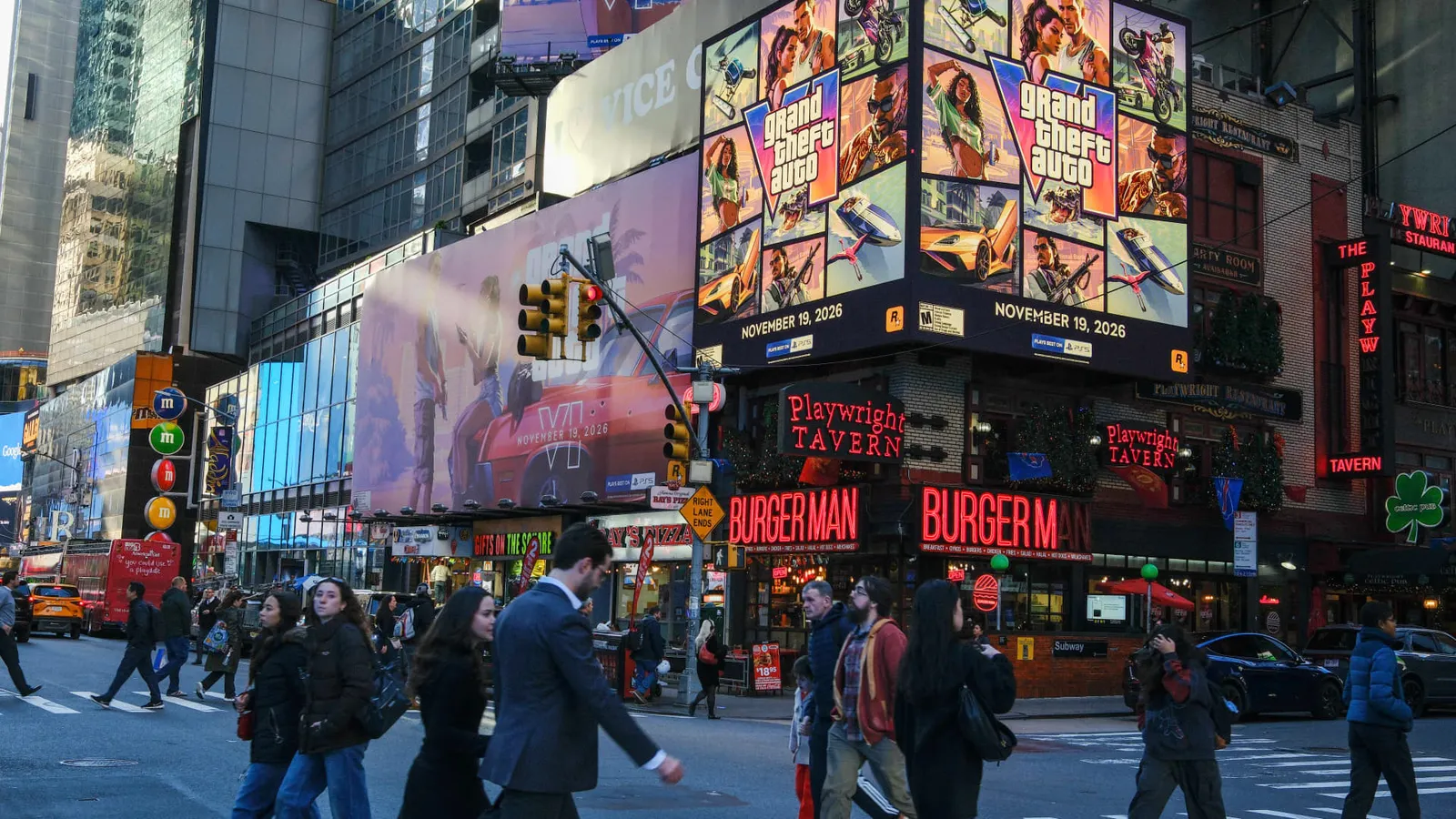
Rockstar Games' GTA VI launch is creating a wider economy around livestreams, social clips and high-volume content farms as millions tune in to watch others play. For decision-makers, it is a live case study in how a flagship launch generates value that accrues well beyond the product itself.
GTA VI's blockbuster launch is doing something bigger than moving units. It is creating a wider economy around livestreams, social clips and high-volume content farms, as millions of people tune in to watch other people play. Read that again: the audience for this game is not only playing it. A meaningful slice of the crowd is watching, clipping, commenting and paying attention to someone else's session, and that attention has become its own market with its own supply, demand and pricing.
Three layers make up that market, and each runs on a different business model. Livestreams are the real-time layer: a creator plays, an audience watches live, and money arrives through ads, subscriptions, donations and sponsorships. Social clips are the distribution layer: short, shareable moments cut from longer sessions that travel across feeds and pull new viewers in. Content farms are the industrial layer: high-volume operations that churn out clips at scale, treating attention as a throughput problem rather than an art form. All three are fed by the same raw material, which is millions of people who would rather watch than play, or who watch first and buy later.
For context, this is less a new dynamic than a scaled-up one. The franchise's previous main entry, GTA V, arrived in 2013 and became one of the best-selling entertainment products of all time, with a commercial tail that stretched across a decade and multiple console generations. Rockstar Games, the studio behind the series, and its parent Take-Two Interactive have historically benefited from an ecosystem of fan-made content, from roleplay servers to montages, that kept the game culturally alive between releases. What is different now is the machinery around it. The creator economy has matured into an industry with its own tools, agencies, sponsorship markets and analytics, and it has spent years waiting for a launch this big.
Why does watching work as a business? Because attention is fungible and platforms pay for it. A viewer who will not buy the game will still happily spend forty minutes watching someone else play it, and that time converts into ad inventory, subscriptions and merchandise. For creators, the calculus is simpler still: a blockbuster launch is a demand spike with a known date. Historically, the biggest entertainment launches have behaved like broadcast events, and the operators who treat them that way, scheduling content around the moment rather than the product, tend to capture the most value.
The second-order effects are where this gets interesting for operators. When a launch generates its own content economy, the publisher's marketing spend is partly subsidized by creators who are effectively working for free in exchange for audience and ad revenue. That is a good deal right up until it is not. Rights management, monetization rules and platform policy all become live questions the moment third parties build real revenue on top of someone else's intellectual property. Publishers in this position typically face a choice: tighten enforcement and risk killing the ecosystem, or let it run and accept that a slice of the value created around the game accrues to people they do not employ and cannot easily measure.
For anyone launching a product with a fandom, the lesson is structural rather than tactical. The second screen is not a marketing channel bolted onto the launch; it is a market with its own participants, economics and momentum. The creators who show up first set the tone, the platforms that host them capture the behavioral data, and the brand that owns the underlying asset often has the least visibility into what is actually happening around it. That asymmetry, not the launch itself, is the real story.
None of this diminishes the launch. A blockbuster is still a blockbuster, and the audience numbers are the reason any of the surrounding economy exists at all. But the value is no longer contained inside the product. It leaks into livestreams, clips and content farms the moment the servers go live. The companies that understand that early, and that measure the creator layer as seriously as they measure sales, will be the ones who keep a claim on the attention their products generate. Everyone else will watch the watchers get paid.
This story's Key Insights and Take-aways are locked.
Create a free account to unlock Executive Actions for one credit.
Register to UnlockAlways free for Executives Club members. Join the Club
More in Technology

Anthropic mathematician claims Claude helped crack the Riemann hypothesis
If the proof holds, AI has toppled math's most famous open problem; if it does not, it is a case study in announcing breakthroughs before anyone verifies them.

AI's $4 Trillion Wipeout Erases Nasdaq's Gains for the Year
A brutal week took roughly $4 trillion off the AI sector and left the Nasdaq flat for the year, and the damage ran the full length of the supply chain.

Anthropic mathematician says AI proved the Riemann hypothesis. Verification will take time.
A single unverified claim from inside Anthropic now sits against more than 160 years of open mathematics, and the gap between asserting a proof and surviving peer review is the entire story.