
Healey rules out 2028, says Democrats need 'a uniter and a fighter'
Massachusetts' governor, who sued Trump dozens of times as attorney general, calls the midterms a 'resetting' and says the next nominee must fight and heal at once.
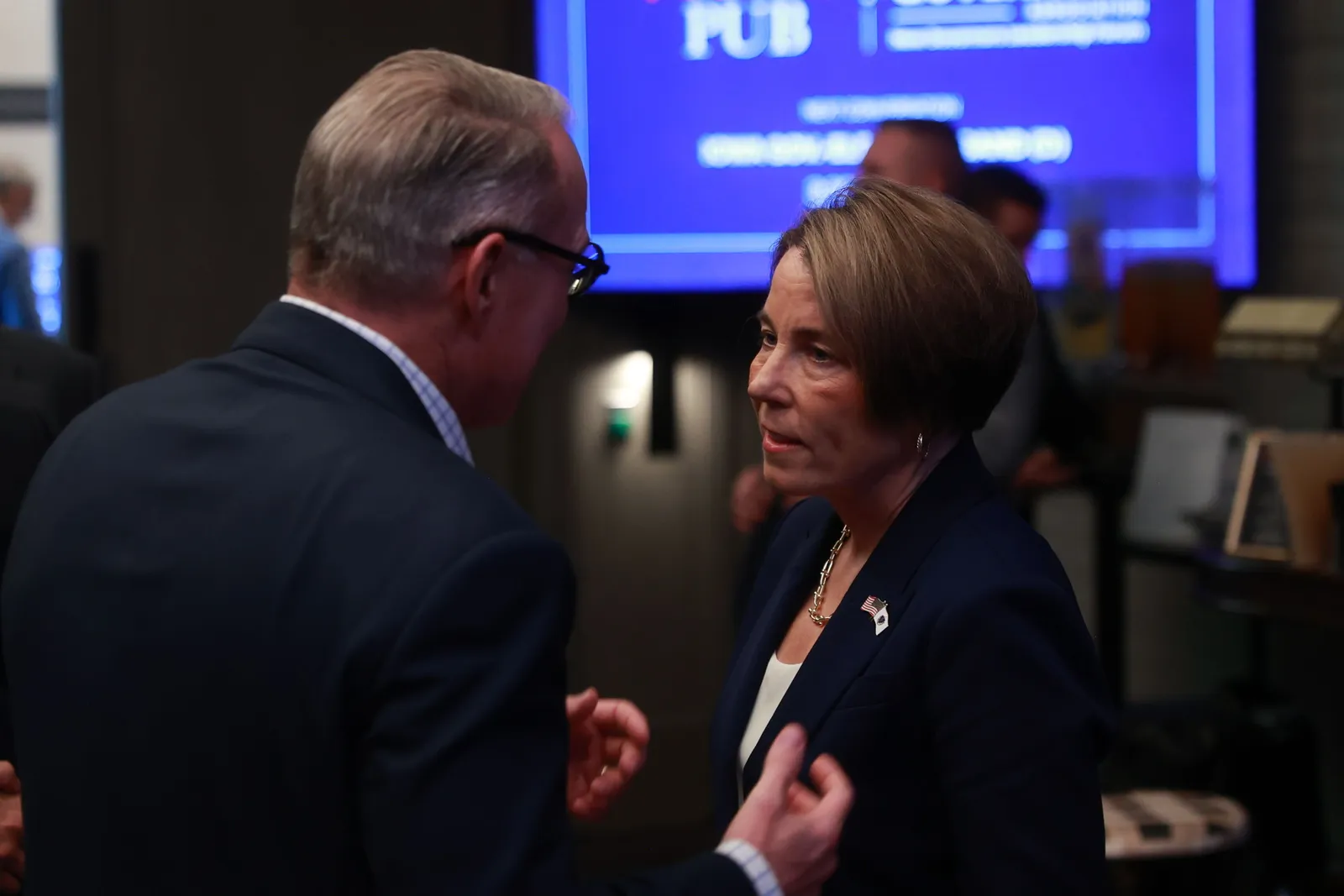
Massachusetts Gov. Maura Healey, fresh off an easy second-term win in a deep-blue state, told POLITICO she wants the Democrats' next presidential nominee to show 'decency' and 'humanity' while ruling out a 2028 run of her own. Her both-halves framing - uniter and fighter, fighter and healer - sets the terms of a shadow primary that will shape how policy gets sold to voters for the next four years.
Maura Healey is not running for president in 2028. She said so on Thursday, in the same interview in which she sketched out what she thinks the Democrat who does run will need to sound like. The Massachusetts governor, fresh off an easy second-term win in one of the country's deepest-blue states earlier this month, told POLITICO that her party's next presidential nominee should show 'decency' and 'humanity.' She delivered the line at the POLITICO Pub, on the sidelines of the National Governors Association's New Governors Leadership Forum in Deer Valley, Utah, in a conversation with POLITICO's Adam Wren. The ruling-out was clean. The rest of the answer was anything but.
Pressed on the question already defining the earliest stage of the Democrats' shadow 2028 primary - fighter or healer? - Healey refused the premise. 'You can be a uniter and a fighter; you can be a fighter and a healer,' she said. That is not a dodge so much as a resume talking. Healey built her national profile as a hard-charging Massachusetts attorney general who sued the first Trump administration dozens of times, and she urged Democrats to oppose the second Trump administration more aggressively. She is, by any reasonable definition, the fighter in the room. Which is exactly why her emphasis on healing lands with more weight than it would from a lawmaker with no scars.
Her argument for the softer half of that pairing is blunt. 'It's really important that we have leaders who genuinely see people, understand their situation,' she said. 'If you don't see people, if you don't understand people, you're never going to be able to deliver for them.' She added: 'Having leaders who have that, and who have a strong moral compass, I think that's really important.' Read that as a governing theory, not a vibe. The case is that empathy is an operational input, not a rhetorical flourish. You cannot deliver for voters you have not correctly modeled, and Healey is arguing the party's recent cycles were, at least in part, a modeling failure.
Healey also offered a frame for what just happened. She suggested the midterms amounted to a 'resetting' as the nation moves toward a post-Donald Trump era. That word choice matters. 'Resetting' implies the previous configuration was broken, not merely beaten, and it implies the next fight is over what replaces it. For a party that spent a decade organized around opposition to one man, the question of what organizes it afterward is not academic. It is the whole ballgame, and it is being litigated right now by governors, senators, and mayors who have not yet announced anything.
The debate is not hypothetical. Candidates of both stripes, brawlers and uniters, won difficult races this cycle, which means the midterm results did not settle the argument so much as supply ammunition to both sides. Healey declined to referee it further. She deflected when asked whether Democrats should nominate a governor, a notable non-answer from someone who is one. But she is unlikely to be a bystander. She has close relationships with several likely contenders and routinely hits the campaign trail for Democrats in New Hampshire, the state that traditionally holds the first presidential primary. A popular two-term governor with a national profile is a validator, and validators shape primaries.
For executives watching politics as a risk variable rather than a sport, the useful signal here is not the horse race. It is the vocabulary. 'Decency,' 'humanity,' 'moral compass,' 'see people' - this is the language of a party that believes it lost persuadable voters on character and comprehension, not on policy detail. If that diagnosis holds, the 2028 Democratic nominee will be someone who campaigns on temperament and relatability first and technocratic specifics second. That has downstream consequences for how policy gets sold. Industrial policy, tariffs, AI rules, and tax fights will all be packaged as questions of who is looking out for whom, and companies that show up with white papers instead of a human story will be arguing on the wrong field.
Watch three things. First, whether other governors echo Healey's both-halves framing or split into camps, because the split will map onto fundraising networks and donor coalitions. Second, whether her New Hampshire travel schedule accelerates, since that is the clearest available proxy for whose primary she is quietly helping. Third, whether 'resetting' becomes the party's default description of the midterms. If it does, the post-Trump era has a start date, and it is now. Healey ruled herself out. She did not rule out shaping who gets in.
This story's Key Insights and Take-aways are locked.
Create a free account to unlock Executive Actions for one credit.
Register to UnlockAlways free for Executives Club members. Join the Club
More in Politics

Fifth Circuit Kills Pregnant Workers' Law Over Pandemic Proxy Votes
A procedural ruling, not a policy one, has blocked a federal pregnancy-accommodation law and put every pandemic-era statute in the crosshairs ahead of an expected Supreme Court appeal.

Measles kills a Virginia child under 5, the state's first death of 2026
Virginia's health department confirmed the death but withheld the child's vaccination status, leaving schools, clinics and employers to plan around the one detail that would explain the most.

Former Brazilian President Bolsonaro Hospitalized with Intestinal Obstruction
The health status of the former far-right leader raises immediate questions about political stability and the trajectory of Brazil's conservative movement.