
Hengqin promised 280,000 residents by 2020. It has 50,000.
Nearly a decade into China's $2.1 trillion Greater Bay Area bet, integration is real but lopsided: Hong Kong and Shenzhen are pulling away, and Guangdong only just matched national growth for the first time since 2021.
Almost ten years after Beijing formalized the Greater Bay Area, the 88-million-person, $2.1 trillion project is delivering mainly through Hong Kong and Shenzhen, with Natixis's Alicia Garcia-Herrero saying the region no longer outgrows China and HKUST's Jerry Patchell saying value creation is not spreading. Guangdong's 4.6% growth in the first three quarters of 2026, matching the national rate for the first time since 2021, is now the number that decides whether Zhuhai, Dongguan and Foshan get to join the story.
Hengqin was supposed to hold 280,000 people by 2020. In 2009, when the island in the mainland city of Zhuhai was still home to oyster farmers and fishermen, that was the plan. By the end of 2025, it had 50,000 residents. The highways are multilane. The architecture is striking. The parks are manicured. The people never arrived. What the island does have, on a landmass three times the size of Macau and a narrow strait away from it, is an 'In-Depth Cooperation Zone,' a development initiative run jointly by Guangdong province and the Macau Special Administrative Region. Its brief: pull Macau's economy away from the casino floor by wiring it into mainland talent and manufacturing capacity. The corridor is built. The traffic is not.
That makes Hengqin the sharpest live test of the Guangdong-Hong Kong-Macau Greater Bay Area, the integration project Beijing has chased for roughly a decade and formalized in 2017. The GBA takes in nine cities around the Pearl River Delta in Guangdong, including Shenzhen, Zhuhai and Guangzhou, plus the Hong Kong and Macau special administrative regions. It is not a marketing slogan. It spans three legal systems, three currencies and three customs territories. It holds 88 million people, more than Germany or Turkey, and a GDP of $2.1 trillion, an economy approaching Canada's in size. Wire its capital, startups and factories together and, the argument goes, you get a world-class innovation ecosystem. Nearly ten years in, the honest scorecard reads: the GBA is real, but it is a Hong Kong-Shenzhen story for now, the former's financial heft bolted onto the latter's hardware and software muscle. Whether the other cities get to join decides the whole thing.
The ingredients were never in doubt. For four decades the delta has been one of China's core economic engines, ever since Beijing designated Shenzhen, then a border market town next to the British colony of Hong Kong, a business-friendly 'special economic zone.' Hong Kong's financial sector surged as China opened up. Shenzhen pulled founders from across the country. Dongguan and Foshan supplied the manufacturing scale that made the region the world's factory. The GBA's job was to double down. 'The original idea was to compete with the [U.S.] Bay Area. That's exactly why the name is the Greater Bay Area,' says Alicia Garcia-Herrero, chief economist for Asia-Pacific at Natixis. Hong Kong's commissioner for the development of the Greater Bay Area, Pamela Lam, frames the goal as complementarity rather than convergence: the aim is not to make cities identical or to 'flatten their distinctive edges,' but to build 'a complete innovation and industrial ecosystem' supporting a 'high-value-adding supply chain that links the entire pipeline from lab to factory.' In plain English: stop duplicating, start specializing, and connect the pieces.
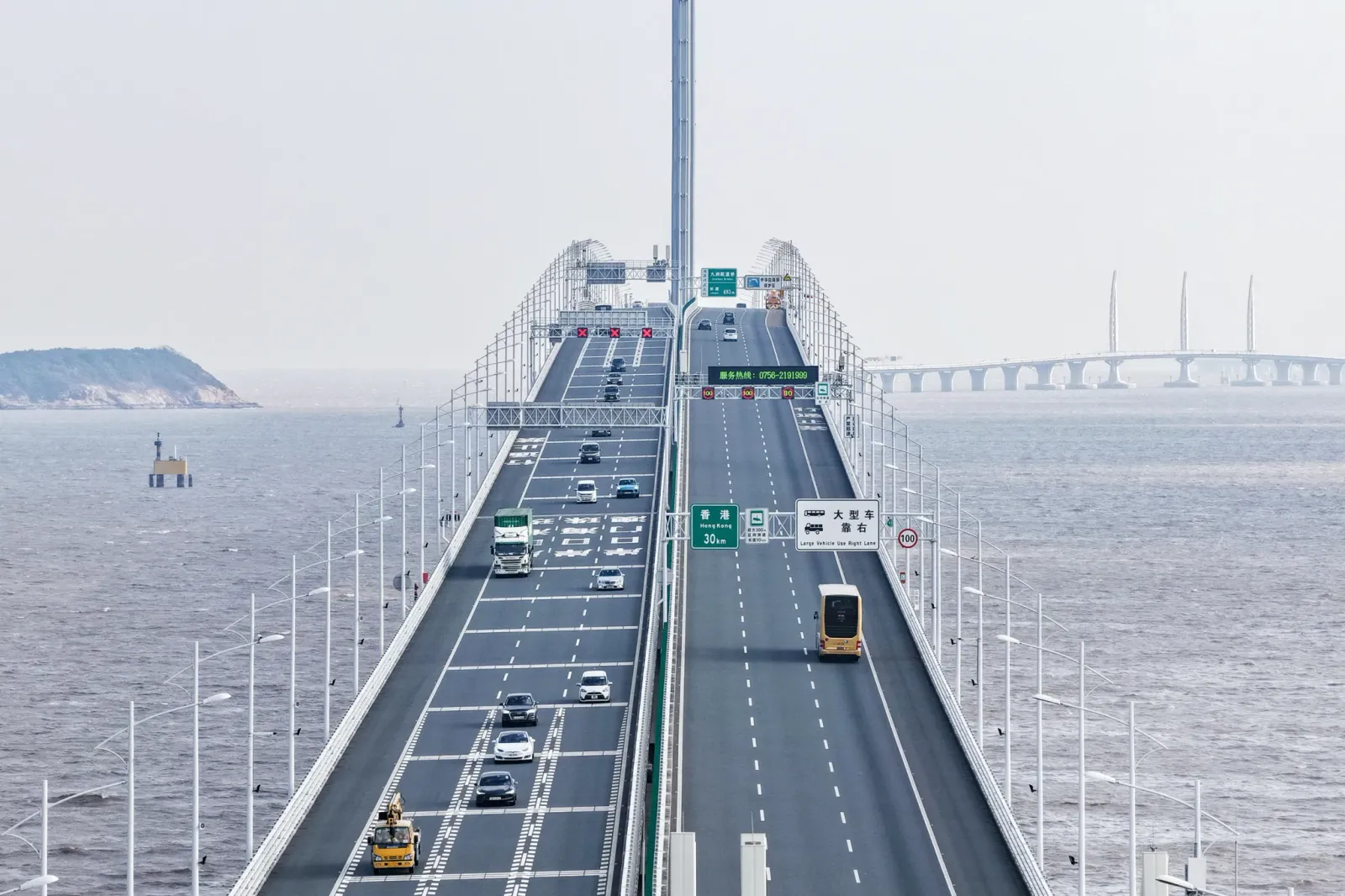
Connective infrastructure has been the policy obsession. Hundreds of kilometers of railway, plus the Hong Kong-Zhuhai-Macau Bridge, the world's longest bridge-and-tunnel sea crossing, at an estimated $20 billion. The stated target is a 'one-hour living circle,' bringing travel between major GBA cities under an hour. Mehran Gul, author of The New Geography of Innovation, argues the two bay areas run on different logic. 'The Greater Bay Area and the U.S. Bay Area are running different operating systems,' he says. 'The U.S. Bay Area is more organic... It almost happened by accident.' In the GBA, 'the division of labor has been central to making it happen.'
The connectivity may be starting to pay. The World Intellectual Property Organization's Global Innovation Index ranked Shenzhen-Hong Kong-Guangzhou the world's leading innovation cluster in both 2025 and 2026. The GBA's nine mainland cities filed more than a third of China's international patent applications in 2025, according to state media, and account for a fifth of the country's unicorn startups. Gul argues the qualitative shift matters more than the counts. 'Ten years ago, you could still make the argument that the Chinese tech industry is a mirror image of the U.S. that lags by about five or six years,' he says. 'But China's tech industry is now driven a lot more by fundamental innovation. The fact that Chinese companies have made that transition means that those linkages have been made. The GBA was a big part of that.' Elwin Ho, a Macau native and cofounder and CEO of Pachira, a speech-recognition AI company headquartered in Hengqin, sees the split from the other side of the Pacific. 'I just visited the [U.S.] Bay Area a couple of weeks ago. I saw a lot of companies that [build] their software and algorithms in the Bay Area, but for the hardware they go to Shenzhen.'
Then there is the macro picture, which is less flattering. Guangdong has grown more slowly than the national average every year from 2021 to 2025. 'Growth-wise, before COVID, the GBA was excelling compared to the rest of China. Not anymore,' Garcia-Herrero says. Two pressures weigh especially heavily on the province: the property market slump and youth unemployment, the latter exacerbated by AI-powered industrial automation. That second one is awkward for anyone pitching the GBA as a lab-to-factory upgrade story, because the automation the region is racing toward displaces the entry-level jobs its labor pool needs most.
Growth inside the region is lopsided too, and the gaps are large. 'A failing of the GBA is that the increase in productivity and value creation is not being spread out that widely,' says Jerry Patchell, associate professor emeritus at the Hong Kong University of Science and Technology and author of a book on the region. 'Shenzhen and Hong Kong are pulling away from the pack. Guangzhou's not too far behind, but a lot of the other cities are not progressing at the same rate. The absolute differences in per capita income between them are significant.' Hong Kong's per capita GDP is more than five times Zhaoqing's, the poorest city in the GBA; Shenzhen's is three times. Hong Kong's capital is not closing the gap either. 'Specific measures to treat the Greater Bay Area preferentially aren't really there,' Garcia-Herrero says. 'I think the key point would be for Hong Kong to financially feed Guangdong. But the reality is that Hong Kong is feeding the whole mainland.'
There are early signs of a turn. In the first three quarters of 2026, Guangdong grew 4.6%, matching the national growth rate for the first time since the third quarter of 2021, according to the provincial statistics bureau. The driver is demand for AI infrastructure and the physical-AI stack around it: robotics, autonomous vehicles and adjacent applications. Stephanie Gao, a professor of practice at City University of Hong Kong, says that demand is 'bringing important new growth impetus' to the region, with its edge coming from a 'tight integration of hardware design, component supply, and software algorithm iteration.' Gul translates that into operational terms: companies iterate on products in days rather than months. Nowhere is that easier to see than Shenzhen, where a design file can become a factory line without crossing a border. Ho is betting Hengqin gets there too. 'It just needs a little bit more time; the area will have a very good future,' he says.
The next phase is where this gets decided, because the scarcity in the GBA is no longer bridges, rail or industrial parks. It is the soft infrastructure that makes a place sticky, and Hengqin is the exhibit. No sea crossing and no one-hour living circle puts 280,000 people on an island if the tax treatment, professional licensing, schooling and commute do not work for the people being invited. For operators, the practical read is that the GBA is a two-city value proposition with a sprawl of options attached. Put engineering, prototyping and supply-chain teams where iteration is measured in days, meaning Shenzhen. Keep capital, legal and cross-border structuring where the financial plumbing is established, meaning Hong Kong. Treat Zhuhai, Dongguan, Foshan and Zhaoqing as real but unproven. And watch Guangdong's quarterly growth against the national rate as the cheapest available indicator of whether the other seven cities are actually joining. Gul, too, thinks the region's underused spaces fill in eventually. The data so far says eventually is doing a lot of work.
This story's Key Insights and Take-aways are locked.
Create a free account to unlock Executive Actions for one credit.
Register to UnlockAlways free for Executives Club members. Join the Club
More in Business

S&P 500 Enters Correction, Down 10% From Its High on AI Worries
The index's slide past the 10 percent line is a symbolic verdict on investor mood, and the AI trade that powered the rally is now the thing testing it.

Dow and S&P 500 enter correction as Nasdaq logs worst week since 2020
All 11 S&P 500 sectors fell more than 1% in the same week for the first time since April 2025, a breadth signal that matters more than any single index level.

Chip stocks lose $2.3 trillion in a week, worst run in 25 years
A $2.3 trillion weekly wipeout in semiconductors is forcing every board with an AI story to ask whether it owns a thesis or just a crowded trade.