
HSBC opens tokenised fund to RedCoin buyers with HK$100 minimum
Starting Thursday, HSBC customers can use as few as 100 RedCoin, worth HK$100 (US$12.74), to subscribe to a tokenised Hong Kong dollar fund, the first retail wealth-management use of its new stablecoin.
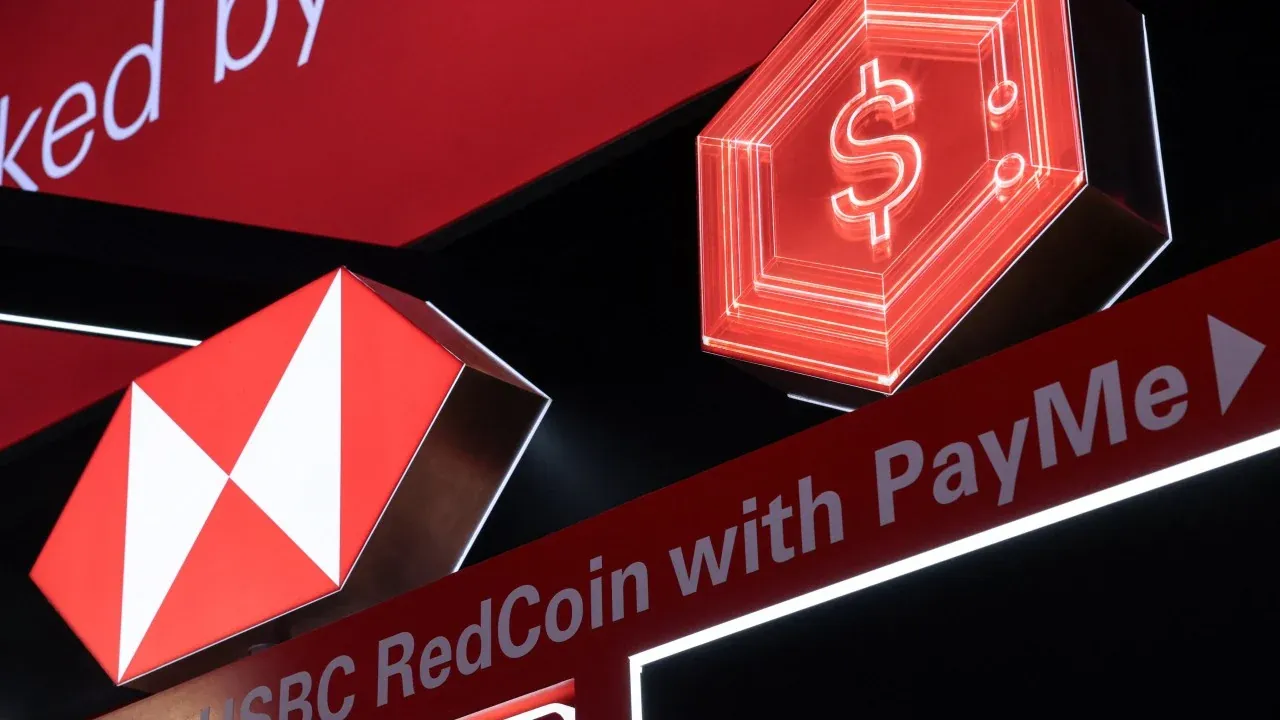
HSBC will let customers use its newly launched RedCoin stablecoin to subscribe to a tokenised class of its Global Money Funds - Hong Kong Dollar, starting Thursday, with a minimum of 100 RedCoin, or HK$100 (US$12.74). The move marks the first retail wealth-management use of the bank's stablecoin and signals that tokenised cash and tokenised funds are converging into a distribution channel that banks, asset managers, and regulators must now treat as real.
HSBC is turning its new stablecoin into a wealth-management on-ramp. Starting Thursday, customers can use as few as 100 HSBC RedCoin, equal to HK$100 (US$12.74), to subscribe to units in a new tokenised class of the HSBC Global Money Funds - Hong Kong Dollar, the bank said in a statement on Thursday. That is the first time the digital currency has been used for retail wealth management. The headline number is HK$100, not a private-bank minimum. It is roughly the price of a lunch in Hong Kong, and it buys exposure to a Hong Kong dollar money fund through a stablecoin.
The significance is not the fund itself. It is the plumbing. HSBC RedCoin is a newly launched stablecoin. By letting it subscribe directly into a tokenised fund class, HSBC is testing whether a bank-issued digital currency can do the job of cash in an investment account. If it works, the stablecoin becomes more than a payment token. It becomes a settlement layer for retail investing. That is why the first retail wealth-management use matters. It connects two things banks have kept separate: deposits and investments.
Tokenisation is the technical bridge. In plain English, it converts ownership rights of real-world assets into digital tokens that can be recorded, transferred, and settled on a blockchain or similar ledger. For a money fund, the underlying assets are still cash instruments and short-term debt. The token is a wrapper. The source says tokenisation converts ownership rights of real-world assets, and HSBC is applying that idea to a fund class that customers can buy with its stablecoin. The result is a product that looks like a traditional money fund on the inside and a digital asset on the outside.
Why HSBC? The bank already runs the Global Money Funds range. Launching a tokenised class of a Hong Kong dollar fund and accepting its own stablecoin is a controlled experiment. It keeps the asset manager, the bank, and the token inside one group. That reduces the coordination problem. It also lets HSBC learn about demand, redemption behavior, and compliance without opening the door to third-party crypto. The minimum of 100 RedCoin is small enough to attract retail curiosity but large enough to avoid dust transactions. For context, US$12.74 is a low entry point for a fund, and low minimums are typically how platforms widen access to wealth products.
The regulatory backdrop matters. Stablecoins typically sit in a gray zone until rules catch up. A bank-issued stablecoin inside a regulated fund subscription is a different animal from an offshore crypto token. HSBC's move suggests the bank believes the compliance path is clear enough to launch, at least for this use case. The source does not detail the approvals or the exact legal structure, but the launch itself is a signal. It tells rivals that a major bank is willing to put its name, its fund, and its stablecoin on the same retail product.
The second-order effects are where this gets interesting. For asset managers, tokenised fund classes could lower distribution costs and open fractional access. For banks, stablecoins could become a deposit-like funding tool, though that raises questions about balance sheet treatment and deposit insurance. For regulators, the line between a payment stablecoin and a money market fund unit gets thinner. If customers can move from RedCoin to fund units in one step, supervisors will ask whether the stablecoin is being used for investment, not just payments. That could trigger new rules on reserves, disclosures, and redemption rights.
What to watch next is adoption, redemption, and expansion. The first test is whether customers actually use RedCoin to buy the fund or stick to traditional channels. The second is whether they can sell fund units back into RedCoin as easily as they subscribed. The source only says customers can subscribe, so the reverse flow is an open question. The third is whether HSBC extends RedCoin to other funds, equities, or third-party products. If it does, the stablecoin becomes a platform, not a feature. That would put HSBC in competition with crypto-native platforms and fintechs, but with a bank charter and a fund factory behind it.
The bottom line is simple. HSBC is not launching a crypto product for speculators. It is using a stablecoin to make a boring money fund easier to buy. That is exactly how tokenisation becomes mainstream: not through memecoins, but through familiar products with lower friction. The HK$100 minimum is the hook. The real story is whether a bank-issued stablecoin can become the cash rail for everyday investing. If it can, the wealth-management industry's distribution model changes, and the race to tokenise funds, deposits, and payments accelerates. For executives, the question is no longer whether tokenisation matters. It is whether their firm has a credible path to use it before customers ask why they do not.
This story's Key Insights and Take-aways are locked.
Create a free account to unlock Executive Actions for one credit.
Register to UnlockAlways free for Executives Club members. Join the Club
More in Business

S&P 500 Enters Correction, Down 10% From Its High on AI Worries
The index's slide past the 10 percent line is a symbolic verdict on investor mood, and the AI trade that powered the rally is now the thing testing it.

Dow and S&P 500 enter correction as Nasdaq logs worst week since 2020
All 11 S&P 500 sectors fell more than 1% in the same week for the first time since April 2025, a breadth signal that matters more than any single index level.

Chip stocks lose $2.3 trillion in a week, worst run in 25 years
A $2.3 trillion weekly wipeout in semiconductors is forcing every board with an AI story to ask whether it owns a thesis or just a crowded trade.