
Iraqi forces surround a Kataib Hezbollah district in decades' most dangerous standoff
Baghdad's troops have boxed in territory run by the Iran-allied militia, and onlookers call it the most dangerous state-versus-militia confrontation Iraq has seen in decades. Here is what is actually at stake.
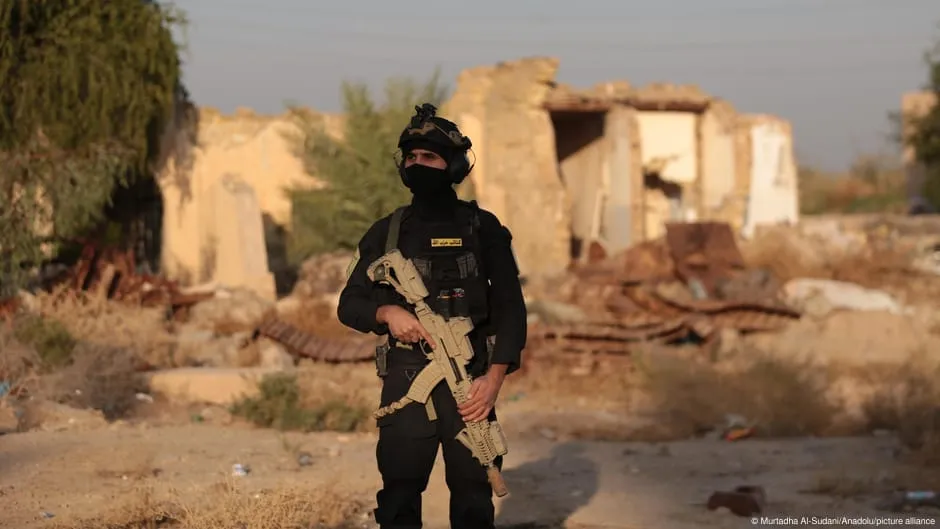
Iraqi security forces this week surrounded an area run by Kataib Hezbollah, the Iran-allied militia, in what onlookers describe as the most dangerous confrontation between the Iraqi state and Iran-allied militias in decades. The standoff tests Baghdad's claim to a monopoly on force in a country where armed factions sit both inside and outside the state, with consequences for an oil-dependent budget, regional risk pricing, and any operator exposed to Iraq.
Iraqi security forces this week surrounded an area run by Kataib Hezbollah, the Iran-allied militia, in a confrontation onlookers describe as the most dangerous between the Iraqi state and Iran-allied militias in decades. Read that again with the emphasis on "surrounded." This was not a raid, an arrest operation, or a checkpoint dispute. It was the uniformed forces of a sovereign government ringing territory that an armed faction has treated as its own, which is a different category of event entirely. For a generation, Baghdad's approach to the militias has been some mix of tolerance, co-option, and accommodation. This week it looked, to the people watching, like something else.
Why the word "decades" is doing the heavy lifting. Iraq's security landscape does not have front lines. Militia networks are woven into neighborhoods, ministries, checkpoints, and payrolls, which means any standoff is a city-block problem rather than a battlefield problem. A single shot fired by a nervous soldier at a nervous gunman can escalate faster than either side's political leadership can de-escalate. That is what makes an encirclement so dangerous: it creates a physical deadline. Encircled men need food, water, fuel, and a way to save face, and the side doing the encircling needs a result it can describe as a result. Neither side can afford to look like it blinked.
For context, Kataib Hezbollah sits at the center of Iraq's structural paradox. Washington has long designated it a terrorist organization, and it is also part of the constellation of Iran-allied factions that were folded into Iraq's state security architecture, most notably through the Popular Mobilization Forces umbrella created to fight ISIS. The result is a system in which some armed groups are simultaneously inside the state and outside its chain of command. That is not a loophole. It is the design. And designs like that only get tested when someone decides to test them.
That test is what makes this week consequential well beyond Iraq. The Iraqi state's core asset, the thing every government since 2003 has guarded, is the claim to a monopoly on legitimate force. A militia that can hold ground against the army in public erodes that claim whether or not a shot is fired. Conversely, a state that visibly rolls back an armed faction sets a precedent that every other faction in the country, and every patron behind them, will price in. There is no small version of this outcome.
Zoom out one more level and the standoff is also a message about the region. Iraq is the place where Iran-allied armed networks are most deeply entangled with a formal state, which makes it the clearest test case for how far that model can bend before it breaks. Any outcome here will be read closely by governments and armed groups far beyond Iraq's borders, not as a local skirmish but as evidence about whether state authority or militia authority wins when the two finally face each other in the open.
Now widen the lens to money. Iraq's economy leans heavily on oil revenue, which means political and security shocks in the country travel straight into budget math, currency pressure, and the government's ability to pay salaries, including the salaries of people who may be standing on the other side of the cordon. For energy markets, Iraq is one of OPEC's largest producers, and instability near the state's institutions historically shows up first as a risk premium rather than a supply outage. For companies with contractors, personnel, or logistics in the country, the practical question is not who wins the standoff. It is how quickly a localized confrontation can change movement, insurance, and evacuation calculus.
Three signals to watch. First, whether the cordon holds, tightens, or gets negotiated down; an encirclement that ends in a deal is a very different precedent from one that ends in a firefight. Second, whether other Iran-allied factions treat this as a shared fight or a Kataib Hezbollah problem, because solidarity is the mechanism that turns a standoff into a crisis. Third, whether Iraq's political leadership can produce a face-saving formula, which is the only realistic exit that does not require one side to surrender publicly.
The broader lesson for anyone operating in places where the state shares its monopoly on force with armed actors is that these arrangements do not unwind on a schedule. They unwind when a specific decision meets a specific moment, and the cost of being surprised is paid in days, not quarters. Boards and operators who treat "stable enough" as a permanent condition tend to discover, at the worst possible time, that the stability was a balance of incentives rather than a fact. This week, in one district of Iraq, that balance got a stress test, and the world is watching to see whether it holds.
This story's Key Insights and Take-aways are locked.
Create a free account to unlock Executive Actions for one credit.
Register to UnlockAlways free for Executives Club members. Join the Club
More in Politics

Fifth Circuit Kills Pregnant Workers' Law Over Pandemic Proxy Votes
A procedural ruling, not a policy one, has blocked a federal pregnancy-accommodation law and put every pandemic-era statute in the crosshairs ahead of an expected Supreme Court appeal.

Measles kills a Virginia child under 5, the state's first death of 2026
Virginia's health department confirmed the death but withheld the child's vaccination status, leaving schools, clinics and employers to plan around the one detail that would explain the most.

Former Brazilian President Bolsonaro Hospitalized with Intestinal Obstruction
The health status of the former far-right leader raises immediate questions about political stability and the trajectory of Brazil's conservative movement.