
JD Vance Is the 2028 GOP Frontrunner. The Midterms Turned That Into a Liability.
Both parties are already jockeying for 2028, and the GOP's midterm losses have turned the vice president's biggest asset into an open question.
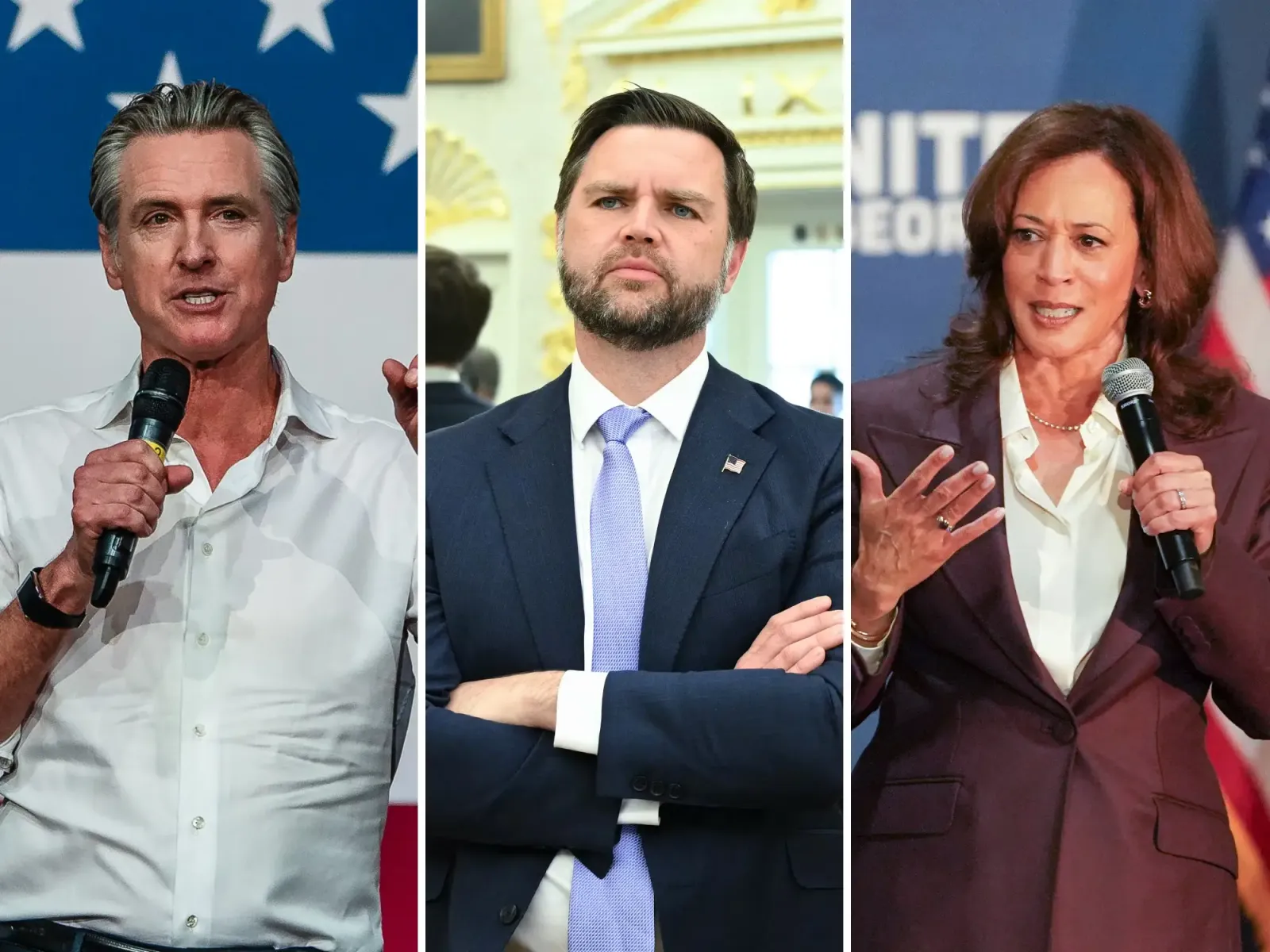
Vice President JD Vance, former Vice President Kamala Harris, and California Gov. Gavin Newsom lead the early 2028 field, with dozens of Democrats reportedly weighing bids and Republicans locked in a Trump succession fight. For executives and boards tracking policy risk, the donor networks, deference deals, and staff commitments forming now will shape tax, tech, and regulatory agendas long before any primary vote.
Vice President JD Vance is the most obvious Republican contender for 2028, and the midterms just complicated that. As the first in line in US presidential succession, Vance is widely considered Donald Trump's heir apparent. But Republican losses in November's midterm elections have raised questions about whether his close alignment with Trump could become a liability in a general election. Vance has said he has not made up his mind about running, and that he and his wife would discuss "what comes next for our family" as a factor in deciding his political future. His office did not respond to a request for comment from Business Insider.
The race is unofficial, but it is underway. After the Democratic blue tsunami in early November's midterms, both parties are looking ahead to their next presidential nominees. Dozens of Democrats have reportedly been considering a presidential bid, while the Republican Party is deciding who will be Trump's political heir. The early list spans heirs apparent, former candidates, and rising party stars, and several of them are already making moves that could lay the groundwork for a White House bid.
On the Democratic side, the biggest name is also the biggest question mark. Former Vice President Kamala Harris, the 2024 Democratic nominee, might be on the national ballot again in 2028. She brings built-in name recognition, a vast national donor network, and strong support within the party. The counterweight: some Democrats fear her record might be too closely attached to the pitfalls of the Biden administration. Harris has said she is thinking about another presidential run but has not decided. Her office did not respond to Business Insider's request for comment. California Gov. Gavin Newsom, meanwhile, has become one of the party's most visible national messengers, directly challenging conservative opponents with an aggressive communication style. He has said he is considering a run, and also that he will not run if Harris enters. That single sentence is the most consequential piece of deference in the field: it effectively hands Harris a veto over the strongest alternative candidate, and it freezes donor and staff decisions until she moves.
The rest of the Democratic bench is a study in optionality. Pennsylvania Gov. Josh Shapiro strengthened his national case with a commanding reelection victory in a swing state, but told NBC News' Kristen Welker that his focus "right now" is governing Pennsylvania and using a new legislative trifecta to advance policy, adding "that's the work I'm focused on doing." Former transportation secretary Pete Buttigieg, who built an unexpectedly strong national following after his 2020 primary campaign, has said he is "more inclined than not" to run again while stressing he has not made a final decision. Illinois' billionaire governor, JB Pritzker, rounds out the governor tier. Georgia Sen. Jon Ossoff, whose reelection victory prompted renewed speculation, has repeatedly and explicitly said he is not running for president in 2028. Rep. Alexandria Ocasio-Cortez, whose profile rose after progressive wins like Abdul El-Sayed's in the midterms, has said she is weighing her next political move, including a possible presidential campaign, but has not committed. Asked about 2028 after the midterms, she told Newsweek that "the last thing people want to hear from me or any other politician here is about the next election" and that people "are less concerned about the horse race."
Republicans have their own crowding problem, just in a different shape. Secretary of State Marco Rubio, the many-hats-wearer of the Trump administration, has emerged as a name to consider. Trump said "Marco's great" in a recent interview when asked about potential successors other than Vance. Rubio, a former 2016 presidential candidate, told The New York Times in November that he "literally will not talk about 2028 anymore" and said he would support Vance if Vance decides to run. Then there is Florida Gov. Ron DeSantis, the outgoing governor and former 2024 Republican primary candidate. After the midterms, some Republicans renewed talks about DeSantis as a potential post-Trump alternative. He has not announced a bid but has declined to rule one out, saying at a University of Notre Dame discussion that if "there's an opening, there is an opening - if I think I can be of service, I can be of service." He also pushed back on a November Washington Post report that he had contacted a potential campaign consultant: "I have not called a single person." His office did not respond to Business Insider.
Why does any of this matter before a single primary vote? Because presidential campaigns are priced long before they are announced. Donor networks, consulting shops, and policy staff get locked up early, and the people who commit first usually shape the platform. For anyone whose business touches tax, tech, energy, or trade, the 2028 field is effectively a preview of the regulatory and legislative fights that will be argued over the next three years. The deference dynamics matter too. Newsom's conditional stand-down and Rubio's pledge to back Vance both shrink the number of real alternatives, which concentrates money and attention on fewer candidates and makes the remaining decisions louder.
The Trump succession fight is the other half of the story. Vance's alignment with the administration is the reason he is the frontrunner and the reason Republicans are nervous after a bad midterm. That tension does not resolve itself; it gets tested in primary polling, fundraising, and whether other Republicans decide the "opening" DeSantis described actually exists. On the Democratic side, the field is waiting on Harris. Until she decides, Newsom is boxed in, and the governors and senators with the strongest resumes have every incentive to keep their answers vague and their options cheap.
Watch three signals over the next year: whether Harris moves, whether Vance converts frontrunner status into an actual operation, and whether the governors who say they are focused on governing start showing up in states that are not their own. The midterms ended the last campaign. The next one started the morning after.
This story's Key Insights and Take-aways are locked.
Create a free account to unlock Executive Actions for one credit.
Register to UnlockAlways free for Executives Club members. Join the Club
More in Politics

Fifth Circuit Kills Pregnant Workers' Law Over Pandemic Proxy Votes
A procedural ruling, not a policy one, has blocked a federal pregnancy-accommodation law and put every pandemic-era statute in the crosshairs ahead of an expected Supreme Court appeal.

Measles kills a Virginia child under 5, the state's first death of 2026
Virginia's health department confirmed the death but withheld the child's vaccination status, leaving schools, clinics and employers to plan around the one detail that would explain the most.

Former Brazilian President Bolsonaro Hospitalized with Intestinal Obstruction
The health status of the former far-right leader raises immediate questions about political stability and the trajectory of Brazil's conservative movement.