
Kalanick vows 'wafer-encrusted megaphone' at Nvidia HQ as 200,000 demand Huang's return
Kalanick is backing a walkout to reinstate Jensen Huang, but Nvidia's board is not considering a return, and the gap between 200,000 signatures and a closed-door decision is the real story.
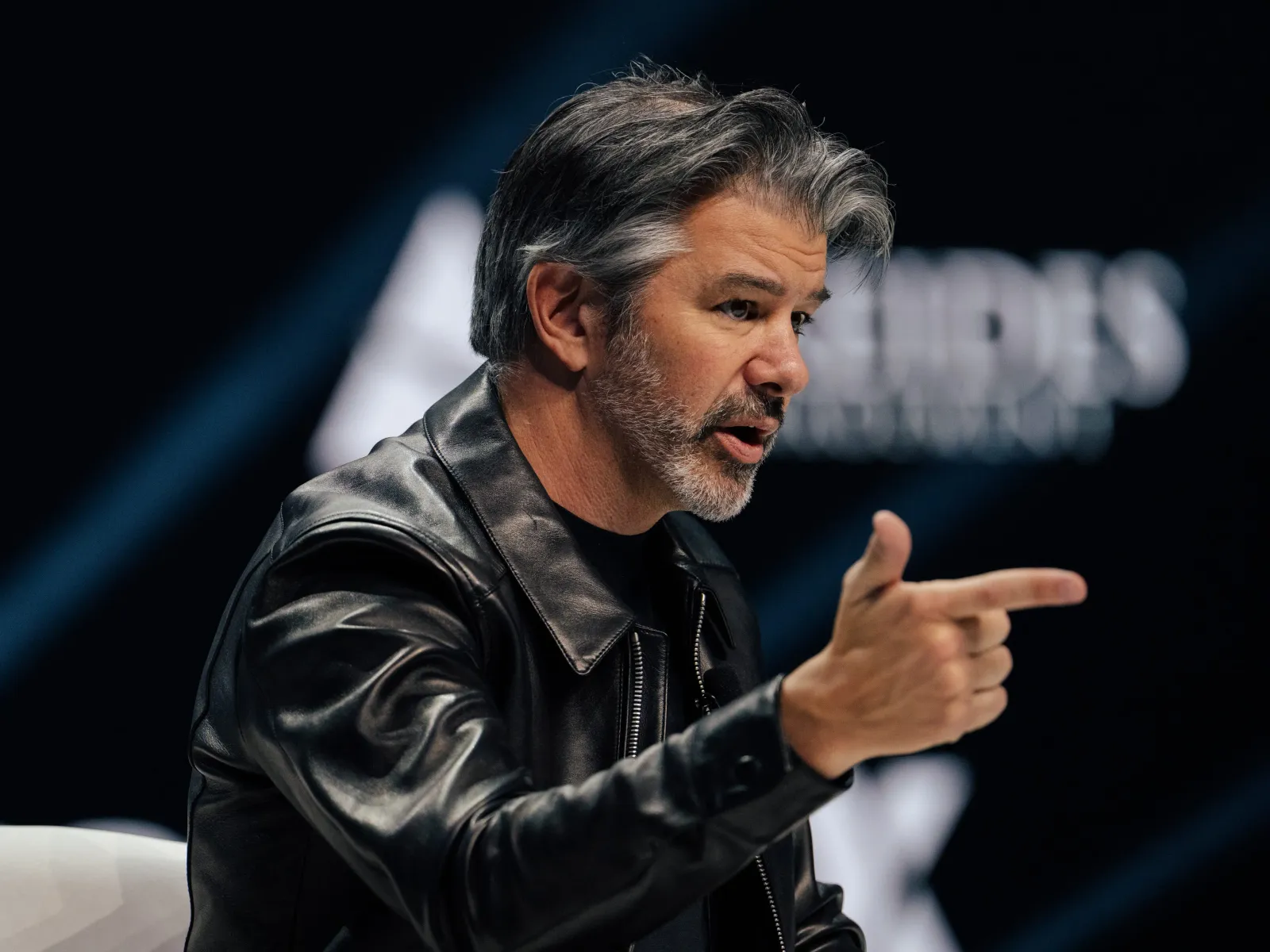
Travis Kalanick, the Uber cofounder and former CEO, told the TomorrowX Summit in Austin he would back an Nvidia walkout to reinstate Jensen Huang, who resigned last Thursday after the board began investigating whether he was the target of a foreign intelligence effort. The episode shows how fast a CEO exit at a strategically critical company becomes a public campaign that the board does not control.
Travis Kalanick has a plan for the Nvidia succession fight, and it involves hardware. The Uber cofounder and former CEO told the TomorrowX Summit in Austin on Wednesday that he would show up at Nvidia HQ with a "wafer-encrusted megaphone," flanked by "tons of Nvidia employees who want to walk out, tons of CEOs, founders." Silicon wafers are the base material in AI chips, so the prop is a pointed one. Kalanick is backing the push to reinstate Jensen Huang as Nvidia's chief executive, and he is explicit that a petition is not the tool he favors. He said he sent Huang screenshots of 2017 news stories about a petition to reinstate him at Uber, with a one-line verdict attached: "I'm like, 'Petition good, walkout better.'" Huang, according to Kalanick, did not reply.
The context matters, because the clock is running. Huang resigned from Nvidia last Thursday after the board began investigating whether he was the "target of a foreign intelligence effort," and he apologized for being unfaithful to his wife. On Tuesday he said he would be "honored" to return. More than 200,000 people have signed a petition to reinstate him. But Business Insider reported that the Nvidia board is not considering bringing him back. That gap, between a loud outside coalition and a quiet inside decision, is the whole story. Kalanick's megaphone is aimed at the only audience that can actually reverse the outcome, and so far that audience has not flinched.
Kalanick is not a neutral narrator here. He resigned from Uber under pressure following an investigation into its workplace culture, prompted by a former engineer's allegations of sexual harassment and HR issues. In 2017, a petition to reinstate him circulated; he lost that fight. So when he says he sent Huang screenshots of those stories, he is doing something specific: casting himself as the guy who already ran this experiment and knows how it ends. His advice to the room was blunt. "Let's fight for what's right and give it our best shot," he said. "We don't have control of the outcome, but let's fucking fight." That is a founder's answer to a governance problem, and it is worth noticing how naturally the two get blurred.
The stagecraft was deliberate. Kalanick wore a black leather jacket, Huang's trademark look. Antonio Gracias, a longtime ally and investor of Elon Musk who shared the stage, told him, "Yours looks a lot like Jensen's." Kalanick's reply: "Yeah, we gotta bring Jensen back." It is a small moment with a large function. It turns a board investigation into a piece of cultural theater, complete with costumes and callbacks, and it hands the reinstatement campaign a recognizable face that is not a lawyer or a proxy adviser.
Kalanick's substantive case rests on who controls AI. He argued that in the future, AI should exist on humanity's terms rather than having power over us as an "AI overlord." "Jensen is the No. 1 guy that's going to give us that liberty, and stood for it," he said. "That's why everybody here should be supporting him in coming back, because if we just care about that, that's enough. But you should also care about justice and due process." That last clause is doing heavy lifting. It reframes a resignation tied to a foreign-intelligence inquiry as a question of fairness to one individual, which is a far easier thing to rally a crowd behind than an investigation file.
Boards, historically, do not move on petitions. They move on legal exposure, disclosure obligations, and the risk that a reinstated leader becomes a liability with regulators, customers, and investors. An inquiry into whether a CEO was the "target of a foreign intelligence effort" sits in a category most directors treat with extreme caution, because the questions involved typically touch national security, export controls, and the company's standing with governments that buy its chips. Nvidia's board has not explained why it is not considering a return, and Kalanick's campaign does not change the arithmetic the directors are running. What it does change is the cost of saying no out loud.
For every executive watching, the Nvidia situation is a live case study in three things at once: how fast a CEO exit becomes a public campaign, how quickly employees and outside founders become stakeholders in a succession decision, and how little control a board has over the narrative even when it holds all the formal power. The lesson is not that walkouts work. It is that a vacuum at the top of a strategically critical company gets filled by whoever speaks loudest, and that is rarely the board. Kalanick's megaphone may never make it to Nvidia HQ. The pressure it represents already has.
This story's Key Insights and Take-aways are locked.
Create a free account to unlock Executive Actions for one credit.
Register to UnlockAlways free for Executives Club members. Join the Club
More in Business

S&P 500 Enters Correction, Down 10% From Its High on AI Worries
The index's slide past the 10 percent line is a symbolic verdict on investor mood, and the AI trade that powered the rally is now the thing testing it.

Dow and S&P 500 enter correction as Nasdaq logs worst week since 2020
All 11 S&P 500 sectors fell more than 1% in the same week for the first time since April 2025, a breadth signal that matters more than any single index level.

Chip stocks lose $2.3 trillion in a week, worst run in 25 years
A $2.3 trillion weekly wipeout in semiconductors is forcing every board with an AI story to ask whether it owns a thesis or just a crowded trade.