
Lisa Su breaks silence on Nvidia turmoil; AMD stock slides 10% on China report
AMD's CEO calls her cousin a 'tremendous leader' and vows to tune out the 'noise', hours before a short-seller report knocks 10% off her own company's shares.
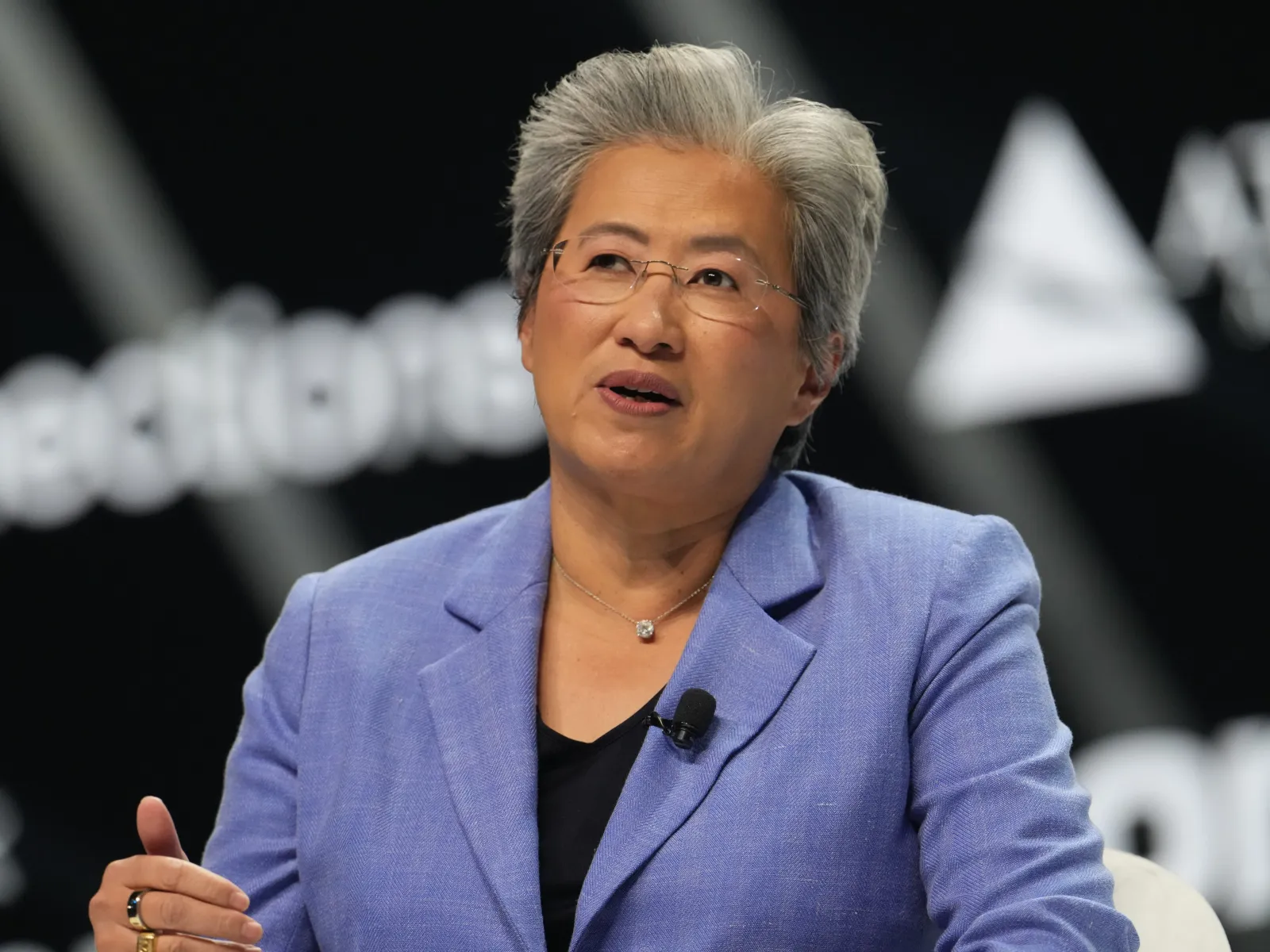
AMD CEO Lisa Su publicly addressed the turmoil at Nvidia for the first time since her distant cousin Jensen Huang resigned as CEO, praising him as a 'tremendous leader' while saying AMD must separate itself from the 'noise.' The next morning, a Hunterbrook short-seller report claiming AMD has its own 'China problem' sent the stock down as much as 10%, proving no chipmaker gets to sit out the sector's China reckoning.
Lisa Su, the CEO of AMD, broke her silence Wednesday on the turmoil at Nvidia, the AI-chip rival run until last week by her distant cousin Jensen Huang. Speaking at the TomorrowX Summit in Austin in a conversation with Dominic Rizzo of T. Rowe Price, Su called Huang "a tremendous leader for the industry" and Nvidia "a phenomenal company," then drew a firm line around what she would not discuss. "What I try to do from an AMD standpoint and from an industry standpoint is, look, we have to separate a little bit from the noise," she said. "The noise will work itself out in time." Business Insider reported the remarks were her first public comments on Nvidia since Huang's resignation. Less than a day later, AMD had noise of its own: the stock fell as much as 10% Thursday morning after the short-seller Hunterbrook published a report claiming the company has its own "China problem."
The Hunterbrook report claimed that "AMD firmware keeps turning up at a blacklisted Chinese company and three companies tied to it." AMD did not immediately respond to a Business Insider request for comment, and the shares pared some of those losses. The timing is the story. Su had just spent a stage appearance carefully declining to engage with the biggest corporate crisis in her industry, and within hours the market handed her one of her own. She did not directly address the allegations involving Huang, his resignation, or whether AMD stands to gain from the leadership vacuum at its largest AI-chip rival. That restraint was almost certainly deliberate. The short-seller report is a reminder that restraint only controls half the narrative.
What Su declined to discuss is substantial. Huang left Nvidia last week after the board opened an investigation into whether he was "the target of a foreign intelligence effort," and he apologized for being unfaithful to his wife. The board appointed Colette Kress as interim CEO and has said it has no intention of reinstating Huang. Since then, media reports have put a spotlight on Nvidia's business dealings in China, precisely as the United States moves to tighten the flow of AI chips to the country. For context, Washington has spent years tightening export rules on advanced semiconductors and the equipment used to make them, which turns China revenue into a live disclosure risk for every major chip designer. Nvidia is the largest, which makes it the most exposed.
Su's answer was to talk about anything else. She said AMD sees a "tremendous opportunity" to help build out AI infrastructure and deliver for customers, and she argued the industry needs to make sure communities affected by data center development "feel the goodness of it." Her framing was that AI should improve lives well beyond Silicon Valley. "I'm a big believer in 'technology has a way of tremendously improving people's lives,' and I think some of that has been lost in the noise," she said. It is a classic operator move: when a competitor's crisis dominates the news cycle, change the subject to demand, buildout, and customers. The problem is that the subject changed back on Thursday morning.
The family dimension adds a layer no communications team can script. Su and Huang are distant cousins, and both appeared at the "Golden Age of American Innovation Summit" in Washington last month. Blood may be thicker than water, but business is business, and Su's public posture was that of a rival CEO who intends to compete on product rather than on someone else's scandal. She praised the man, protected the relationship, and refused to touch the question every AMD shareholder wants answered: does Nvidia's leadership crisis hand AMD an opening?
For executives watching, there are two lessons and they point in opposite directions. The first is that disciplined silence about a rival's troubles is usually right; speculating about a competitor's internal investigation is a one-way risk with no upside. The second is that silence buys you nothing if your own exposure is unresolved. AMD's 10% intraday drop came from a claim about firmware at a blacklisted Chinese company, a claim the company had not yet answered publicly. Any hardware business with a complex supply chain and a China footprint now has to assume a short-seller is reading its shipping manifests.
The stakes for peers in Su's seat are concrete. Boards should expect harder questions about China-linked revenue, distributor and firmware traceability, and how fast the company can respond when a report lands at 9 a.m. The Nvidia situation also shows how quickly a governance shock becomes a geopolitical story: an investigation into foreign intelligence contact, a board that has ruled out reinstatement, and an interim CEO in Colette Kress running the most valuable franchise in AI chips while Washington tightens the rules on its biggest export market.
What to watch next: whether AMD responds substantively to Hunterbrook, whether Nvidia's board makes the interim arrangement permanent, and whether either company's China exposure forces new disclosure. Su's line, that "the noise will work itself out in time," may prove right. But Thursday showed the noise does not wait for a convenient moment, and it does not care whose family is involved.
This story's Key Insights and Take-aways are locked.
Create a free account to unlock Executive Actions for one credit.
Register to UnlockAlways free for Executives Club members. Join the Club
More in Technology

Anthropic mathematician claims Claude helped crack the Riemann hypothesis
If the proof holds, AI has toppled math's most famous open problem; if it does not, it is a case study in announcing breakthroughs before anyone verifies them.

AI's $4 Trillion Wipeout Erases Nasdaq's Gains for the Year
A brutal week took roughly $4 trillion off the AI sector and left the Nasdaq flat for the year, and the damage ran the full length of the supply chain.

Anthropic mathematician says AI proved the Riemann hypothesis. Verification will take time.
A single unverified claim from inside Anthropic now sits against more than 160 years of open mathematics, and the gap between asserting a proof and surviving peer review is the entire story.