
Luca Guadagnino Cast Andrew Garfield as Sam Altman. The Trailer Just Landed.
Neon's 'Artificial' hands the OpenAI CEO a big-screen portrayal from the director of 'Challengers,' and the first footage promises a sharp, funny read on the AI boom.
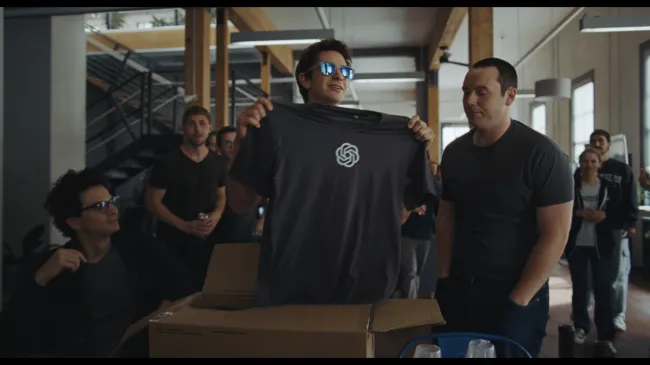
Director Luca Guadagnino has cast Andrew Garfield as OpenAI CEO Sam Altman in 'Artificial,' with Neon releasing and a first trailer now out. For executives, the film marks the moment the AI boom's most powerful figure becomes a mainstream cultural character, with reputational stakes no communications team fully controls.
The trailer for "Artificial" is out, and the single fact that matters is the casting: Andrew Garfield plays Sam Altman, the CEO of OpenAI, in a film directed by Luca Guadagnino, the filmmaker behind "Call Me by Your Name" and "Challengers." Neon is releasing it. IndieWire's read on the first footage is that Guadagnino delivers a sharp, shocking, and funny portrayal of the most powerful executive in artificial intelligence. That is the whole confirmed story, and it is already a lot.
What the source does not say is just as telling. There is no release date. There is no word on whether Altman, OpenAI, or anyone connected to the company participated, consulted, or objected. There is no detail on how much of Altman's tenure the film covers, or where it lands tonally beyond those three adjectives. So the confirmed facts are narrow. The signal is not.
Start with the timing. For most of modern business history, the screen treatment arrived late. Steve Jobs got his films years after his death. Mark Zuckerberg is the closest parallel that actually holds: "The Social Network" hit theaters in 2010 while he was still running Facebook, and it turned a young founder into a character with a score by Trent Reznor. That was considered audacious at the time. Fifteen years later, the lag has collapsed to nearly zero. Altman is running OpenAI, negotiating compute deals, and answering to regulators while a major director puts a version of him on screen.
Altman's public profile is part of why this lands. He has spent the past two years as the face of the AI boom, testifying before lawmakers, fielding questions about safety and competition, and navigating internal drama that played out in full public view. That is exactly the kind of figure prestige cinema tends to circle, and exactly the kind of figure whose employers would prefer a quieter profile.
Then look at who signed on. Guadagnino built his reputation on desire, bodies, and mood, from "Call Me by Your Name" to "Challengers." A director with that profile choosing AI as his subject is a statement about where prestige filmmaking believes the culture is heading. Neon, the independent distributor behind the release, has built its business on auteur-driven films and slow-burn awards campaigns. A trailer is not a movie. It is the first beat of a marketing clock, and that clock has now started.
Why should anyone outside Hollywood care? Because narrative is a regulatory input. The rules being written for AI in Washington and Brussels, including the European Union's AI Act, are shaped in part by how the public feels about the people building the technology. A film that makes a CEO legible, funny, or unsettling to millions of people who will never read a model card or a safety framework does something no policy paper can. It sets the emotional baseline.
The second-order effects run in both directions. A flattering portrayal is worth more than any paid campaign, because audiences discount advertising and absorb stories. A hostile one is harder to rebut, because you cannot issue a correction to a narrative. And the more studios chase AI as subject matter, the more founder characters get minted, which raises the odds that any high-profile CEO eventually gets a version of themselves they did not authorize and cannot control.
For executives at AI companies, the practical lesson is uncomfortable: assume you are already a character. Communications strategy used to mean press, earnings calls, and congressional testimony. It now includes entertainment, where the rules are different, the timelines are longer, and the audience is everyone. The people who will vote on AI policy, work alongside AI tools, and decide whether to trust the companies selling them are forming their impressions from screens, not filings.
Watch the release calendar. The source gives no date, which means the timing of the campaign is itself a story to track. A trailer that lands during a regulatory fight reads differently than one that lands in a quiet stretch. And watch whether Altman or OpenAI engage publicly at all. Silence is a strategy, and it has a shelf life.
Strip it down and here is what you have: two minutes of marketing that doubles as the first draft of how a mass audience will picture the man building the technology reshaping their work. The film has not opened. The premiere, in the sense that matters, already has.
This story's Key Insights and Take-aways are locked.
Create a free account to unlock Executive Actions for one credit.
Register to UnlockAlways free for Executives Club members. Join the Club
More in Technology

Anthropic mathematician claims Claude helped crack the Riemann hypothesis
If the proof holds, AI has toppled math's most famous open problem; if it does not, it is a case study in announcing breakthroughs before anyone verifies them.

AI's $4 Trillion Wipeout Erases Nasdaq's Gains for the Year
A brutal week took roughly $4 trillion off the AI sector and left the Nasdaq flat for the year, and the damage ran the full length of the supply chain.

Anthropic mathematician says AI proved the Riemann hypothesis. Verification will take time.
A single unverified claim from inside Anthropic now sits against more than 160 years of open mathematics, and the gap between asserting a proof and surviving peer review is the entire story.