
Microsoft outage takes down Teams, Outlook and Copilot at once
One Microsoft failure knocks out the chat, inbox and AI assistant modern offices run on, putting the company's AI pitch inside the same blast radius as its email.
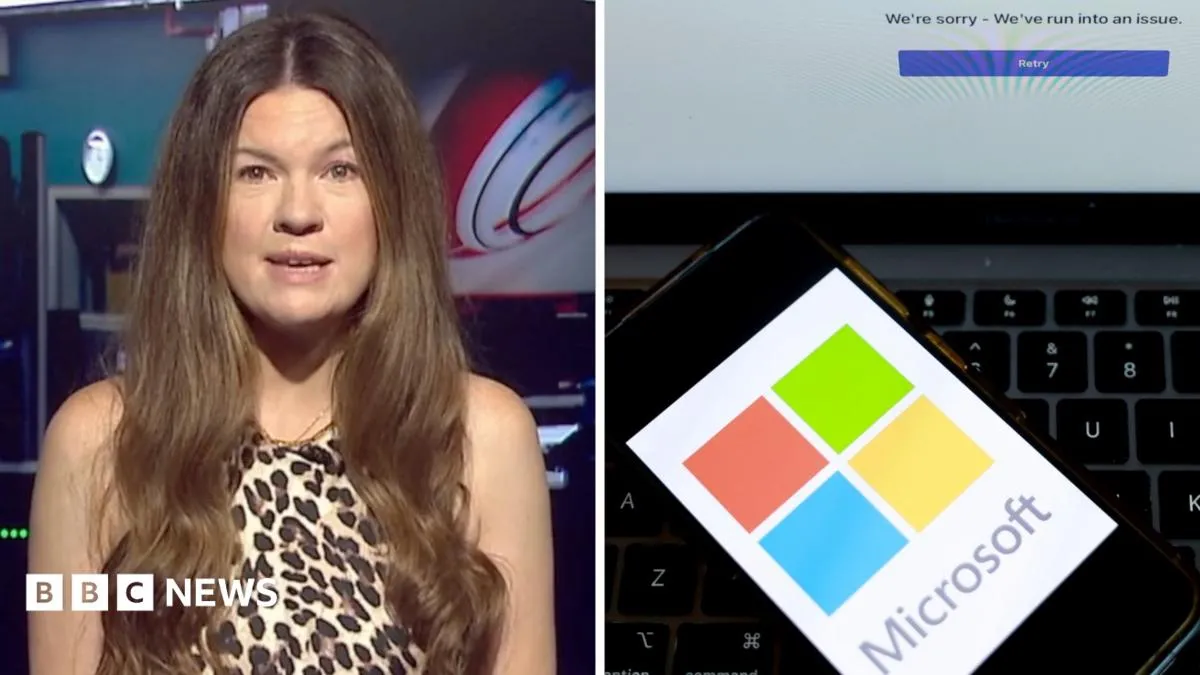
A Microsoft outage is affecting services including Teams, Outlook and AI software Copilot, according to BBC News. For decision-makers, the incident is a live test of how much of the working day now depends on a single vendor, and of whether AI features sold as productivity gains hold up when the underlying stack fails.
Microsoft is down, and the outage is not confined to email. According to BBC News, a Microsoft outage is affecting services including Teams, Outlook and AI software Copilot. Read that list again, because it is the entire shape of a modern working day: the chat and meeting layer, the inbox and calendar layer, and the AI assistant Microsoft has spent recent years positioning as the intelligence on top of both. When one company's infrastructure stumbles, all three go quiet together.
The detail worth pausing on is Copilot. Cloud services fail from time to time; that is not new, and no vendor has a perfect record. What is newer is that a generative AI product now sits inside the same blast radius as the boring, essential tools. Copilot is not a standalone app you can swap out at will. It is woven into the productivity suite, which means it depends on the same identity systems, data stores and infrastructure as the mail and chat it is meant to augment. When those wobble, the AI does not cleverly work around the problem. It stops.
For anyone running a company, the practical damage is easy to picture. Teams is where meetings, internal chat and a lot of informal decision-making happen. Outlook is where commitments, contracts and calendars live. Copilot is where a growing number of people draft, summarize and search. Take all three offline at once and you do not lose a feature. You lose the coordination layer. Historically, the cost of an outage like this is not the software subscription; it is the meetings that did not happen, the replies that did not go out and the deals that slipped by a day.
The deeper issue is concentration. Most large organizations have deliberately consolidated onto a handful of cloud and productivity vendors because integration is cheaper and security is easier to police. That logic holds right up until it does not. Outages at major cloud providers have typically traced back to something narrow, a bad configuration change, a failed update, an identity service under strain, and the cascade is what does the damage. A single fault domain becomes everyone's fault domain. The more functions you fold into one suite, the more surface area one incident can reach.
That is why Copilot's presence in this outage matters more than the headline suggests. Enterprises have been buying AI assistants on a productivity promise: faster drafting, quicker synthesis, less time lost to routine work. Reliability is part of that return on investment, even if it rarely appears in the pitch deck. An assistant that is unavailable during the exact hours it is needed is not a productivity multiplier; it is another dependency. Buyers should be asking vendors a blunt question: when core services fail, does the AI degrade into something useful, or does it simply vanish?
Contracts rarely make companies whole. Enterprise cloud agreements typically include service-level commitments backed by credits, and those credits are usually small relative to the business interruption they are meant to offset. Regulators, meanwhile, have spent recent years building operational resilience regimes aimed at critical third-party technology providers, on the theory that a bank or a hospital cannot outsource its own accountability to a vendor. For boards, vendor concentration is shifting from an IT line item to a governance question with real reporting implications.
The playbook for the next one is not exotic. Know which workflows are single-threaded on one provider. Keep a fallback channel for urgent communication that does not depend on the same stack. Make sure someone owns the status page and the internal update cadence before an incident, not during it. And rehearse it. Tabletop exercises feel bureaucratic until the day the inbox goes dark and everyone starts asking who is supposed to say what, to whom, and how fast.
The strategic takeaway is uncomfortable but simple. The AI layer inherits every weakness of the stack beneath it, and the stack beneath it is shared by nearly everyone. Microsoft's bad day is a reminder that resilience is now a competitive variable, not a compliance checkbox. The executives who come out of this well will be the ones who already know exactly what breaks when Teams, Outlook and Copilot go quiet at the same time, and what their teams do in the first hour.
This story's Key Insights and Take-aways are locked.
Create a free account to unlock Executive Actions for one credit.
Register to UnlockAlways free for Executives Club members. Join the Club
More in Technology

Anthropic mathematician claims Claude helped crack the Riemann hypothesis
If the proof holds, AI has toppled math's most famous open problem; if it does not, it is a case study in announcing breakthroughs before anyone verifies them.

AI's $4 Trillion Wipeout Erases Nasdaq's Gains for the Year
A brutal week took roughly $4 trillion off the AI sector and left the Nasdaq flat for the year, and the damage ran the full length of the supply chain.

Anthropic mathematician says AI proved the Riemann hypothesis. Verification will take time.
A single unverified claim from inside Anthropic now sits against more than 160 years of open mathematics, and the gap between asserting a proof and surviving peer review is the entire story.