
Mullin's 98% certainty lasted 3 minutes. The White House benched him.
DHS Secretary Markwayne Mullin told a nervous country the outages were not cyberattacks, then lost the explainer job to Jay Clayton as his own allies piled on.
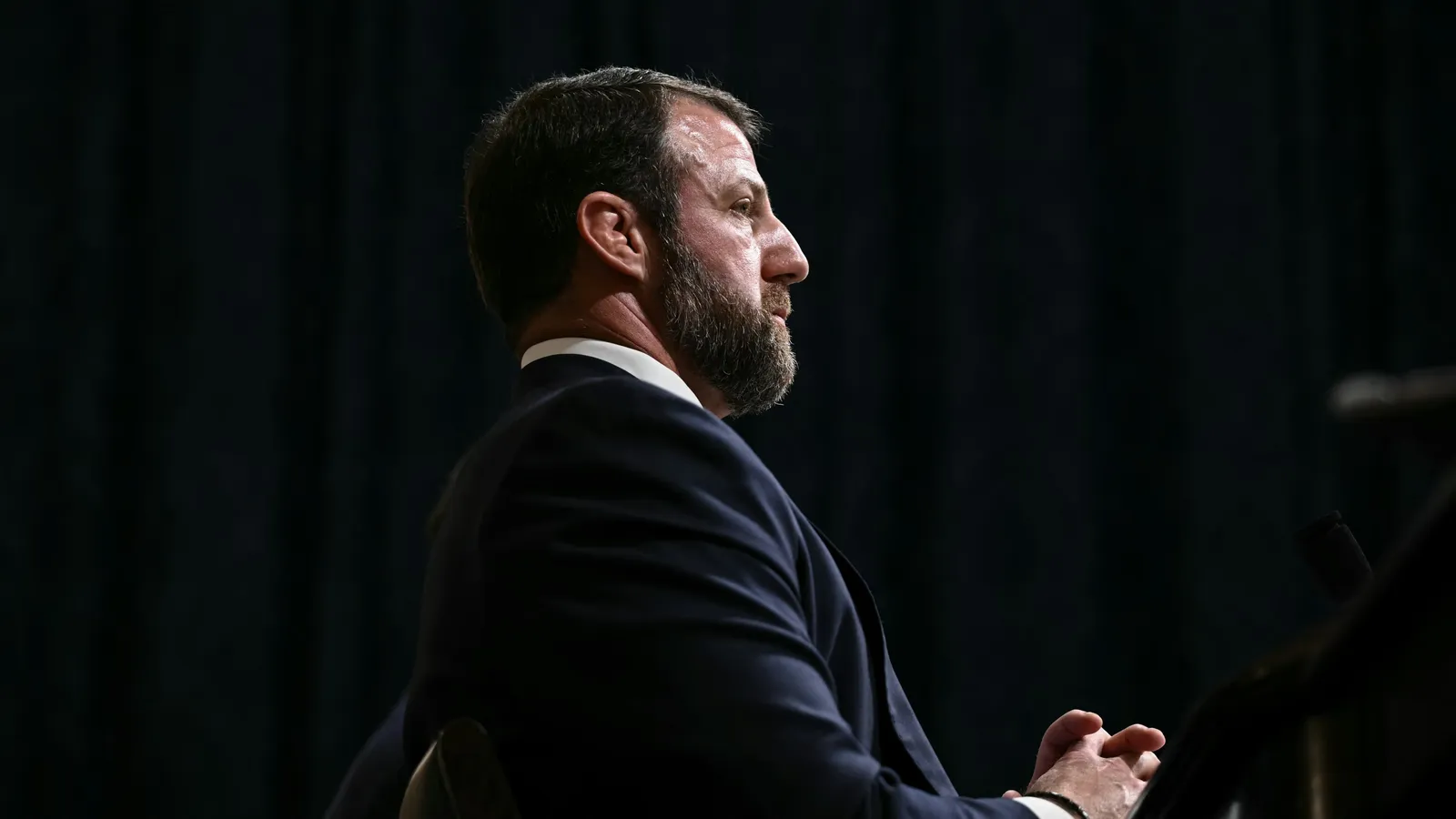
Homeland Security Secretary Markwayne Mullin spent a week reassuring Americans about crashing software, a halted air traffic system and glitching banks, then watched the White House hand the explainer role to Director of National Intelligence Jay Clayton. For executives, the episode shows how fast public credibility erodes when a leader's certainty outruns the evidence behind it.
Markwayne Mullin's certainty had a shelf life of about three minutes. On Tuesday, during a CNBC interview, the Department of Homeland Security secretary declared: 'I can tell you with complete certainty that we are not under attack.' Three minutes later, by his own accounting, that certainty regressed to 98 percent. It was the second time in a week he had landed on that oddly precise figure. Days earlier, on Sean Hannity's Fox News show, Mullin had said with '98 percent certainty' that a wave of outages was not a cyberattack, and he gave no indication of how he had arrived at that view. By then, the White House had already seemingly relieved him of his role as the designated explainer of the mysterious outages, handing the job to Director of National Intelligence Jay Clayton, who brings a more lawyerly bearing. 'Good move by the White House,' former Press Secretary Karoline Leavitt wrote on X as Clayton took the lead on Fox News.
The week had started badly. After the FAA lifted its hours-long ground stop on Friday evening, Mullin appeared alongside Transportation Secretary Sean Duffy and announced that the problem was likely caused by the FAA's own upgrades. That put the onus on Duffy, who stared at the floor and shook his head. The two have not appeared at briefings together since. Three nights later, after thousands of Chase Bank customers were unable to access their accounts and other financial institutions' clients reported problems with digital payments, Mullin went on Hannity and described a conversation he had had a few hours earlier with 'one guy that's very smart with tech' (but not, Mullin made clear, Elon Musk) who had claimed that AI was indirectly causing the outages. 'As it starts self-fixing itself it's like doing a change order on a house,' Mullin said. It was not clear whether that assessment came from cybersecurity experts, particularly those at the Cybersecurity and Infrastructure Security Agency, which is under Mullin's command at DHS.
Mullin's path to the job explains the style. He first rose to prominence by building his family's plumbing business into a home-services giant in northeast Oklahoma, and his sentences still tend to travel like a drain line, making loops and turns en route to an unseen destination. He does not seem to work from talking points. He parlayed that folksy manner into a successful bid for Congress in 2012, wore a cowboy hat around Washington, D.C., and became one of President Trump's fiercest allies on Capitol Hill. When Trump picked him to replace Kristi Noem at DHS earlier this year, he carried a reputation as the martial artist of MAGA politics. That made him a somewhat unusual choice for a job that, until Trump's second term, had typically been held by more buttoned-up figures who choose their words carefully, especially during moments of crisis.
The reviews are not kind, and they are coming from his own side. A frustrated senior DHS official, who did not want to be identified bad-mouthing the boss, told The Atlantic that Mullin 'gives the perception that he's winging it,' adding that 'he's giving Biden a run for his money with the frequency of gaffes.' Late-night comedians are now mocking him, along with right-wing commentators. The podcaster Megyn Kelly declared that 'he seems like an idiot.' Steve Bannon, a longtime adviser to the president, said on his War Room show that he is 'not so sure it's helpful to keep putting Markwayne Mullin on shows like Sean Hannity or even have him go on CNBC.'
Mullin's public response was to fight a different battle. In testimony before the House Homeland Security Committee yesterday, he used nearly his entire opening statement to angrily justify flying on a government jet to see a college-football game in Louisiana less than 24 hours after the FAA ground stop had been lifted, as thousands of travelers remained stranded. 'I wanted to be a good uncle and take my little niece, who has never been to an LSU game, and she's a huge LSU fan, to a game,' he said. DHS, for its part, told The Atlantic that 'Mullin surrounds himself with a variety of experts' from across the department's 22 agencies and components, citing his track record on deportations, border security, and drug seizures. 'The results speak for themselves,' the statement said.
Where imprecision has cost him most, especially among right-wing critics, is immigration enforcement, the most politically charged part of the job, where partisans on all sides hunt for signifiers in every utterance. During his confirmation hearing, Mullin told lawmakers he wanted to turn down the visibility and temperature of Trump's mass-deportation campaign, relaying direction he had received from the White House following the killing of two U.S. citizens during an ICE crackdown in Minneapolis. Immigration arrests and deportations have reached record highs in recent months, but some of the president's most ardent supporters, among them loyalists to Noem, have retained their skepticism of Mullin. After Democrats' historic midterm wins, he said Congress could work on immigration reform 'where we can look at DACA and figure out a way that these individuals can become maybe legal permanent citizens or something like this.' There is no such thing as 'legal permanent citizens' in U.S. immigration law; Mullin appeared to conflate legal permanent residency with U.S. citizenship. The DACA mention alone triggered outrage on the right.
Then came the language hard-liners treat as evidence of intent. Mullin said some DACA recipients 'may not even speak English or never even lived in their country,' apparently intending to say that such people spoke only English. He used the word 'amnesty,' which Trump and others have insisted the administration would not support, when he meant 'asylum' during an interview with Fox News's Laura Ingraham. He has referred to gang members as 'serious affiliated drug bangers' and used 'collateral criminals' instead of collateral arrests, ICE's term for people swept up in raids who were not the intended target. And after an ICE officer in Maine fatally shot a Colombian delivery driver on July 13 while his family was nearby, Mullin ordered a suspension of nonessential traffic stops. Hard-liners protested to Trump that the move made the administration look weak, and the next day Trump reversed the order.
There is no indication that Trump is preparing to fire Mullin, despite calls on the right to do so. The more instructive move is the quieter one: the White House did not remove the secretary, it removed him from the microphone, substituting a lawyerly intelligence chief for a folksy operator at the exact moment the public needed a credible voice. For executives, that is the lesson worth banking. Crisis communication is a distinct competence, and it does not transfer from operational success, political loyalty, or personal charm. Certainty is a claim that has to be backed by evidence, and when it is not, the market, the media, and eventually your own allies will price it in. The safest structure is the one the White House improvised under pressure: keep the operator running the agency, and put the person who can explain the facts in front of the cameras.
This story's Key Insights and Take-aways are locked.
Create a free account to unlock Executive Actions for one credit.
Register to UnlockAlways free for Executives Club members. Join the Club
More in Politics

Fifth Circuit Kills Pregnant Workers' Law Over Pandemic Proxy Votes
A procedural ruling, not a policy one, has blocked a federal pregnancy-accommodation law and put every pandemic-era statute in the crosshairs ahead of an expected Supreme Court appeal.

Measles kills a Virginia child under 5, the state's first death of 2026
Virginia's health department confirmed the death but withheld the child's vaccination status, leaving schools, clinics and employers to plan around the one detail that would explain the most.

Former Brazilian President Bolsonaro Hospitalized with Intestinal Obstruction
The health status of the former far-right leader raises immediate questions about political stability and the trajectory of Brazil's conservative movement.