
Musk says Tesla plans a 7-seat Model Y with no steering wheel
The Cybercab seats two and Waymo's Ojai seats four, so Musk's answer to the family-sized robotaxi gap is a stripped Model Y, with no word yet on how the interior works.
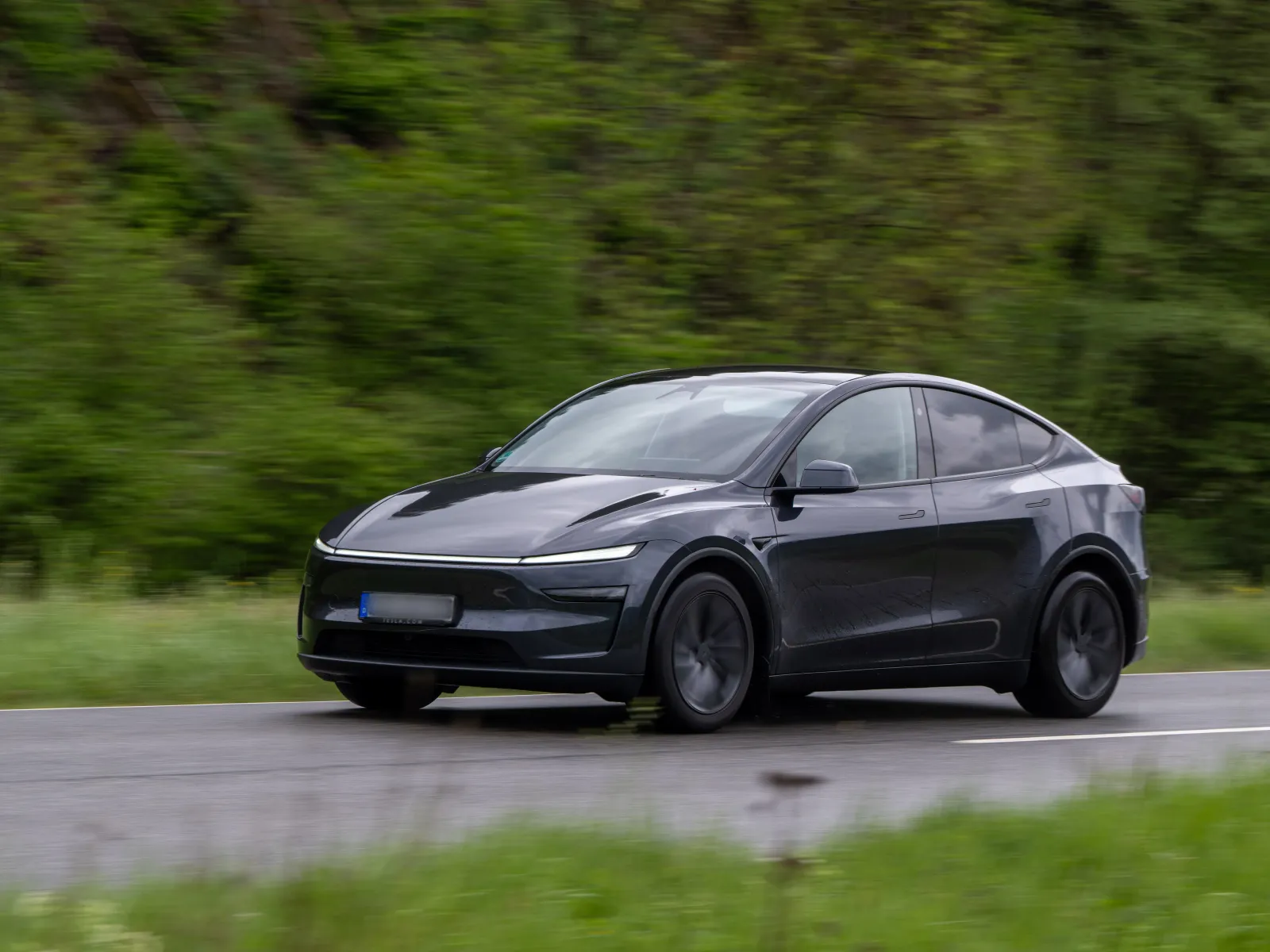
Elon Musk said at The New York Times DealBook Summit that Tesla plans to build an autonomous Model Y with no steering wheel or pedals that can carry six or seven passengers. The move targets the one slice of US autonomous ride-hailing that Tesla, Waymo, and Uber's Lucid partnership have all left underserved: groups bigger than four.
Elon Musk used The New York Times DealBook Summit on Wednesday to sketch out a vehicle Tesla does not build yet: an autonomous Model Y with no steering wheel, no pedals, and room for six or seven people. The Tesla CEO said the company plans to develop it, and he did not explain how Tesla would configure the interior of a car that today ships as a five-seat crossover. That missing detail is the whole story. Tesla's robotaxi service runs on Model Ys right now, and its terms of service cap seating at four people. Its purpose-built robotaxi, the Cybercab, is a two-seat coupe with no steering wheel or pedals. So the company selling the most famous electric SUV on earth has no autonomous vehicle that can move a family of five.
Musk framed the gap himself. He said the Cybercab will cover most of the passenger miles driven for Tesla's robotaxi service, but that a bigger autonomous car is still needed. "If you've got a whole family in the car, you still need autonomous vehicles for that, so what we plan to do is have an autonomous version of Model Y that wouldn't have steering wheels and pedals and would be good for transporting groups of six or seven people," he said. Read that closely: the Cybercab is the volume play, the stripped Model Y is the capacity play. Two vehicles, two jobs, and only one of them exists today.
The competitive picture explains the timing. Waymo's Ojai, positioned as the company's roomier platform next to its Jaguar SUVs, fits up to four people. Uber plans to launch robotaxis with Lucid's Gravity SUV, which the ride-hailing company said can seat six. That leaves the six-and-seven-seat autonomous ride-hailing segment relatively underserved in the US, which is precisely the slice Musk just claimed. Nobody in the driverless business has shipped a vehicle that comfortably handles a full family plus luggage, and the incumbents' current answers top out at four seats.
Why seating is the metric that matters here: for a robotaxi operator, the vehicle is the cost center and the seat is the revenue unit. More seats per vehicle means more revenue per mile driven and fewer cars needed to serve the same demand. A two-seater Cybercab optimizes for cheap, short, one-or-two-rider trips. A six-or-seven-seat Model Y optimizes for airport runs, family travel, and group nights out, the trips where a human driver today charges a premium. Tesla currently cannot serve any of them autonomously, which means every one of those rides goes to a competitor or stays with a human behind the wheel.
The regulatory context is where the announcement gets thin. Historically, US federal motor vehicle safety standards have been written around cars with human controls, which is why vehicles without steering wheels have typically required exemptions or rule changes before they can be sold or deployed at scale. Musk has talked about removing the steering wheel before, and the hard part has never been the announcement. It is the certification path, the crash-test regime, and the state-by-state patchwork that governs who can operate a driverless car and where. None of that was addressed on Wednesday, and Musk offered no timeline.
Also unanswered: price, production plan, and whether this would be a new build or a modification of the existing Model Y line. Musk did not explain the interior configuration, which is not a small omission. Six or seven seats in a vehicle with no steering column and no pedals means a genuinely different cabin layout, a different airbag strategy, and different seating geometry. That is engineering work, not a software update pushed overnight to the fleet.
For Tesla investors, the announcement lands in a familiar pattern: a product vision stated on a conference stage, ahead of the product. The Cybercab itself is the reference case. Musk has positioned it as the backbone of the robotaxi fleet, and it still has to reach the road. Adding a second, larger autonomous platform to the roadmap expands the addressable market on paper while adding another program to execute, another certification to win, and another line to fund.
The strategic read for peers is simpler. Capacity is becoming the next battleground in autonomous ride-hailing, and whoever wins the family and group segment may capture trips that today default to human drivers, minivans, and airport shuttles. Waymo has four seats. Uber's Lucid plan has six. Musk just said Tesla wants seven. Whoever actually ships the big one first gets a market that, for now, nobody serves.
This story's Key Insights and Take-aways are locked.
Create a free account to unlock Executive Actions for one credit.
Register to UnlockAlways free for Executives Club members. Join the Club
More in Business

S&P 500 Enters Correction, Down 10% From Its High on AI Worries
The index's slide past the 10 percent line is a symbolic verdict on investor mood, and the AI trade that powered the rally is now the thing testing it.

Dow and S&P 500 enter correction as Nasdaq logs worst week since 2020
All 11 S&P 500 sectors fell more than 1% in the same week for the first time since April 2025, a breadth signal that matters more than any single index level.

Chip stocks lose $2.3 trillion in a week, worst run in 25 years
A $2.3 trillion weekly wipeout in semiconductors is forcing every board with an AI story to ask whether it owns a thesis or just a crowded trade.