
Nasdaq Erases 2026 Gains as Anthropic IPO Fails to Stop $4T AI Rout
Anthropic's record-breaking listing could not hold the market up on its second day, leaving the Nasdaq 5% below its 1 January level and both the Dow and S&P 500 in correction territory.
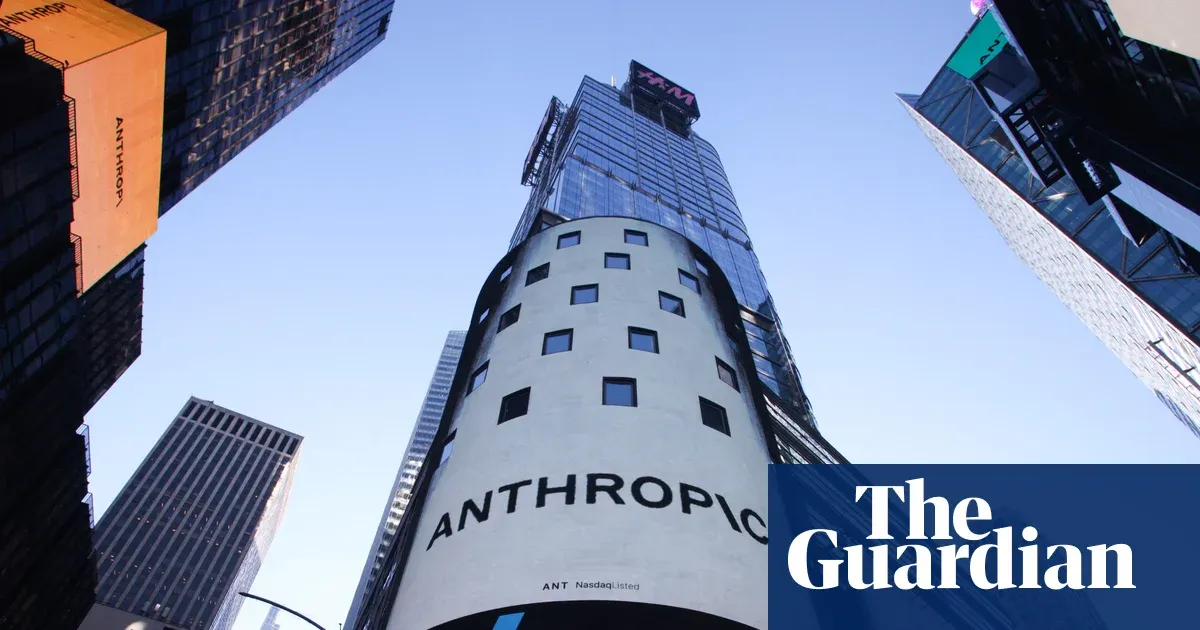
Anthropic's record-breaking IPO failed to stem a global sell-off in AI-linked companies, and the Nasdaq Composite closed Friday down 5% from 1 January, erasing all of its 2026 gains while the Dow and S&P 500 closed in correction territory. For decision-makers, the marquee AI listing becoming a liability rather than a floor signals that public markets are now actively re-pricing the AI buildout, which will feed straight into private valuations, IPO timing and the cost of capital for every AI-heavy business.
The Nasdaq Composite closed Friday down 5% from its value on 1 January, erasing every gain the index had built in 2026. The Dow Jones Industrial Average and the S&P 500 both closed in correction territory. And the tech-heavy index wiped out roughly $4tn in market value over the week, according to the Wall Street Journal. A full year of upside, gone in days, with a four-trillion-dollar hole left where the AI trade used to sit.
The company that was supposed to stop the bleeding did the opposite. Anthropic, whose record-breaking IPO had been the market's biggest live test of AI demand, failed to stem a global sell-off in AI-linked companies, and its stock dropped on its second day of trading. Instead of a floor, the listing became another data point for anyone arguing that AI valuations ran ahead of AI revenue. The seven co-founders of Anthropic are now worth $180bn, according to the Guardian. On paper, and paper is carrying an unusual amount of weight in that number right now.
What "correction territory" actually means: in market shorthand it typically denotes a fall of at least 10% from a recent high. It is the middle rung of investor disappointment, well short of the 20% drop that defines a bear market, but it is also the threshold where momentum funds, risk desks and retail traders stop treating a dip as a discount. Two of the three major US indices sitting there at once, while the third hands back an entire year of gains, is the kind of alignment that historically forces a rethink of positioning rather than a reflex buy.
The real number under the tape is not Anthropic's day-two share price. It is the question investors are now asking out loud: whether the huge sums being poured into the AI buildout will ever produce returns that justify the price paid. That question has been building for a while. An IPO is the cleanest way to answer it, because it drags a private AI company into public daylight and forces a market-set price onto a business that was previously valued by friendly private rounds. When the marquee listing of the cycle cannot hold its first 48 hours, the answer the market gives is not the one the buildout needed.
The read-across lands first on private balance sheets. Late-stage AI companies carry marks set in a friendlier market, and public listings are the pricing mechanism those marks quietly lean on. When the bellwether stumbles out of the gate, every private CFO defending a valuation set last year, every venture partner marking a book and every lender holding stock as collateral has to revisit the number. The second read-across is the queue. A broken IPO window tends to freeze the companies lined up behind it, pushing them back to private capital on less generous terms or forcing a delay that costs them hiring and compute budgets.
Then there is the founder wealth. The $180bn attached to Anthropic's seven co-founders is a mark-to-market figure, not cash. Founders and early employees at newly listed companies typically sit inside a lockup period, commonly around six months, which means their net worth now moves with the same index that just erased a year of gains in a week. That matters well beyond the gossip: concentrated founder stakes are collateral, compensation and recruiting leverage all at once, and a falling share price tightens all three simultaneously.
For boards, the change is about cadence. A private AI company argues its case once a quarter to a handful of investors. A public one gets a referendum every afternoon, run partly by people who own the stock for a week. Anthropic's stumble, and the wider sell-off that greeted it, hands every AI board a live stress test nobody had to commission: what does the plan look like if the equity market stops paying for growth at any price? The companies that answer that question before their investors ask it will set their own terms. The ones that wait will negotiate from the tape.
The strategic stakes for peers are straightforward, and they are not about panic. The AI buildout is financed on the assumption that capital stays cheap and equity stays generous. This week the Nasdaq, the Dow and the S&P 500 all told the same story at once: the market is re-underwriting that assumption in public, and it is doing so while the most anticipated AI listing in memory is still in its first week of price discovery. CEOs and CFOs running AI-heavy businesses should expect harder questions from lenders, later-stage investors and their own boards, and they should walk in with a number for what their plan looks like if the multiple compresses further. The IPO was supposed to be the proof. Instead it became the question.
This story's Key Insights and Take-aways are locked.
Create a free account to unlock Executive Actions for one credit.
Register to UnlockAlways free for Executives Club members. Join the Club
More in Business

S&P 500 Enters Correction, Down 10% From Its High on AI Worries
The index's slide past the 10 percent line is a symbolic verdict on investor mood, and the AI trade that powered the rally is now the thing testing it.

Dow and S&P 500 enter correction as Nasdaq logs worst week since 2020
All 11 S&P 500 sectors fell more than 1% in the same week for the first time since April 2025, a breadth signal that matters more than any single index level.

Chip stocks lose $2.3 trillion in a week, worst run in 25 years
A $2.3 trillion weekly wipeout in semiconductors is forcing every board with an AI story to ask whether it owns a thesis or just a crowded trade.