

Netflix Hits 325M Subscribers as Rivals Quit Keeping Score
Netflix's $3.67 billion quarterly profit and 325 million subscribers now sit atop a field where Disney, Skydance and Fubo are all retreating from quarterly disclosure, leaving Peacock as the last streamer that still shows its hand.
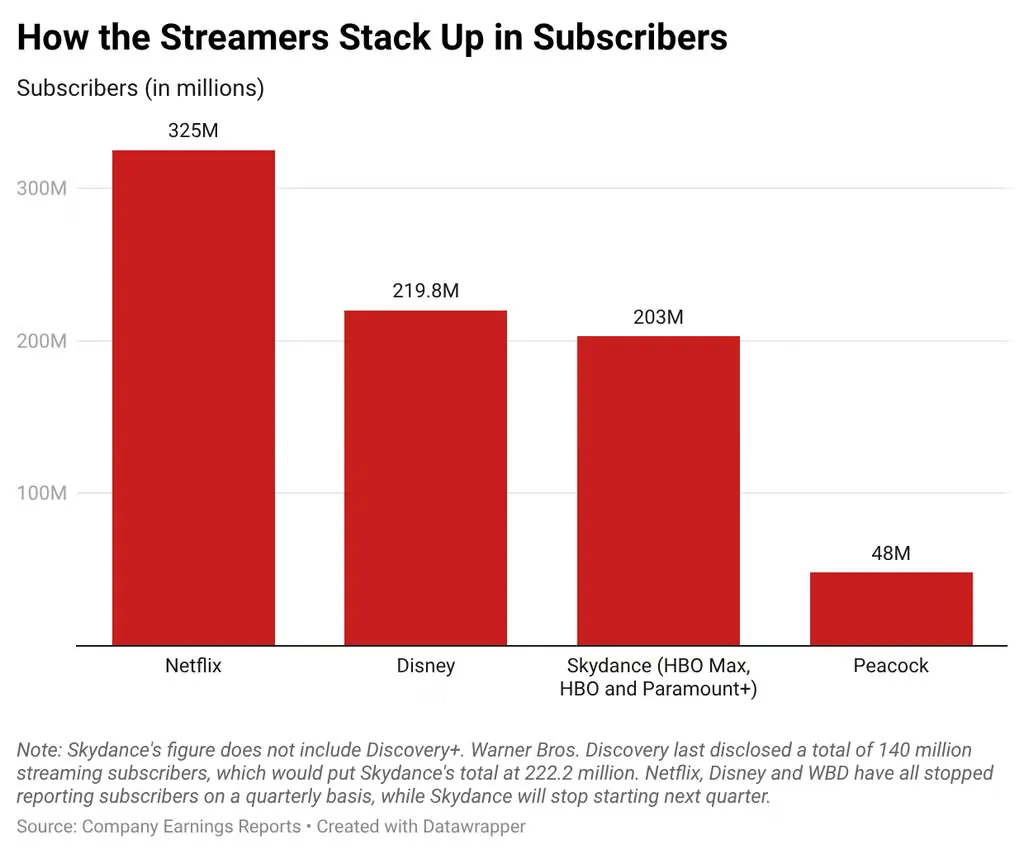
Netflix reported 325 million subscribers, $12.87 billion in revenue and $3.67 billion in profit for its third quarter, while Disney, Skydance and Fubo moved to stop disclosing subscriber counts and profit breakouts on a quarterly basis. For executives and boards, that retreat means benchmarking streaming performance shifts from public filings to bundling, pricing power and ad-tier economics.
Netflix closed its third quarter with 325 million subscribers, $12.87 billion in revenue and $3.67 billion in profit, and it is still the only streamer that can say all three out loud without flinching. Here is the part that matters more: the scoreboard is being switched off. Disney previously stopped reporting subscribers on a quarterly basis. Fubo, now 70% Disney-owned after merging with the Hulu + Live TV business, will stop too. And Skydance, the David Ellison-led company that just closed its $110 billion Paramount-Warner Bros. Discovery combination, said it will pare back quarterly disclosures starting next quarter. That leaves NBCUniversal's Peacock, at 48 million subscribers, as the only major streamer still reporting a subscriber count every three months.
The retreat matters because it is landing right as the industry finally has something to brag about: streaming is now on a path of consistent profitability across the industry, after years of expensive land grabs. But the leader is not coasting. Netflix's engagement grew just 2% in the first half of the year. Ahead of the quarter it cut 6% of its total workforce and fired Chief Content Officer Bela Bajaria and film chief Dan Lin, with Bajaria replaced by former Disney and Fox executive Peter Rice. Guidance leaned cautious too: fourth-quarter revenue growth of 11.5% to $13.4 billion, full-year growth of 13% to $51.1 billion, and 2026 ad revenue trimmed by $300 million to $2.7 billion from a prior $3 billion projection.
Disney is the closest thing to a real counterweight. Entertainment streaming revenue grew 19% to $6.05 billion, and Disney+ and Hulu's combined profit more than doubled to $824 million in the fourth quarter. The streaming business posted a double-digit full-year operating margin of 11.5%, which it expects to keep growing, and Disney now generates more revenue from streaming than from linear TV. The push is structural: the "digital centerpiece" transformation under CEO Josh D'Amaro is taking shape, with a fully unified Disney+-Hulu app launching in December that includes live TV and select premium add-ons, plus TikTok creator content, more vertical video, live sports, podcasts and a bigger slate of local originals over the next three years. Note the disclosure retreat here too. Disney does not break out financials for its ESPN streaming service, gave no specific streaming revenue guidance for 2027, and will stop breaking out Disney+/Hulu combined profit starting in 2027.
Skydance arrives with scale and a reporting headache. Its first quarter as a combined company showed 203 million subscribers globally across Paramount+, HBO Max and HBO, split between 82.2 million on Paramount+ after adding 600,000 subscribers and 120.8 million on HBO and HBO Max. That figure excludes Discovery+; Warner Bros. Discovery said it had surpassed 140 million total streaming subscribers before the deal closed, which would put the combined footprint around 222.2 million. That is within striking distance of Disney's last disclosed 219.8 million and still well behind Netflix. The economics lag the scale: Paramount's streaming business grew revenue 11% to $2.5 billion, with Paramount+ up 21% to $2.13 billion, its fastest quarterly growth this year, and profit of $225 million despite higher programming costs. Pluto TV slipped to roughly 75 million monthly active users from the 80 million last disclosed in 2023. Skydance's results did not include the financials of the combined company nor break out the Warner Bros. Discovery side, so the full picture stays fuzzy.
Peacock is the last transparent one, and it is not a coincidence that it is also the smallest and the most domestic. Revenue jumped 34% to $1.8 billion on higher distribution and advertising, its August price increase and the World Cup, and the service is on a profitability streak as NBCUniversal prepares to separate from Comcast next year. But 48 million subscribers, holding steady from last quarter, is a domestic-only base competing against global platforms, and its reach ambitions now lean on a new distribution deal with YouTube set for 2027.
Two giants sit outside this comparison entirely, and that is the point. Amazon and Apple do not break out streaming subscribers, revenue or profitability each quarter because video remains a small part of each tech giant's business. Amazon CFO Brian Olsavsky said Prime Video is "profitable in its own right" with a revenue run rate in the "tens of billions" of dollars, and an NFL presentation to the FCC has previously pegged the service at roughly 180 million subscribers, a figure Amazon has not publicly confirmed. Apple reports more than 1.5 billion paid subscriptions across its Services business, an all-time high and double-digit growth year over year, without saying how much comes from Apple TV; services vice president Eddy Cue has said the streamer has "significantly more" than analysts' initial 45 million estimate.
The strategic read for operators is that streaming has stopped being a pure subscriber race and become a margin and bundling contest, conducted increasingly in private. Skydance expects strong top-line growth and expanded streaming margins in the fourth quarter and 2027 as it works toward bringing HBO Max and Paramount+ together, with a bundle launching in early 2027 and both services merging onto the same backend within the first year of the deal closing. Netflix is buying growth through subscriptions, advertising and price increases while cutting costs and reshuffling its creative leadership. Disney is converting its app into a single destination with live TV inside it. Peacock is renting distribution. When the disclosures thin out, the winners will be the companies whose bundles, pricing power and ad stacks are strong enough that they never need to publish a subscriber count to prove it.
This story's Key Insights and Take-aways are locked.
Create a free account to unlock Executive Actions for one credit.
Register to UnlockAlways free for Executives Club members. Join the Club
More in Business

S&P 500 Enters Correction, Down 10% From Its High on AI Worries
The index's slide past the 10 percent line is a symbolic verdict on investor mood, and the AI trade that powered the rally is now the thing testing it.

Dow and S&P 500 enter correction as Nasdaq logs worst week since 2020
All 11 S&P 500 sectors fell more than 1% in the same week for the first time since April 2025, a breadth signal that matters more than any single index level.

Chip stocks lose $2.3 trillion in a week, worst run in 25 years
A $2.3 trillion weekly wipeout in semiconductors is forcing every board with an AI story to ask whether it owns a thesis or just a crowded trade.