
NIST's quantum method verifies where you are, and hackers can't copy it
Physicists used entangled photons to confirm a person's location within a zone 4.5 times smaller than classical methods allow, a first step toward anchoring bank, grid and health data security to physical place.
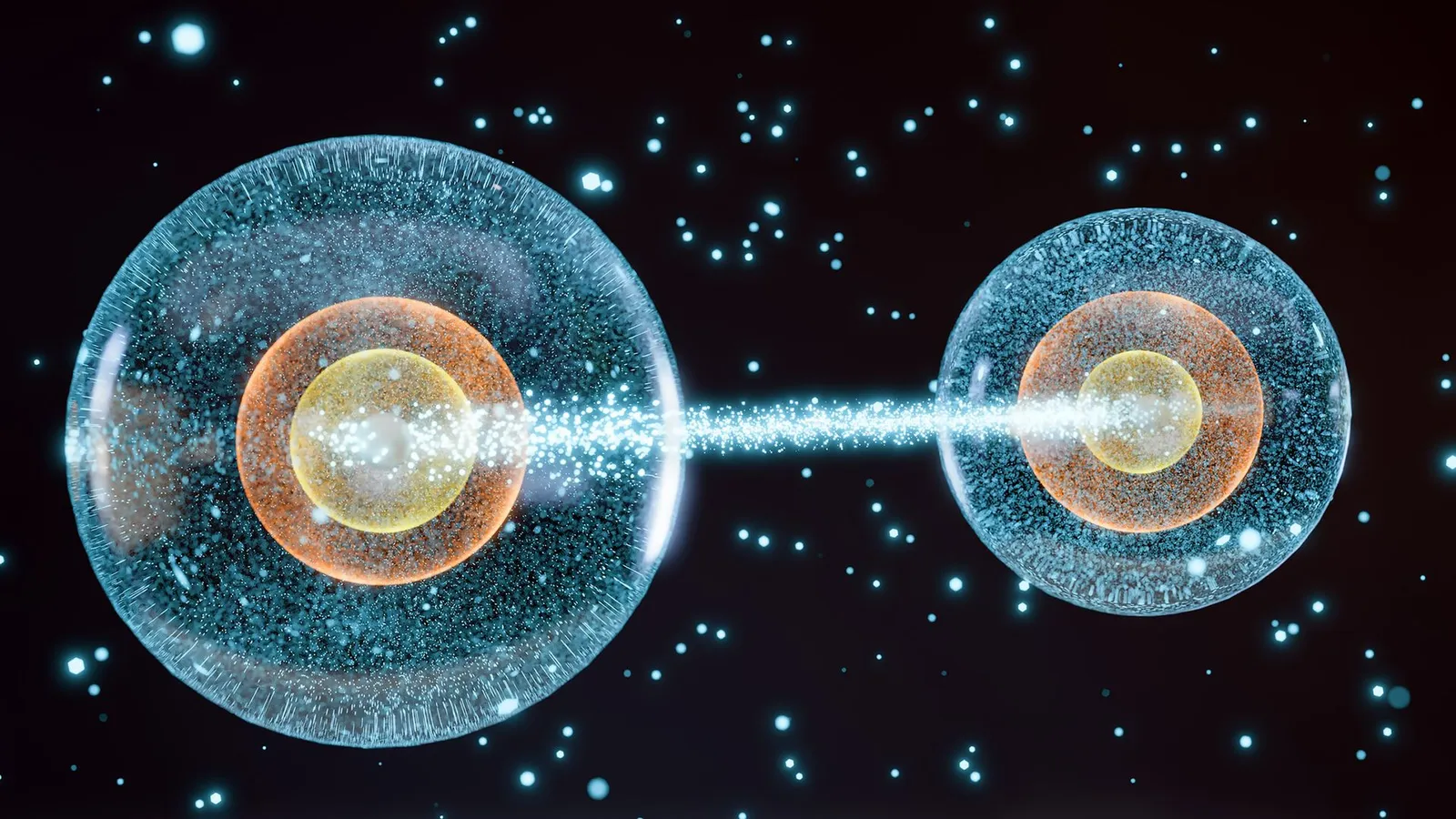
NIST physicists led by Krister Shalm used entangled photons to verify a participant's location between two stations 640 feet apart, the first complete demonstration of quantum position verification, published Wednesday (Nov. 18) in Nature. For decision-makers, it signals a coming security layer that anchors digital access to physical place, though real-world deployment is more than a decade out.
For the first time, physicists have used quantum entanglement to confirm where a person physically is. The team at the U.S. National Institute of Standards and Technology (NIST), led by quantum physicist Krister Shalm, published the result Wednesday (Nov. 18) in the journal Nature, and it is the first complete demonstration of a method called quantum position verification. The setup: two trusted stations, called verifiers, sat 640 feet (195 meters) apart on NIST's campus in Boulder, Colorado, linked by cables and optical fibers running through the hallways of a research building. A third participant, the prover, sat in between. The verifiers confirmed the prover's location within a region about 4.5 times smaller in volume than what a comparable classical method could guarantee.
That precision is the point. Location is a basic layer of security: banks, power grids and government agencies typically limit access to sensitive systems to people physically inside a secure building. The problem is proving location remotely. Classical, nonquantum methods time how long signals take to travel, and hackers working together can spoof them. Quantum physics closes that gap because a single quantum particle cannot be copied. "Is this call coming from my bank, or is it coming from someone in North Korea or somewhere else?" Shalm told Live Science. "That's really powerful if you can anchor digital security to a physical location."
The experiment borrows a technique called ranging, the same principle behind radar and the lidar sensors in some smartphones: send a signal, measure how long the response takes to return. "You can send a signal at the speed of light and measure how long it takes to get back," Shalm said. "But the problem is, that's the thing that can always be spoofed classically." So the team added entanglement. One verifier created pairs of entangled photons, particles so deeply linked that measuring one reveals something about the other even when they are separated at great distances. The verifier kept one photon from each pair and sent its twin to the prover. At the same time, both verifiers sent random bits of information timed to reach the prover at the same moment. The prover combined the two inputs with a simple math operation and used the result to decide how to measure the photon's polarization, the direction in which its electric field oscillates. The measuring device works much like the filter in polarized sunglasses. A detector recorded whether the photon made it through, and the prover sent that yes-or-no result back to both verifiers. Because nothing travels faster than light, the round-trip time told the verifiers how far away the prover could be. Because the photon cannot be copied, the measurement had to be made in that exact spot.
To confirm that no one cheated, the team ran a loophole-free Bell test, which checks whether particles are more strongly correlated than classical physics allows. If anyone tampers with the photons or the equipment, the test fails. Shalm led one of the first such tests in 2015. The system ran about 250,000 trials per second. Each verification required 30 million to 60 million rounds of signals sent back and forth, roughly two to four minutes of data. Over two days in fall 2024, the team ran 335 verifications, and nearly all of them passed.
Scientists first proposed position verification in the late 2000s, but the experiments are extremely demanding. Many earlier designs could tolerate losing only a few percent of the photons along the way, which Shalm called "just not practical or reasonable" with today's technology. The NIST team relied on superconducting detectors that catch nearly every photon. The surprise, Shalm said, was that the Bell test approach worked at all on the first try. It offers the strongest security of any quantum protocol because it makes very few assumptions about how the equipment works, but it is usually the hardest to pull off. "The sort of gold-plated deluxe version - you were able to do that on the first demonstration of a full protocol," he said.
The result comes with boundaries. The experiment proved secure against attackers who shared little or no entanglement of their own. Protecting against attackers with more powerful quantum resources will require longer strings of random bits, the researchers wrote. Real-world use may be more than a decade away, NIST physicist and study co-author Scott Glancy said in a statement. Verifying that a customer is truly communicating with someone from their bank would require high-quality quantum networks to share entangled photons between the two parties.
The first users are expected to be data centers, financial backend systems and critical infrastructure like power plants, Shalm said. Cellphones are much further out, because the components are currently too large and expensive. "In terms of a computer analogy, we are much closer to the building-sized computers of the 1950s and 1960s than today's smartphones," he said in an email. "However, with consistent improvement it might be possible in several decades to come up with a compact handheld version of the devices needed for quantum position verification."
The team already knows how to speed things up. Faster measurement devices could cut each verification from minutes to about a second, according to the study, and low-latency communication links could shrink the verified zone to a single building, even with stations miles apart. "It may not be this year, but I think it's something that we're building towards, and we know the steps that are needed to get there," Shalm said. The stated upside is broad: protecting health records, stopping remote attackers from sending commands to power grids or water treatment plants, blocking unauthorized stock trades and thwarting phishing attacks carried out over phone or video calls. For executives, the practical read is that identity and access systems built purely on passwords, tokens and timing checks have a known ceiling. Quantum position verification is not a product yet, and the hardware is nowhere near a phone. But the direction of travel is now demonstrated rather than theorized, and the organizations that depend most on remote access to physical infrastructure have the most to gain from watching it closely.
This story's Key Insights and Take-aways are locked.
Create a free account to unlock Executive Actions for one credit.
Register to UnlockAlways free for Executives Club members. Join the Club
More in Technology

Anthropic mathematician claims Claude helped crack the Riemann hypothesis
If the proof holds, AI has toppled math's most famous open problem; if it does not, it is a case study in announcing breakthroughs before anyone verifies them.

AI's $4 Trillion Wipeout Erases Nasdaq's Gains for the Year
A brutal week took roughly $4 trillion off the AI sector and left the Nasdaq flat for the year, and the damage ran the full length of the supply chain.

Anthropic mathematician says AI proved the Riemann hypothesis. Verification will take time.
A single unverified claim from inside Anthropic now sits against more than 160 years of open mathematics, and the gap between asserting a proof and surviving peer review is the entire story.