

OpenAI Movie Poster Looks AI-Generated. Every Mistake Was Hand-Drawn.
Neon turns AI's telltale errors into a human flex for Luca Guadagnino's OpenAI film, as Sam Altman shrugs that the movie doesn't crack his top 10 weirdest things.
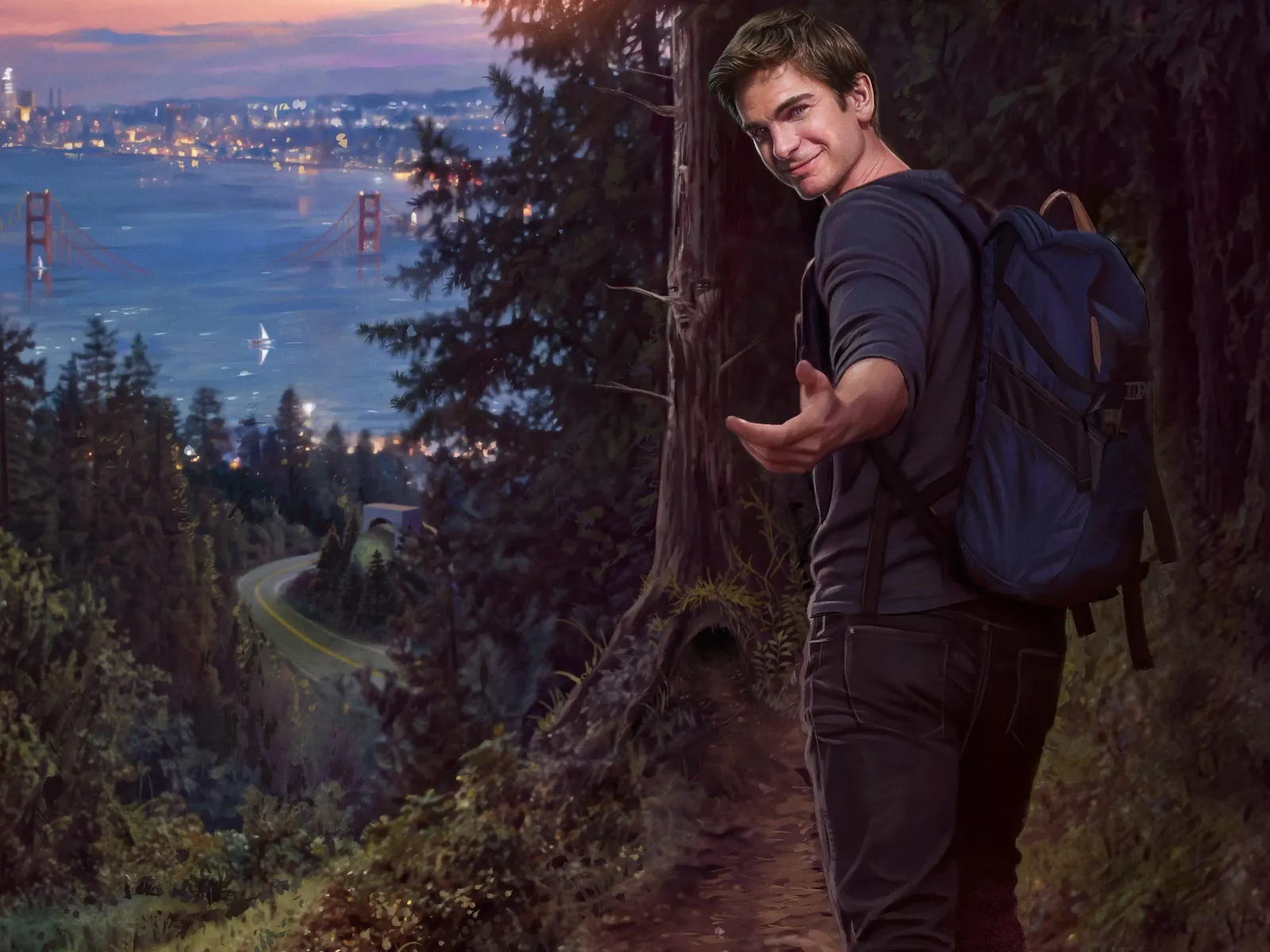
Neon released a poster for Luca Guadagnino's OpenAI film 'Artificial' that mimics AI-generated mistakes but was hand-drawn by artist Mike Thompson and agency Gravillis Inc. The stunt makes human craft the selling point and turns Sam Altman's public reaction into a live test of how AI leaders handle cultural scrutiny.
The poster for 'Artificial' looks like AI slop, and that is the point. Neon, the film's distributor, released artwork for Luca Guadagnino's movie about OpenAI that appears to carry the telltale failures of an image generator: a sinking Golden Gate Bridge, an upside-down plane, a Pinocchio-like face peering from a tree trunk, branches that turn into snakes and a backpack logo that reads like garbled AI text. Then comes the twist. The poster was hand-drawn. Neon credited artist Mike Thompson and creative agency Gravillis Inc., and a small note on the image reads 'Artwork made by Humans.'
At first glance, Andrew Garfield, who plays OpenAI CEO Sam Altman, stands on a wooded path overlooking San Francisco Bay, looking like a standard prestige-film poster. Look longer and the uncanny details pile up, including Garfield's face itself feeling a little unfamiliar. That is the gag: every mistake a viewer might blame on a machine was put there by a person. The distributor also shared a video showing the artwork's creation, using dialogue from the film as the image takes shape. In it, Garfield's Altman says, 'We get to be the ones to shepherd people into this new world.' He closes with: 'I'm so excited to see it.'
The poster is doing more than showing off a clever illustration. 'Artificial' follows the rise of OpenAI and the struggle over who controls increasingly powerful AI technology, with Yura Borisov and Monica Barbaro in supporting roles. It also revisits the 2023 leadership crisis at OpenAI, when the company's board fired Altman as CEO and reinstated him days later after a backlash from employees and investors. That is a story about governance, power and trust, and the marketing is already priming audiences to read the film that way: the machine's supposed errors are actually human choices.
The stunt lands because AI-generated imagery is now familiar enough that audiences have learned its visual tics. Warped text, impossible architecture, objects that melt into each other: these are the kinds of details people now scan for when they suspect a machine made an image. Neon takes that instinct and reverses it. The poster invites viewers to play spot-the-error, then reveals that the errors are evidence of a human hand. For a movie about OpenAI, that is a neat piece of positioning. The company at the center of the AI story is also at the center of a public argument about what is real, what is synthetic and who gets to decide.
The day before the poster was released, Altman was asked about the film at a New York Times DealBook summit. He said a movie about him would have seemed strange 20 years ago. Now, he said, it does not rank among 'the top 10 weirdest things about my life.' He pointed instead to the responsibility of developing AI amid concerns about its effects. That response is worth parsing. The CEO of the company at the center of the film is not treating the project as a threat or a vanity project. He is treating it as one more strange item in a job that already includes hard arguments about the technology he is building.
Neon's decision to credit the artist and agency by name is part of the message. In an era when studios are experimenting with AI tools and audiences are increasingly alert to synthetic images, 'Artwork made by Humans' functions as a quiet flex. The poster invites the viewer to play spot-the-error, then flips the punchline: the error is the evidence of a human hand. It also gives the film a conversation starter before a single review lands. 'Artificial' is scheduled for select theaters on Christmas Day and everywhere January 8.
For executives beyond Hollywood, the lesson is not that AI imagery is bad or that hand-drawn posters sell tickets. It is that audiences and customers are developing a sharp eye for authenticity, and they will reward brands that can show their work. The same instinct applies to AI products, disclosures and governance. If a company cannot explain where the machine ends and the human decision begins, it risks the same uncanny feeling the poster deliberately creates. The OpenAI story in 'Artificial' is a reminder that control of AI is not only a technical question. It is a narrative contest, and the people who can tell the most credible story about human judgment will have an advantage.
Boards should expect more of this. As AI becomes a cultural subject, not just an enterprise tool, the reputations of CEOs and directors will be shaped by films, posters and viral jokes as well as quarterly calls. The 'Artificial' poster works because it does not deny AI's visual mistakes. It reframes them. That is a useful template for leaders facing scrutiny: do not pretend the weirdness is not there. Name it, show the human choices behind it and make the audience part of the joke. The film opens Christmas Day in select theaters and January 8 everywhere. The conversation starts now.
This story's Key Insights and Take-aways are locked.
Create a free account to unlock Executive Actions for one credit.
Register to UnlockAlways free for Executives Club members. Join the Club
More in Technology

Anthropic mathematician claims Claude helped crack the Riemann hypothesis
If the proof holds, AI has toppled math's most famous open problem; if it does not, it is a case study in announcing breakthroughs before anyone verifies them.

AI's $4 Trillion Wipeout Erases Nasdaq's Gains for the Year
A brutal week took roughly $4 trillion off the AI sector and left the Nasdaq flat for the year, and the damage ran the full length of the supply chain.

Anthropic mathematician says AI proved the Riemann hypothesis. Verification will take time.
A single unverified claim from inside Anthropic now sits against more than 160 years of open mathematics, and the gap between asserting a proof and surviving peer review is the entire story.