
Pentagon's Colby tells NATO Ukraine's deep strikes are failing. Germany pushes back.
A senior U.S. defense official used a high-level NATO session to argue Kyiv's long-range campaign is not working, and Berlin pushed back in the room.
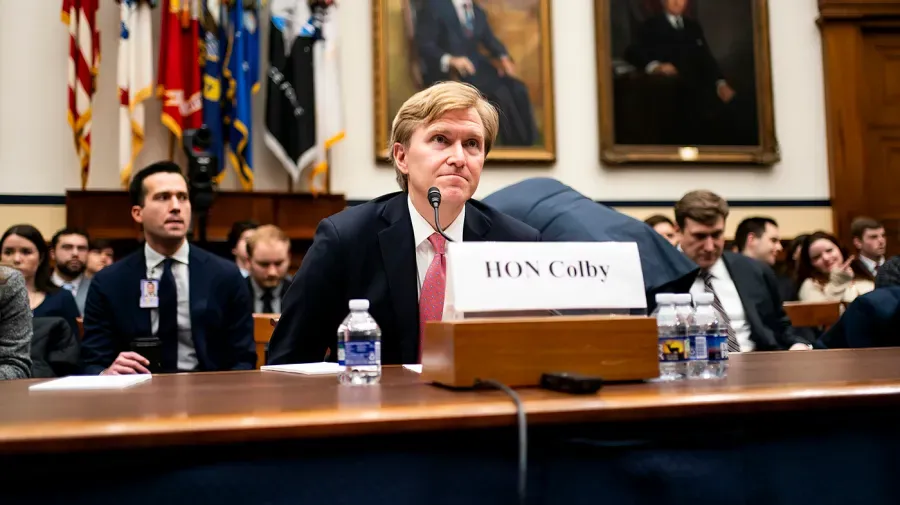
Elbridge Colby, the U.S. under secretary of defense, told allies at NATO headquarters on Tuesday that Ukraine's long-range strikes inside Russia "have not been effective" and do not blunt Russian advances on the front line, drawing a rebuke from Germany. The public split inside the alliance signals that U.S. backing for one of Kyiv's most visible and costly campaigns is now openly contested, with direct consequences for defense procurement, European budget planning, and energy supply expectations.
Elbridge Colby, the U.S. under secretary of defense, walked into NATO headquarters on Tuesday and told a room of allies that Ukraine's long-range strikes inside Russia are not working. The strikes "have not been effective," he said, "nor do they contribute to blunting Russia's advances on the front line." The pushback was immediate, and it came from Germany.
That is the story: a sitting senior Pentagon official, at the alliance's own headquarters, publicly questioning the value of one of Kyiv's most visible and most expensive military campaigns, and a major European ally rebuking him for saying it in the room. This was not a think-tank essay or an anonymous briefing. It was the U.S. delegation using a high-level NATO session to argue that a core element of Ukraine's strategy is buying little, and Germany refusing to let the framing stand unchallenged.
Colby is not a peripheral voice. As under secretary of defense for policy, he sits at the point where political direction becomes military posture, the office that shapes force planning, alliance burden-sharing, and which theaters get priority. He has long been associated with the argument that Washington's finite attention and finite stockpiles should tilt toward the Indo-Pacific, and that Europe should carry more of the load on its own continent. Read in that light, Tuesday's intervention is less a stray comment than a signal about how one influential part of the Pentagon is thinking about the war's trajectory, and about who should be paying for it.
The substance of the dispute is real, and it is not new. Ukraine's long-range campaign, typically flown with domestically produced drones and a limited supply of Western-supplied missiles, has targeted oil refineries, airfields, logistics nodes, and command infrastructure deep inside Russia. The logic is straightforward: raise the economic and operational cost of the war for Moscow, degrade the fuel and repair capacity that keeps Russian units supplied, and force Russian air defenses to cover a much larger map. The counterargument, which Colby made explicitly, is that none of that changes the front line, where Russian forces continue to press. Both claims can be true at once, which is exactly why the argument is so hard to settle and so politically charged.
What makes Tuesday unusual is the venue and the volume. NATO allies disagree constantly, but they usually do it in private, and they usually do it without a senior American official publicly grading a partner's military campaign while that partner is fighting. A German rebuke in that setting matters because Germany has steadily expanded its military support for Kyiv and has become one of the loudest European voices on the need to keep supplying Ukraine. When Berlin pushes back on Washington's characterization of Ukrainian operations, it is not only defending Kyiv. It is defending a European position that the continent's security is decided on the continent, and that the United States does not get to define what counts as effective.
The second-order effects run well beyond the conference room. For defense contractors and the drone makers that have scaled up around this war, the question of whether deep strikes are "effective" is a procurement question. If Washington signals that long-range systems are a lower priority, the funding and export approvals that follow could shift toward air defense, artillery, and training instead. For energy markets, Ukrainian strikes on Russian refining capacity have been one of the few variables that periodically tighten global fuel balances, and any signal that the campaign could be curtailed is a signal about future supply. For European governments already wrestling with budget math, a U.S. official questioning the value of the fight is an argument they will have to answer at home, where voters are tired and treasuries are stretched.
Watch three things from here. First, whether Colby's framing hardens into policy, for example through tighter guidance on how and where American-supplied weapons may be used. Second, whether European allies respond by filling gaps themselves, which would accelerate the shift toward a more European-led supply effort. Third, whether Ukraine adjusts its targeting in response, or doubles down to prove the critics wrong. Any of those moves would surface quickly, and each carries its own procurement and market consequences.
For executives and boards, the takeaway is that alliance cohesion is now a variable, not a constant. Companies with exposure to European energy, defense procurement, drone and counter-drone supply chains, or logistics tied to the region should treat a public U.S.-Germany split at NATO as an early indicator rather than a one-off. The policy that follows an argument like this one rarely arrives with an announcement. It arrives in guidance, in budget lines, and in the quiet reordering of what gets bought and what gets defended.
This story's Key Insights and Take-aways are locked.
Create a free account to unlock Executive Actions for one credit.
Register to UnlockAlways free for Executives Club members. Join the Club
More in Politics

Fifth Circuit Kills Pregnant Workers' Law Over Pandemic Proxy Votes
A procedural ruling, not a policy one, has blocked a federal pregnancy-accommodation law and put every pandemic-era statute in the crosshairs ahead of an expected Supreme Court appeal.

Measles kills a Virginia child under 5, the state's first death of 2026
Virginia's health department confirmed the death but withheld the child's vaccination status, leaving schools, clinics and employers to plan around the one detail that would explain the most.

Former Brazilian President Bolsonaro Hospitalized with Intestinal Obstruction
The health status of the former far-right leader raises immediate questions about political stability and the trajectory of Brazil's conservative movement.