
Senate clears permitting reform, a massive step toward faster US energy builds
Thursday's Senate passage moves legislation aimed at speeding up energy production and infrastructure a massive step closer to law, leaving the House, the signature, and implementation as the real risk.
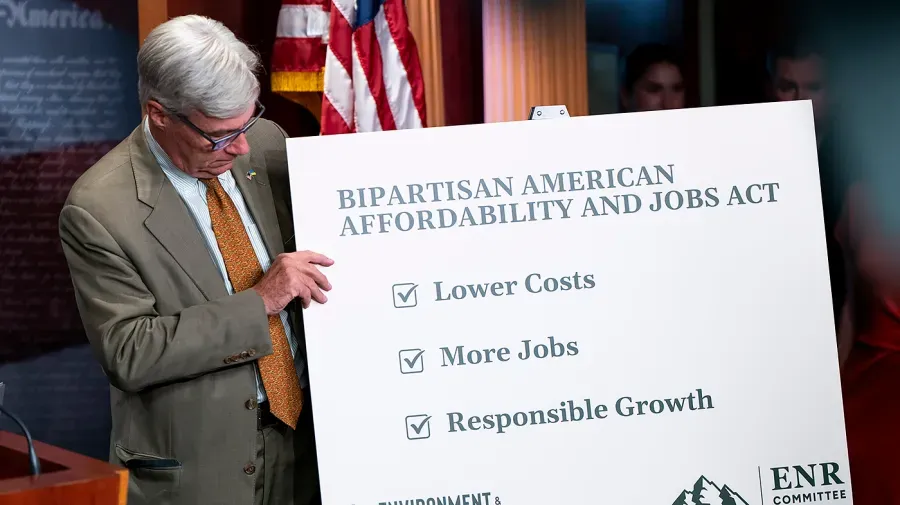
The Senate passed a major permitting reform bill Thursday, a vote that takes legislation designed to speed up the build-out of the nation's energy production and infrastructure a massive step toward becoming law. For developers, utilities, data center operators, and the investors funding them, the value now sits in the remaining path to enactment, because the timing of that path decides which projects get financed first.
The Senate passed a major permitting reform bill Thursday, a vote that takes the legislation a massive step toward becoming law. The bill's purpose is narrow and enormous at the same time: speed up the build-out of the nation's energy production and infrastructure. That is the entire fight in one line. Washington has spent years arguing about what kind of energy America should build. This bill goes after a less glamorous question that decides just as much, which is how long it takes to get permission to build anything at all. The Senate's answer, as of Thursday, is: not this long.
Treat "massive step" as literal, not rhetorical. A bill that clears the Senate has survived the chamber where ambitious energy packages have historically gone to die, tangled in procedural thresholds and regional grudges. It is still not law. What remains is the rest of the path to enactment, which typically runs through the House and then to the president's desk, with every stop capable of slowing, reshaping, or killing the text. Those next steps are not detailed in the passage itself, and that gap is exactly where the risk sits. Passage is momentum. Enactment is the event.
Start with what a permit actually is, because the word hides the stakes. Before a transmission line, pipeline, solar farm, wind project, or gas plant gets built on or across federal jurisdiction, it typically has to clear a stack of reviews: environmental analysis, land approvals, siting decisions, and the consultations that come with them. Each layer carries its own clock, its own appeal rights, and its own litigation exposure. Historically, that stack has stretched timelines for major interstate projects into years, sometimes a decade or more, and the threat of a courtroom challenge can outlast the administration that approved the project. Permitting reform is shorthand for compressing that stack without deleting the protections inside it.
Timing is why this lands now. For roughly two decades, US electricity demand was flat, and a slow approval process was annoying rather than expensive. That era is over. Data centers built for AI training and inference, electrification of transport and heating, and a push to reshore manufacturing have all pointed the same direction: more power, sooner, in places the existing grid was not designed to serve. Interconnection queues for new generation have historically run long, and transmission build-out has lagged the demand curve. A bill that shortens approvals does not create electrons, but it changes the schedule on which every project, contract, and financing model depends.
Permitting reform has historically been one of the few energy topics with a genuinely cross-cutting coalition. Developers want certainty. Utilities want to plan capital spending on a predictable clock. Labor wants construction jobs. Some environmental advocates have backed faster approvals for clean generation and transmission, while other groups have opposed anything that could accelerate fossil infrastructure. That tension is why the issue has produced more speeches than statutes for years. A Senate passage does not resolve the tension; it moves the argument to the next room, where the same coalition math applies with different players and a different calendar.
Watch three things from here. First, the House: whether the text moves intact or gets amended, because amendments are where narrow deals get widened or unwound. Second, the president's signature, which converts a vote into an operative statute with deadlines and agency obligations. Third, implementation, because a law that shortens a statutory clock still depends on agencies staffing the reviews and on courts interpreting the new language. Each stage is a separate risk, and each one is priced differently by the market. The Senate vote repriced the first. The other two are still open.
The second-order effects are where operators should focus. Projects that already hold permits gain relative scarcity value if new approvals accelerate but do not instantly flood the market. Developers sitting on stalled applications gain an option they did not have last week. Data center operators negotiating power purchase agreements gain a reason to revisit delivery dates. Investors underwriting long-dated infrastructure gain a shorter assumed timeline, which changes returns without changing a single megawatt. Conversely, anyone who assumed the status quo would persist now carries a new variable in their model. Regulatory timelines are an input, and this bill just moved the input.
None of this is finished. A Senate vote is a signal, not a statute, and the gap between the two is where most energy policy has historically died. But signals move capital before statutes do, and Thursday's vote is the strongest signal permitting reform has produced in this cycle. For executives, the practical question is not whether to celebrate. It is whether your project pipeline, your offtake terms, and your capital plan are built for a world where approval takes years less than it used to. If they are not, the clock just started.
This story's Key Insights and Take-aways are locked.
Create a free account to unlock Executive Actions for one credit.
Register to UnlockAlways free for Executives Club members. Join the Club
More in Politics

Fifth Circuit Kills Pregnant Workers' Law Over Pandemic Proxy Votes
A procedural ruling, not a policy one, has blocked a federal pregnancy-accommodation law and put every pandemic-era statute in the crosshairs ahead of an expected Supreme Court appeal.

Measles kills a Virginia child under 5, the state's first death of 2026
Virginia's health department confirmed the death but withheld the child's vaccination status, leaving schools, clinics and employers to plan around the one detail that would explain the most.

Former Brazilian President Bolsonaro Hospitalized with Intestinal Obstruction
The health status of the former far-right leader raises immediate questions about political stability and the trajectory of Brazil's conservative movement.