
Senate Passes Bill Loosening Environmental Law as 14 Democrats Defect
A bipartisan quartet led by Whitehouse, Heinrich, Capito and Lee won the vote, and the 14 Democratic defections are the part that changes the energy math.
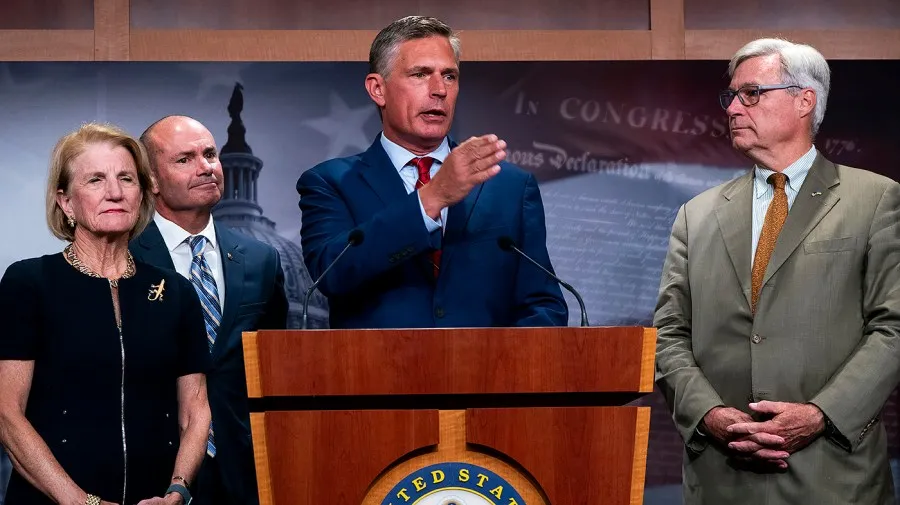
The Senate voted late Thursday night to pass a bipartisan bill, spearheaded by Sens. Sheldon Whitehouse (D-R.I.), Martin Heinrich (D-N.M.), Shelley Moore Capito (R-W.Va.) and Mike Lee (R-Utah), that loosens environmental laws to speed the nation's energy and infrastructure build-out. Fourteen Democrats crossed over to support it even as most of their caucus opposed it, a split that matters to every developer, utility and investor whose project timeline runs through federal environmental review.
Fourteen Senate Democrats voted to loosen the nation's environmental laws. That is the number to sit with. Late Thursday night, the Senate passed a bill that seeks to speed up the country's energy and infrastructure build-out, and it does so in part by easing the environmental rules that have historically been the most reliable lever for slowing projects down. Most Democrats opposed the measure. Fourteen did not.
The push was bipartisan, and explicitly so. It was spearheaded by four senators: Sheldon Whitehouse of Rhode Island and Martin Heinrich of New Mexico on the Democratic side, Shelley Moore Capito of West Virginia and Mike Lee of Utah on the Republican side. That roster is the tell. A bill that pairs a Rhode Island Democrat with a West Virginia Republican is not a messaging exercise. It is a trade, and the currency is speed.
Why the defections matter more than the vote count. The headline number is 14, but the more consequential fact is the direction of travel inside the Democratic caucus. When most of a party votes against loosening environmental law and 14 of its own members vote for it anyway, that party is not unified on the question now sitting at the center of American energy policy: is the environmental review process a shield worth keeping, or a bottleneck worth cutting? Both answers have constituencies, and both are now on the record.
For context on why this is a big deal. Federal environmental review has historically functioned as two things at once: a protection for communities and a schedule risk for builders. Projects typically must clear environmental analysis before construction begins, and that analysis can be challenged in court, which means timelines can stretch from months into years. Developers, utilities and the lenders behind them price that uncertainty into every project before a shovel moves. Both parties have complained about the process, for opposite reasons. One side argues it is the only real check on unchecked development. The other argues it is why the country cannot build transmission lines, power plants or pipelines fast enough to keep up with demand.
Note the scope of the bill. It targets energy and infrastructure build-out broadly, not one fuel or one technology. That breadth is exactly why the coalition held together, and it is why the consequences reach further than any single industry. Anything that needs a federal permit and a construction schedule sits inside this story: generation, transmission, data centers, manufacturing plants, ports, pipelines.
The stakes for anyone allocating capital. The binding constraint on American energy and infrastructure has been time, not ambition. Capital is available. Demand is not the problem. The problem is that a project can be fully financed and still sit for years waiting on review and defending against litigation. If this law compresses that timeline, the cost of delay falls, and projects that were marginal on paper become financeable in practice. If litigation risk survives intact, the law's real-world effect will be smaller than its headline. That gap between statute and outcome is where the next two years of this story live.
The political math is now personal. The four sponsors own the result. If build-out accelerates, they get the credit. If agencies slow-walk implementation or environmental groups tie projects up in court, they own that too. And the 14 Democrats who crossed over now carry a vote that primary challengers can cite and donors can question. That is the price of being the deciding vote on a bill your own caucus mostly opposed.
What to watch next. Implementation runs through federal agencies, the courts and state governments, and each is a place where speed can be added or subtracted. For executives, the practical move is to re-underwrite project pipelines against a faster-review scenario and a no-change scenario, and to know which of your projects flip from unbuildable to buildable under each. The Senate has voted to change the math. Whether the math actually changes is now someone else's decision.
This story's Key Insights and Take-aways are locked.
Create a free account to unlock Executive Actions for one credit.
Register to UnlockAlways free for Executives Club members. Join the Club
More in Politics

Fifth Circuit Kills Pregnant Workers' Law Over Pandemic Proxy Votes
A procedural ruling, not a policy one, has blocked a federal pregnancy-accommodation law and put every pandemic-era statute in the crosshairs ahead of an expected Supreme Court appeal.

Measles kills a Virginia child under 5, the state's first death of 2026
Virginia's health department confirmed the death but withheld the child's vaccination status, leaving schools, clinics and employers to plan around the one detail that would explain the most.

Former Brazilian President Bolsonaro Hospitalized with Intestinal Obstruction
The health status of the former far-right leader raises immediate questions about political stability and the trajectory of Brazil's conservative movement.