
Signal blocks screenshots again, and this time AI agents are the reason
The encrypted messaging app is re-arming a defense it first built against Microsoft Recall, and the precedent now lands on every company deploying screen-reading AI agents.
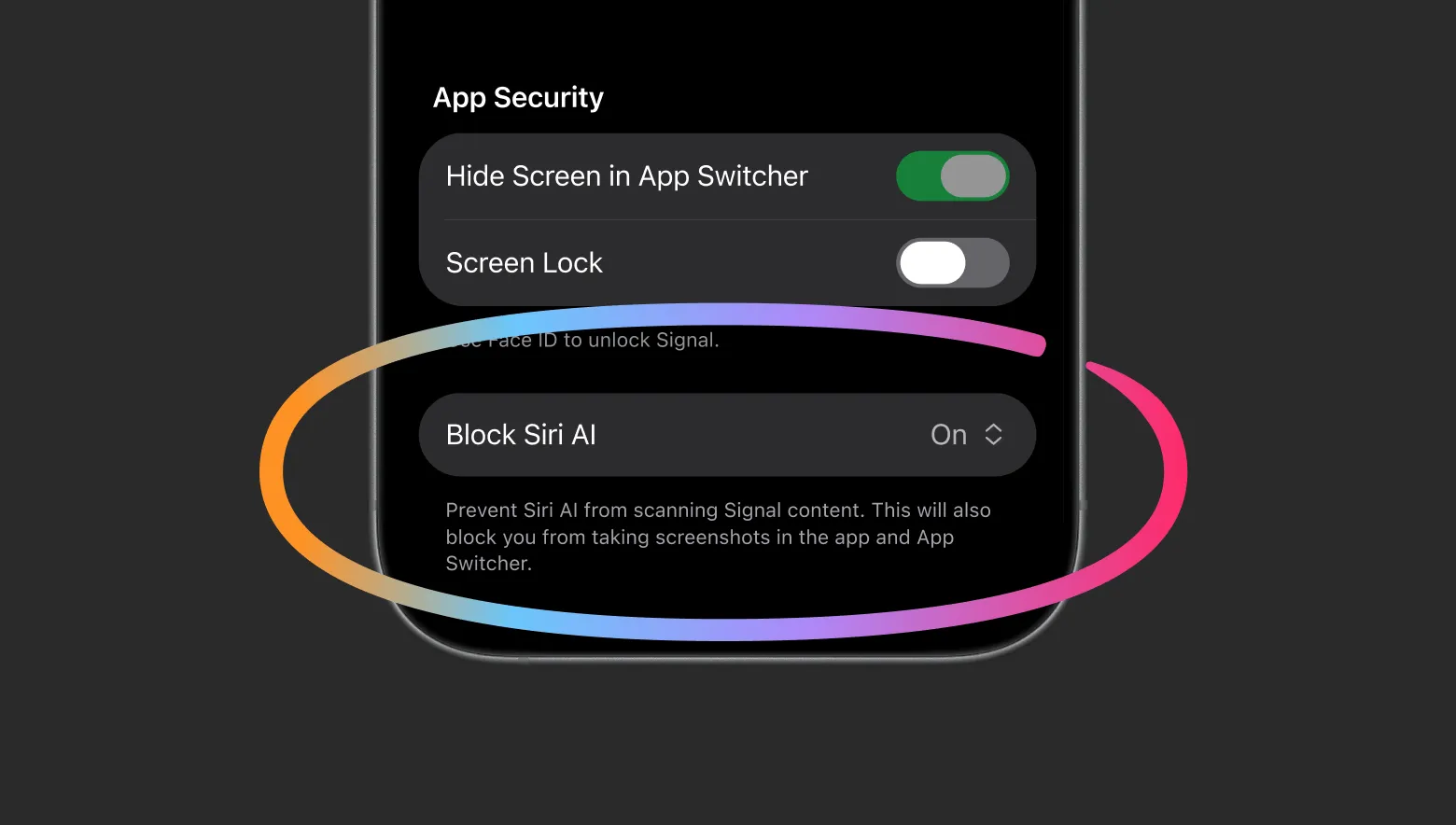
Signal is moving to restrict screenshots again, this time citing concerns about AI agents, after limiting them last year over Microsoft Recall. The decision signals that screen access is becoming a governed permission for enterprises deploying agents, not a background detail.
Signal is restricting screenshots again, and this time the stated reason is AI agents. ZDNet reports the encrypted messaging app is moving to limit screenshot capability over concerns about AI agents, a defensive step it has taken before.
The repeat is the story. Last year, per the same report, Signal limited screenshots because of Microsoft Recall, the Windows feature that captures snapshots of on-screen activity so users can search their own history. The threat model has now widened from one operating system feature to an entire class of software: AI agents that can see what is on a screen and act on it.
Start with why screenshots are the soft spot in any encrypted product. Signal's core promise is end-to-end encryption, which means messages are scrambled in transit and on the server, and only the sender and recipient hold the keys. That protects the pipe. It does not protect the pane of glass. Once a message is rendered on a device, anything that can read the screen can copy it, and screenshot blocking has historically been a request to the operating system rather than an absolute guarantee. A camera pointed at a phone, a second device, or a modified OS can all defeat it. Signal's move is best read as raising the cost of automated, casual capture, not as sealing the leak.
What changed is who is doing the capturing. The AI agents now shipping across the industry are typically built to observe a screen and take actions on it, which is exactly the capability a messaging app cannot ignore. A human taking one screenshot is a discrete act. An agent with screen access can archive a conversation at machine speed, continuously, without anyone deciding to press anything. That is a different risk profile, and it is the one Signal appears to be responding to.
There is precedent for the playbook, and it is not confined to messaging. Microsoft Recall drew heavy scrutiny from privacy advocates and security researchers when it was announced, and Microsoft reworked how the feature shipped; Signal's earlier screenshot restriction landed in that window. For context, screenshot restrictions themselves are old news: banking apps, health portals, and enterprise chat tools have long blocked screen capture on mobile, usually through a flag the app asks the operating system to honor. What is new is the justification. The pressure is no longer only human snooping or a lost phone. It is automated ingestion, where the value of a screen is that a model can read it at scale.
That shift has a regulatory edge. Data protection regimes such as Europe's GDPR generally put the burden on whoever controls personal data to protect it, and a screenshot pipeline that feeds an AI system is a processing activity like any other. The EU AI Act layers transparency obligations on top for certain systems. No regulator has issued a Signal-specific ruling, and none is needed for the direction of travel to be clear: the screen is becoming a compliance surface, not just a user interface.
The second-order effects land hardest on enterprises. Companies rolling out AI agents are handing them permissions that most security teams have never inventoried, and screen access sits at the top of that list. An agent that can read a screen can read a chat thread, a spreadsheet, a customer record, or a private message, and the retention question, where that content goes and how long it lives, is usually answered by a vendor's default settings rather than by a policy someone signed.
So the strategic read for anyone running a company is not really about Signal. It is that the boundary between what a user sees and what a machine can capture has quietly dissolved, and the products that treat the screen as a data boundary are moving first. Signal has now done it twice, once for an operating system feature and once for a class of agents, which tells you it expects the second wave to be bigger than the first. The practical question for a board is unglamorous and urgent: which agents in your stack can read a screen, what do they keep, where does it go, and can you prove any of it? If assembling that answer takes more than a day, you have a gap. Signal's decision is small, reversible, and probably unpopular with some users. It is also a preview of the argument every software company is about to have with its own customers.
This story's Key Insights and Take-aways are locked.
Create a free account to unlock Executive Actions for one credit.
Register to UnlockAlways free for Executives Club members. Join the Club
More in Technology

Anthropic mathematician claims Claude helped crack the Riemann hypothesis
If the proof holds, AI has toppled math's most famous open problem; if it does not, it is a case study in announcing breakthroughs before anyone verifies them.

AI's $4 Trillion Wipeout Erases Nasdaq's Gains for the Year
A brutal week took roughly $4 trillion off the AI sector and left the Nasdaq flat for the year, and the damage ran the full length of the supply chain.

Anthropic mathematician says AI proved the Riemann hypothesis. Verification will take time.
A single unverified claim from inside Anthropic now sits against more than 160 years of open mathematics, and the gap between asserting a proof and surviving peer review is the entire story.