

Sila Inks $1B Panasonic Deal, Backed by a $1.4B Trump Defense Loan
Sila's first mass-market contract scales production at least tenfold and shows why US battery startups now sell sovereignty to Washington, not decarbonization to investors.
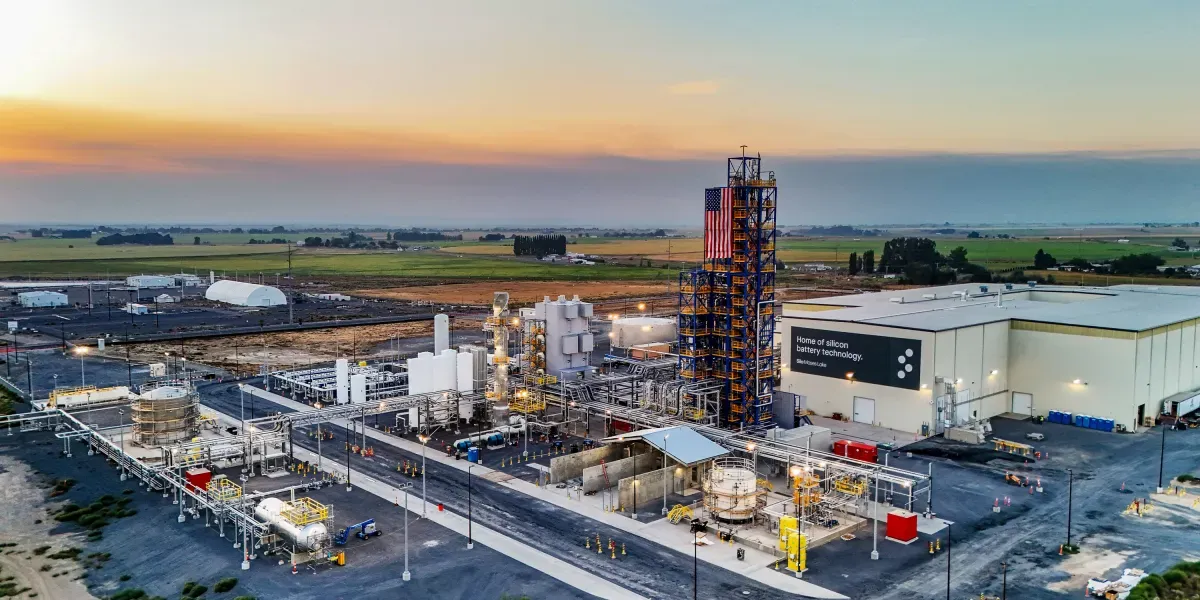
Sila, the silicon-anode maker led by cofounder and CEO Gene Berdichevsky, signed a supply agreement with Panasonic Energy that it says could be worth more than $1 billion over time, scaling output at its Moses Lake, Washington factory to at least 10 times current levels. The deal, underwritten in part by a $1.4 billion Defense Department loan, signals that US battery startups now raise capital by selling technology sovereignty and AI power rather than the energy transition.
Sila has a deal that its chief executive says changes the scale of the company. The maker of silicon-based anodes for lithium-ion batteries, founded in 2011, signed an agreement with Panasonic Energy, a global battery manufacturer, to supply silicon-carbon anode material, and Sila says the contract could be worth more than $1 billion over time. It is Sila's first mass-market deal, and it arrives with an unusual co-signer: a $1.4 billion loan from the Trump administration's Defense Department, aimed at helping the US confront what a press release called a "significant technology sovereignty challenge." A major part of the financial backing for the factory's production comes from that loan.
The payoff is in the physics. Sila makes silicon-based anodes for lithium-ion batteries, and the company says its anode weighs a fifth as much as the graphite used in anodes today while cutting volume in half. That matters because anode material is dead weight and dead space inside a cell: pack in something lighter and denser, and the same battery holds more energy, which translates into longer range for EVs, more power, and faster recharging than conventional chemistry allows. Gene Berdichevsky, Sila's cofounder and CEO, says the Panasonic agreement will help the company scale to at least 10 times more production than current levels. Panasonic has committed to buying tens of thousands of tons of material, Berdichevsky says, though Sila is not sharing specific numbers on the total commitment or on the price Panasonic is paying.
The contract sits on top of a plant that is already running. Sila opened its factory in Moses Lake, Washington in September 2025, and it is operating today. The facility's lineage traces to 2022, when Sila announced plans for it and received $100 million from the US Department of Energy, part of a multibillion-dollar round of grants under the Biden administration designed to support the US battery supply chain. The company's material has been in the wild for years: MIT Technology Review's James Temple covered Sila when its battery first appeared in Whoop fitness wearables in 2021. Things have gotten a lot bigger since then, and a Panasonic-scale customer is the difference between a demonstration and a business.
Scale matters here because the sector has been brutal. Two billion-dollar battery companies, 24M and ESS Tech, have declared bankruptcy and shut down in just the last year. For a US next-generation battery market that has largely been on the ropes over the past few years, a billion-dollar supply agreement with a manufacturer of Panasonic's size is the first genuinely positive signal in a while. It also resets the benchmark: if Sila can convert a chemistry advantage into a mass-market purchase commitment, the question for every other advanced battery startup is why they cannot.
The more interesting story may be how the deal is being sold. Batteries used to be filed firmly under climate technology. Not anymore. China dominates the battery world and particularly the battery anode market, controlling over 90% of graphite production today. For years the US has tried to curb reliance on Chinese batteries, battery materials, and other critical inputs such as rare earth metals. The Trump administration has ramped that effort up, and the $1.4 billion Defense Department loan to Sila is aimed squarely at the sovereignty problem rather than at emissions.
Read Sila's announcement and notice what is missing. It mentions EVs, but not climate, emissions, or the energy transition. It is all about American industrialization, plus a nod that a North American battery supply chain can also help power the AI market. That is a deliberate translation: same factory, same chemistry, a different buyer for the story. Climate was the pitch to the Biden-era Energy Department. Sovereignty, and AI's appetite for power, is the pitch now.
Berdichevsky was asked directly whether the company still holds decarbonization as a priority. "I think the politics of it has shifted around us much more than our motivations have shifted," he said. "It's really the energy efficiency that motivates engineers like myself and technologists at our company. And I still think that that's still at the heart of it." That is a useful frame for anyone selling capital-intensive hardware into Washington right now: the engineering did not change, the language did, and the funding followed the language.
For executives, the strategic read is that US battery startups no longer get to choose between climate capital and defense capital. They increasingly need both, and the second one is now the louder one. A CEO with a US manufacturing plan should expect to argue sovereignty and supply chain resilience first and energy efficiency second. A CFO should note that a single anchor customer like Panasonic can de-risk a plant that government grants built, which is a healthier capital structure than grant dependence. And boards should keep an eye on the graphite number: over 90% Chinese control of anode graphite is the vulnerability that turns a chemistry breakthrough into a national security line item. Sila just showed that framing can be worth $1 billion.
This story's Key Insights and Take-aways are locked.
Create a free account to unlock Executive Actions for one credit.
Register to UnlockAlways free for Executives Club members. Join the Club
More in Business

S&P 500 Enters Correction, Down 10% From Its High on AI Worries
The index's slide past the 10 percent line is a symbolic verdict on investor mood, and the AI trade that powered the rally is now the thing testing it.

Dow and S&P 500 enter correction as Nasdaq logs worst week since 2020
All 11 S&P 500 sectors fell more than 1% in the same week for the first time since April 2025, a breadth signal that matters more than any single index level.

Chip stocks lose $2.3 trillion in a week, worst run in 25 years
A $2.3 trillion weekly wipeout in semiconductors is forcing every board with an AI story to ask whether it owns a thesis or just a crowded trade.