
Some Taiwan Food Vendors Are Distancing From Jensen Huang. Others Refuse.
The split among vendors who once traded on proximity to Nvidia's former CEO is a real-time read on how fast a founder's halo can flip into a liability.
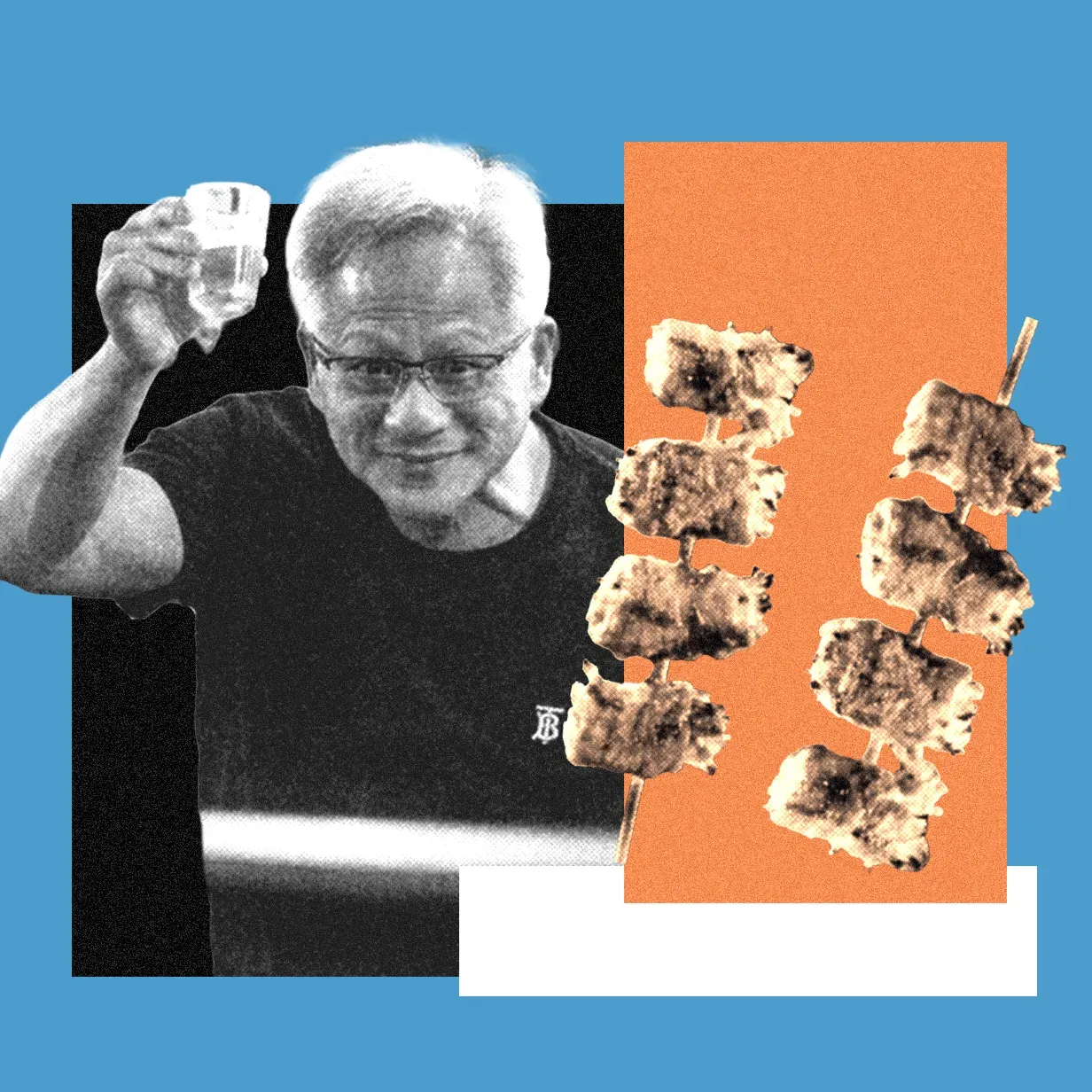
In Taiwan, some food vendors are distancing themselves from Nvidia's former CEO Jensen Huang while others publicly stand by him, according to WIRED, with one shop owner saying, "It's not as if he killed someone or set something on fire." The split is a real-time sentiment index on a founder's personal brand, and a reminder to boards that reputation concentrated in one person carries volatility no disclosure regime captures.
In Taiwan, some food vendors are distancing themselves from Jensen Huang. Others are standing by him. That is the finding in WIRED's report on the blast radius around Nvidia's former CEO, and the split is the story. One shop owner, declining to join the retreat, offered the line that frames the whole thing: "It's not as if he killed someone or set something on fire."
Read that quote twice, because it tells you where the bar now sits. A man who has been one of the most recognizable faces of the AI boom is being defended on the grounds that he has not committed a violent crime. That is a low bar, and a revealing one. The report does not lay out the full chain of events that pushed some vendors to pull back. What it does show is the behavior itself: businesses that once had every incentive to be seen with him are now choosing, at least some of them, not to be.
The backdrop explains why anyone would care what a food stall does. Nvidia's chips became the scarce input for the global AI buildout, and the company's valuation climbed on the back of that demand. Huang has historically been the public face of that rise. He is also, for context, a Taiwan-born executive who moved to the United States as a child and has stayed closely tied to the island; his visits have typically been covered as homecomings rather than business trips.
Taiwan is why this lands harder there than anywhere else. The island is the physical chokepoint of the semiconductor supply chain, home to the advanced manufacturing capacity the AI economy runs on, and its street food culture is a point of civic pride. Vendors operate on thin margins and enormous word of mouth. A single photograph with a famous customer can function as years of marketing. That is the halo economy, and historically it has been a one-way trade: association flows from the famous to the small, and the small business collects the upside.
The trouble is that a halo is not an owned asset. It is borrowed, and it can be recalled. A stall owner has no communications team, no crisis playbook, and no way to address one audience without addressing all of them. When the association becomes contested, the cheapest available move is silence, which from the outside looks exactly like distancing. The vendors standing by Huang are making a different wager: that the current turbulence fades, and that loyalty compounds in the meantime.
Corporations have a playbook for this, and it is not pretty either. When the cost of a celebrity association exceeds the benefit, brands typically cut the tie quietly, scrub the imagery, and let the contract lapse. Endorsement markets have repriced on far thinner evidence than a shift in a few vendors' signage. What is unusual here is that the repricing is happening at the smallest possible scale, decided by people who own one counter and one sign, with no legal department to run it past.
For executives, the instructive part is not the food. It is the speed and the resolution of the signal. Large companies manage reputational risk through layers of machinery: legal review, communications, investor relations, a board committee that meets quarterly. The vendors in Taiwan are running the same calculation with none of that, and they are running it in public, in days rather than quarters. Their behavior amounts to a real-time sentiment index on one person's brand, priced in foot traffic rather than basis points.
That raises a question most boards do not ask out loud: how much of the enterprise value is actually the founder's personal standing? Nvidia sells chips, not vibes, and its customers buy compute because they need compute. But the pattern generalizes. When an organization routes its storytelling through one human being, it inherits that human's volatility, and it inherits it without a hedge. The Taiwan vendors are showing what that looks like when the concentration is total and the hedging options are zero. The strategic read for anyone in a similar seat is unglamorous: personal brand is an asset with no lock-up period and no disclosure requirement, and it can be repriced by people who have never read a 10-K and never will. The report does not allege any wrongdoing by Huang. It documents a split, some stepping back and some refusing to. Reputational shocks are rarely unanimous. They get settled one counter at a time.
This story's Key Insights and Take-aways are locked.
Create a free account to unlock Executive Actions for one credit.
Register to UnlockAlways free for Executives Club members. Join the Club
More in Technology

Anthropic mathematician claims Claude helped crack the Riemann hypothesis
If the proof holds, AI has toppled math's most famous open problem; if it does not, it is a case study in announcing breakthroughs before anyone verifies them.

AI's $4 Trillion Wipeout Erases Nasdaq's Gains for the Year
A brutal week took roughly $4 trillion off the AI sector and left the Nasdaq flat for the year, and the damage ran the full length of the supply chain.

Anthropic mathematician says AI proved the Riemann hypothesis. Verification will take time.
A single unverified claim from inside Anthropic now sits against more than 160 years of open mathematics, and the gap between asserting a proof and surviving peer review is the entire story.