
Sotomayor Says Colleagues May Be Counting on Elections to Check the President
The liberal justice told a Philadelphia audience that the midterm results may have reassured the court's majority that its immunity ruling did not end presidential accountability, leaving voters as the backstop.
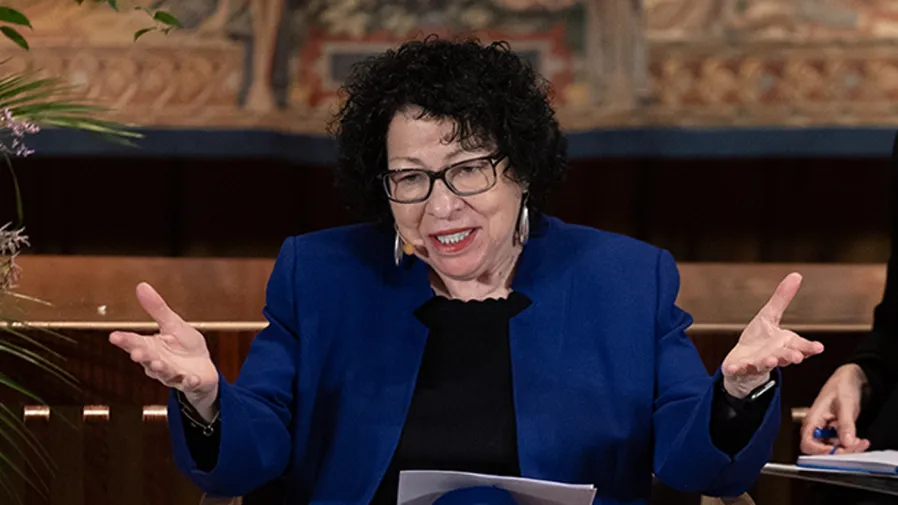
Supreme Court Justice Sonia Sotomayor said Friday in Philadelphia that her colleagues may be counting on elections as an institutional safeguard, replying 'absolutely' when asked whether the court views the midterm results that way. For executives, the signal is that regulatory and legal risk now tracks election outcomes more directly than judicial doctrine.
Supreme Court Justice Sonia Sotomayor said Friday that her colleagues may be counting on elections, not judges, to check the president. Asked in Philadelphia whether the court's justices were treating the ballot box as an institutional safeguard, the liberal justice answered with a single word: 'absolutely.'
The answer is the closest thing to a window into how the court's liberal wing reads the current political moment, and it carries an implicit concession. If the justices are relying on voters to restrain the presidency, then the judiciary has stepped back from a role it once claimed for itself. Sotomayor's remark also suggests she reads the midterm elections, in which Democrats won sweeping victories, as evidence that the political system still functions as a check even as the legal one tightens.
The concept is simple enough in plain English. An institutional safeguard is any mechanism that stops abuse of power without requiring a court to intervene: elections, impeachment, the bureaucracy, the press. When a justice talks about elections as the safeguard, she is describing a world in which voters, not nine lawyers in black robes, are the final backstop against a president who overreaches.
The backdrop is the court's recent immunity decision, which critics argue removed one of the last judicial brakes on presidential power. For context, that ruling, decided in July 2024 by a 6-3 margin along ideological lines, held that former presidents enjoy at least presumptive immunity from prosecution for official acts, while unofficial conduct gets no such protection. Chief Justice John Roberts wrote for the majority. Sotomayor dissented, and her warning about the consequences for accountability was blunt enough that she read it from the bench. The decision changed how prosecutors and lower courts must approach any case touching a president's conduct in office, which is why the phrase 'checks on the president' now carries a different weight in legal circles.
Sotomayor's framing also says something about how the minority sees its own leverage. With a 6-3 conservative majority, dissents are the liberal wing's primary tool, and the justices who lose the big constitutional fights increasingly describe their job as documenting the stakes for the public rather than shaping the outcome. Pointing to elections as the safeguard is, in effect, an acknowledgment that the courtroom is no longer where this fight gets settled.
That is a striking posture for an institution that has spent years absorbing criticism over ethics, transparency, and the reach of its own power. Public approval of the Supreme Court has hovered near historic lows in recent polling, and proposals to impose term limits or an enforceable ethics code have moved from the fringe into mainstream Democratic politics. Against that backdrop, a justice telling an audience that elections are the real check is both a statement of fact and a defensive move: it locates the remedy outside the building.
For companies and boards, the practical read-through is regulatory volatility. When the courts signal that they will defer to the political branches and let elections sort out the boundaries of executive power, the rules governing antitrust enforcement, tariffs, immigration, energy permitting, and financial regulation become more sensitive to election cycles. Legal strategy that assumes a stable judicial backstop gets more expensive to run. Compliance teams that plan on multi-year regulatory horizons should expect those horizons to shorten, and general counsels should expect more scenarios in which the winning argument depends on who won the last election.
The next test is whether the court's docket forces the issue. Cases involving executive authority, agency rulemaking, and the scope of presidential power will keep arriving, and each one gives the justices a chance to reinforce or retreat from the immunity framework. Sotomayor's comments suggest she expects the political process, not her colleagues, to do the heavy lifting. Whether that holds depends on whether voters keep showing up in the same numbers.
The strategic takeaway for executives is to stop treating legal risk and political risk as separate line items. If the Supreme Court's own liberal wing is publicly pointing to elections as the check on presidential power, then the regulatory environment is now a function of electoral outcomes in a way that most corporate planning models do not assume. Boards that map policy exposure to the election calendar, rather than to the slow grind of litigation, will be better positioned for the next two years. The court, in other words, may have just told the market where the real decision-making now sits.
This story's Key Insights and Take-aways are locked.
Create a free account to unlock Executive Actions for one credit.
Register to UnlockAlways free for Executives Club members. Join the Club
More in Politics

Fifth Circuit Kills Pregnant Workers' Law Over Pandemic Proxy Votes
A procedural ruling, not a policy one, has blocked a federal pregnancy-accommodation law and put every pandemic-era statute in the crosshairs ahead of an expected Supreme Court appeal.

Measles kills a Virginia child under 5, the state's first death of 2026
Virginia's health department confirmed the death but withheld the child's vaccination status, leaving schools, clinics and employers to plan around the one detail that would explain the most.

Former Brazilian President Bolsonaro Hospitalized with Intestinal Obstruction
The health status of the former far-right leader raises immediate questions about political stability and the trajectory of Brazil's conservative movement.