
SpaceX catches falling Starship booster with 'chopsticks' in historic first
The catch turns the most expensive piece of a rocket into reusable hardware, resetting the cost math for launch rivals and NASA's Moon plans.
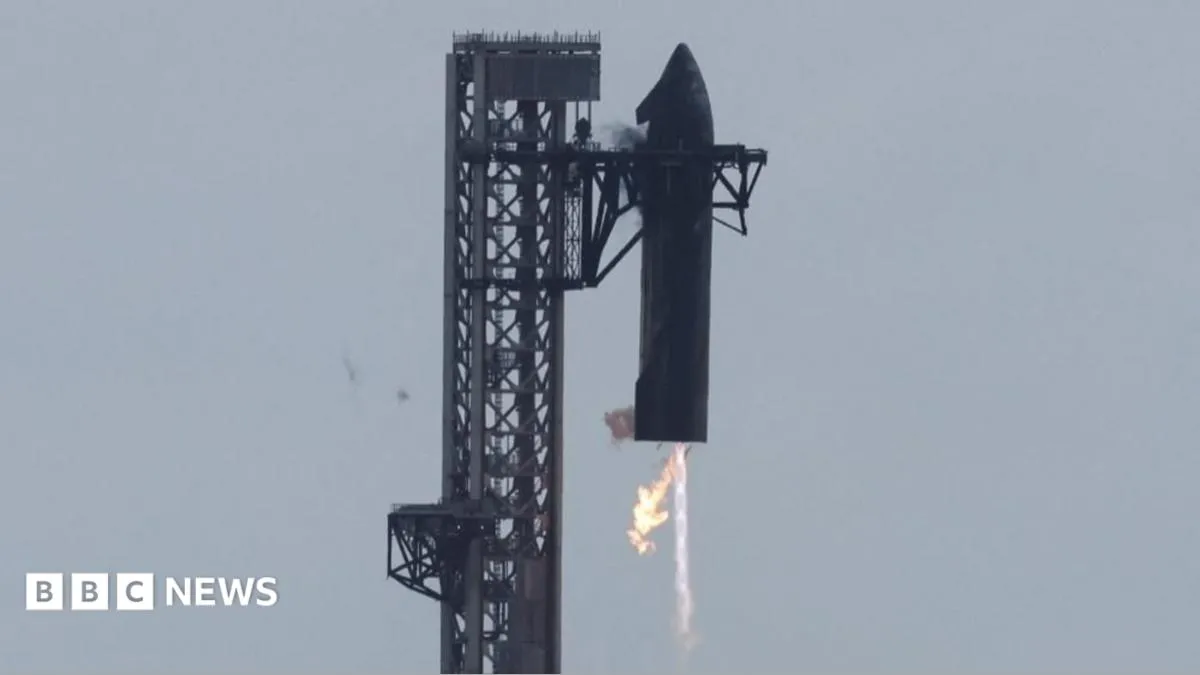
SpaceX, Elon Musk's rocket company, has performed a historic catch of a returning piece of its Starship rocket using mechanical arms nicknamed 'chopsticks.' The milestone pushes reusability onto a super-heavy vehicle, which matters for launch economics, NASA's Artemis plans, and every competitor trying to match SpaceX on cost.
SpaceX has caught a returning piece of its Starship rocket out of the air with mechanical arms nicknamed "chopsticks," a historic first that turns the most expensive hardware in rocketry into something you reuse rather than throw away. The arms, mounted on the launch tower, closed around the descending booster as it came back to Earth, plucking it out of the sky instead of letting it splash into the sea or settle onto landing legs. That single maneuver is the line between a disposable rocket and one that behaves, in principle, like an aircraft.
The reason it is a big deal is simple: the booster is the largest, heaviest and most costly single piece of the stack. Historically, every launch has meant writing off that hardware after one flight. SpaceX already proved with its Falcon 9 work that landing and re-flying a booster rewrites the economics of reaching orbit. The chopsticks catch pushes that same logic onto a far bigger vehicle. If the hardware survives the trip, the marginal cost of the next flight becomes fuel, inspection and refurbishment rather than a brand-new rocket off the production line.
The mechanics are as audacious as the idea. Rather than carry heavy landing legs, the booster returns to the tower and is caught by two enormous arms that close around it. That saves mass on the vehicle, which matters because every kilogram of structure is a kilogram that cannot be payload. It also demands precision: the booster has to arrive at the right spot, at the right speed, at the right angle, next to a structure SpaceX cannot afford to damage. Historically, catching a falling object of that size has been the stuff of engineering fiction. Doing it repeatedly, and cheaply, is the harder problem still.
For context on why investors and operators care, look at what reusability does to a launch business. Falcon 9's reusable first stage is widely credited with helping SpaceX drive down the effective price of getting to orbit and with enabling its own Starlink satellite constellation, which in turn funds more launches. A fully reusable super-heavy system points at the same flywheel at a much larger scale: more mass per flight, more satellites per flight, and a lower cost per kilogram. That is the number that quietly governs who can afford to build a constellation, a defense payload, or a science mission.
There is a public-sector stake too. NASA has contracted SpaceX to use Starship as a human landing system for its Artemis moon program, which means the catch is not just a company milestone but a step toward hardware the agency is counting on. For NASA, a reusable, high-cadence super-heavy lifter is the difference between a flags-and-footprints return to the Moon and a sustained presence. For SpaceX, it is the difference between a test program and an operational vehicle.
Regulators sit in the middle of all of this. Launch and reentry activity in the United States requires licenses and environmental review, and high-profile test campaigns at SpaceX's Starbase site in Texas have drawn scrutiny over their local impact. Every dramatic milestone tends to pull more attention from agencies and nearby communities, which means the pace of testing and the pace of permitting are now linked. Executives in any capital-intensive, safety-critical industry should read that as a preview: technical breakthroughs increasingly arrive bundled with regulatory and community questions.
Competitors are watching with reason. Blue Origin, United Launch Alliance, Rocket Lab and a roster of state-backed programs in China and Europe are all chasing lower launch costs, and reusability is the lever everyone is reaching for. A successful catch does not end the race, but it widens the gap SpaceX has been building since it first landed a booster. For rival programs, the strategic question is no longer whether reuse is the right bet, but whether they can close the distance before the cost curve makes them uncompetitive on price.
The takeaway for boards and operators outside aerospace is about the shape of the bet. SpaceX spent years absorbing failures in public, iterating on hardware, and treating each test as data rather than a verdict. That is a capital-allocation posture as much as an engineering one: fund the iteration, expect the setbacks, and let the cost curve compound. The chopsticks catch is a spectacle, but the durable story is the one underneath it, a company converting a one-time expense into a reusable asset and changing what the rest of the industry can charge.
This story's Key Insights and Take-aways are locked.
Create a free account to unlock Executive Actions for one credit.
Register to UnlockAlways free for Executives Club members. Join the Club
More in Science

Anthropic's I.P.O. Made Rank-and-File Researchers Worth Tens of Millions
Researchers who joined just a few years ago are now worth tens of millions, and the windfall resets the pay benchmark for every private A.I. lab still paying in paper.

NASA's Mars relay lost a wheel, and Perseverance lost both radios
Odyssey's backup wheel stopped spinning with only months of hydrazine left, while Perseverance's primary and backup radios are both sidelined, pausing science on the surface.

Three Hours With Elizabeth Holmes, and Not One Question About the Fraud
Nathan Fielder's 'You Can See Everything' bets that eye contact can out-truth a fraud conviction, and the Guardian's critic argues that is an insult to objective truth.