

SpaceX Catches Starship Back at Its Texas Pad, Closing the Reuse Loop
The spacecraft returned from orbit to the exact spot it lifted off, the milestone SpaceX has staked its entire cost model on.
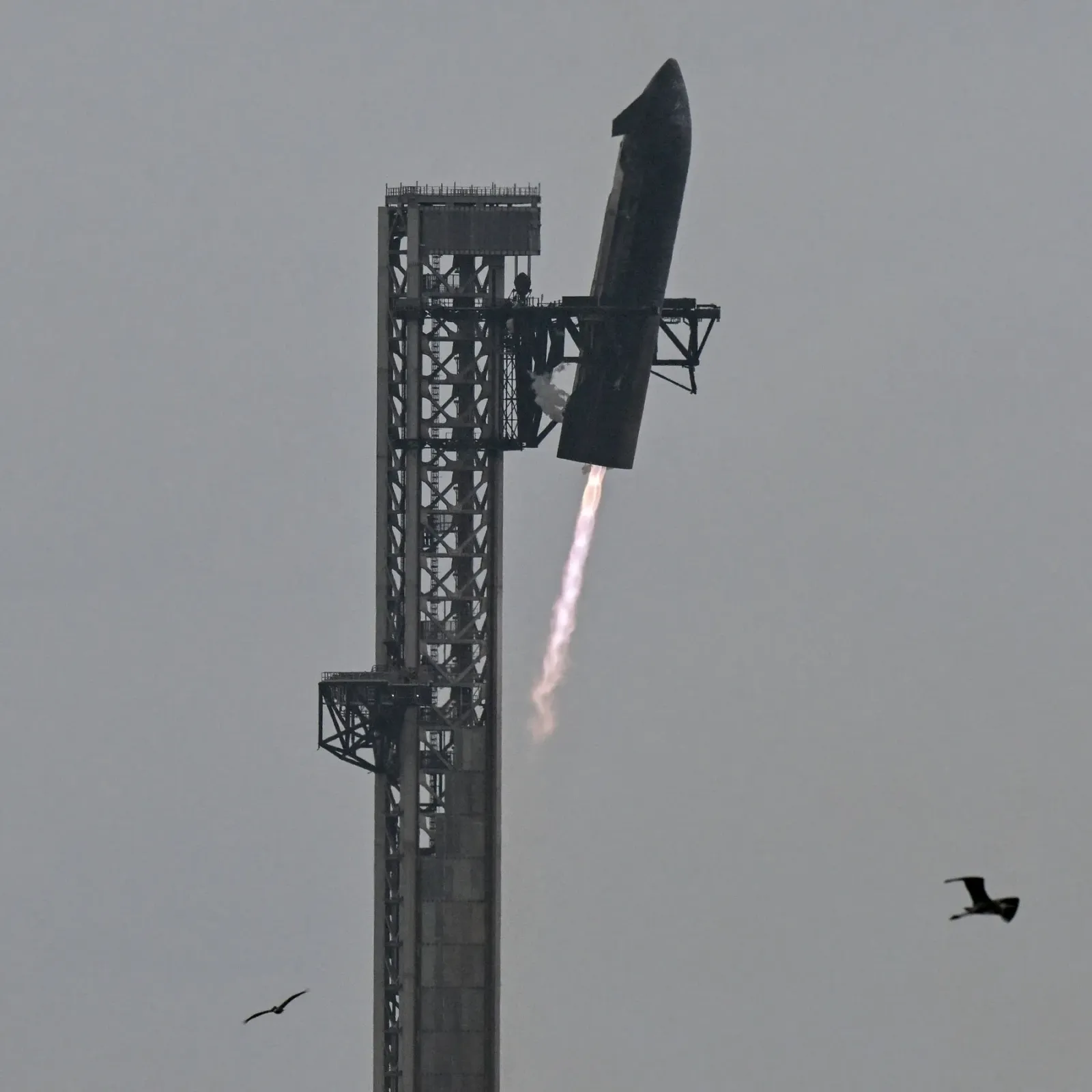
SpaceX, led by CEO Elon Musk, caught its Starship spacecraft as it returned from orbit to the same Texas site where it launched, a flight the New York Times called history-making and a key milestone in the company's vision of fully reusable rockets. For decision-makers, the catch matters less as a spectacle than as a signal that launch economics, NASA's lunar timeline, and the cost of anything touching orbit are all being repriced.
SpaceX caught its Starship spacecraft as it returned from orbit to the same Texas spot where it lifted off, a first that the New York Times described as history-making and a key milestone in the company's long-stated vision of building fully reusable rockets. Read that again: the vehicle went to orbit, came back, and arrived at the pad it left from. For six decades, the most expensive hardware in aerospace was the hardware you burned up, dropped in the ocean, or left drifting in orbit. SpaceX, led by CEO Elon Musk, has spent years arguing the opposite should be true. This flight is the strongest evidence yet that the argument is winning.
Why this is the number that matters: a rocket company is mostly a manufacturing business until it becomes an operations business. Every expendable launch means building a new vehicle, testing it, shipping it, and writing it off after a single use. Reusability flips that math. Fly the same hardware repeatedly and the amortized cost of the vehicle falls, which is the lever the industry has been chasing for two decades. SpaceX already proved the concept at smaller scale with Falcon 9 boosters, which routinely fly, land, and fly again. Starship is the version where the entire stack, not just part of it, is supposed to come home.
The catch itself is the hard part, and it is why this milestone is about the tower as much as the rocket. SpaceX's design philosophy has been to skip landing legs where it can and bring returning hardware back to the launch site, where the tower's arms can grab it. That approach removes mass from the vehicle and removes a recovery ship from the logistics chain, but it demands precision with almost no margin. Historically, landing a booster meant hitting a broad target; catching one means threading a much tighter one, with ground infrastructure standing nearby. Getting the spacecraft back to its own launch point is the difference between a stunt and a system.
The downstream stakes are already contracted. NASA has selected a version of Starship as a lunar lander for its Artemis program, which means the agency's return-to-the-Moon timeline is tied to this vehicle working. SpaceX's own Starlink satellite business depends on launch cadence, and cadence depends on turnaround: the faster a vehicle can be inspected, refueled, and reflown, the more mass a single factory can put into orbit per year. That is the real prize. A reusable rocket is not valuable because it is elegant. It is valuable because it converts fixed manufacturing capacity into a compounding flight rate, and flight rate is what determines who gets to build the next generation of orbital infrastructure.
Competitors are watching with reason. Blue Origin, United Launch Alliance, and Rocket Lab have all been moving toward reusable or partially reusable designs, and each now has a clearer benchmark for what "reusable" has to mean to count. Regulators are in the loop too: launches from the company's Texas site require FAA licensing along with airspace and environmental review, and a higher flight rate turns those approvals from one-off events into a standing operational requirement. The permitting pipeline, not the engineering, may end up being the binding constraint on how quickly this milestone becomes routine.
Second-order effects are where executives outside aerospace should pay attention. Cheaper, more frequent launch changes the economics of anything that touches orbit: Earth observation, communications constellations, insurance underwriting for payloads, and defense architectures that assume satellites are scarce and expensive. It also changes the cost of failure. When hardware is reusable, the marginal cost of a test flight drops, which compresses development cycles across the industry and makes fast iteration the default rather than the exception. Companies in adjacent sectors, from logistics to materials to energy, should expect the same playbook to be applied to them: if the asset can come back, the business model changes.
What to watch next is turnaround time. A catch is a milestone; a schedule is a business. The questions that matter now are how many flights the vehicle can sustain, how much refurbishment each one requires, and whether the cadence holds when something goes wrong, because something eventually will. SpaceX has already absorbed public failures on this program and kept flying. The strategic takeaway for peers in any capital-intensive industry is blunt: the company that owns the reuse loop sets the price floor everyone else has to live with. SpaceX just moved closer to owning it in orbit.
This story's Key Insights and Take-aways are locked.
Create a free account to unlock Executive Actions for one credit.
Register to UnlockAlways free for Executives Club members. Join the Club
More in Science

Anthropic's I.P.O. Made Rank-and-File Researchers Worth Tens of Millions
Researchers who joined just a few years ago are now worth tens of millions, and the windfall resets the pay benchmark for every private A.I. lab still paying in paper.

NASA's Mars relay lost a wheel, and Perseverance lost both radios
Odyssey's backup wheel stopped spinning with only months of hydrazine left, while Perseverance's primary and backup radios are both sidelined, pausing science on the surface.

Three Hours With Elizabeth Holmes, and Not One Question About the Fraud
Nathan Fielder's 'You Can See Everything' bets that eye contact can out-truth a fraud conviction, and the Guardian's critic argues that is an insult to objective truth.