

SpaceX catches Starship rocket stage midair with 'chopsticks' for first time
The first midair catch of a Starship stage using mechanical 'chopsticks' signals reusable heavy-lift is moving from test to operating model, with cost and cadence stakes for launch customers.
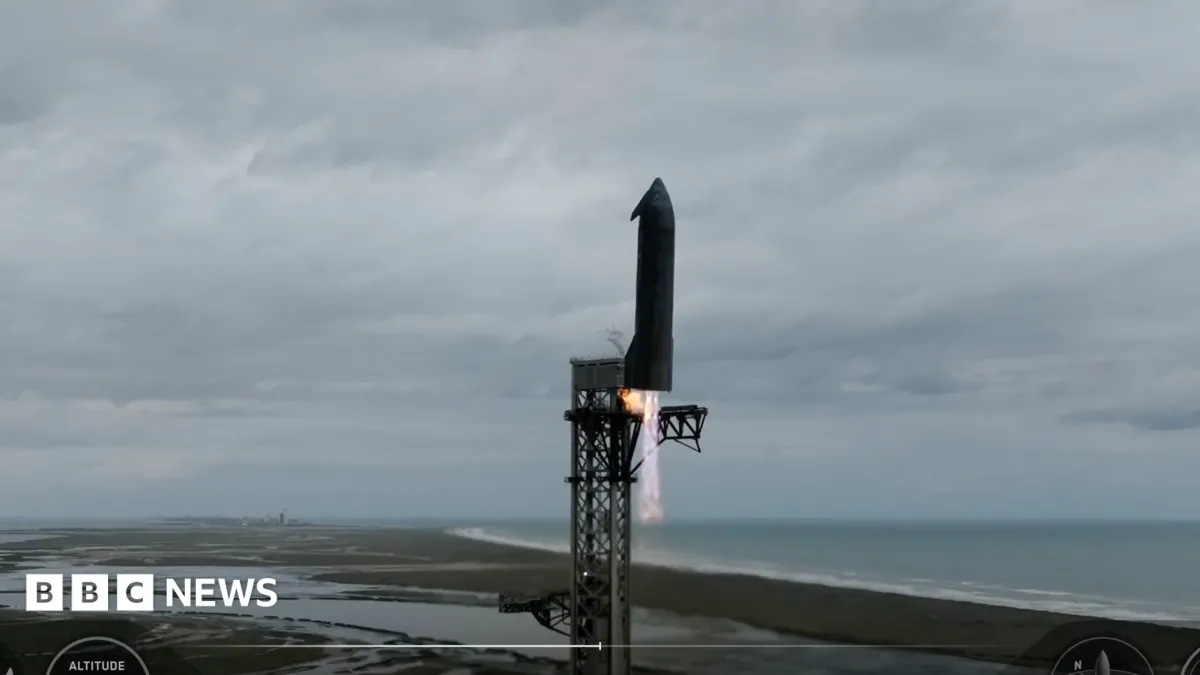
SpaceX has successfully caught the top of its huge Starship rocket midair for the first time, using mechanical arms nicknamed 'chopsticks.' The milestone matters because it points to a future where the largest rocket stages are recovered and reused, reshaping launch economics and access to orbit for satellite, defense, and exploration customers.
SpaceX has done something no one had done before: it caught the top of its huge Starship rocket in midair. The company used giant mechanical arms nicknamed 'chopsticks' to snag the rocket stage as it returned, according to BBC News. The catch was a first. It turns a rocket stage from a disposable asset into something that can, in principle, be recovered and flown again. For an industry built on throwing hardware away, that is the whole ballgame.
The headline fact is simple and enormous. The stage was caught midair, not on a landing pad, not in a net, not with landing legs. The 'chopsticks' are mechanical arms, and they closed around the stage while it was still in the air. That is a precision maneuver. A rocket stage returning from the edge of space is moving fast, carrying residual propellant, and facing aerodynamic and thermal loads. To catch it, the arms must meet it at the right point, at the right speed, with the right force. Miss by a little, and you have a very expensive crash. Nail it, and you have a reusable building block for the largest rocket in operation.
Why does this matter beyond the spectacle? Launch is the toll booth to space. Every satellite, every crew mission, every science payload pays it. Historically, that toll has been high because rockets were expendable. SpaceX already changed the math with Falcon 9 by landing and reusing boosters. Starship is the next step: a fully reusable, heavy-lift system designed to carry far more mass. Catching a stage midair is a proof point for that architecture. It suggests the recovery hardware can work, not just in computer models but in the real world. For satellite operators, that could mean more launch capacity and potentially lower prices over time. For investors, it is a signal that the reusable launch thesis is still compounding.
The 'chopsticks' nickname is not just color. It reflects a design philosophy: instead of adding landing legs to the rocket, SpaceX moved the catching hardware to the ground. That saves mass on the stage, which can be used for payload or propellant. It also means the recovery system is part of the launch infrastructure, not the vehicle. That has trade-offs. The ground system must be robust, and the stage must be able to return to a precise point. But if it works, it can simplify the rocket and increase reusability. The first catch is a validation of that bet. It does not prove the entire Starship program is finished, but it clears a major technical hurdle.
The context is a launch market that is already shifting. SpaceX dominates commercial launch with Falcon 9, and Starship is intended to go further: bigger payloads, lower cost per kilogram, and missions to the Moon and Mars. NASA has chosen Starship as a lunar lander for Artemis, and the U.S. military has shown interest in point-to-point cargo and rapid launch. A successful catch supports those ambitions. It also raises the bar for competitors. Blue Origin, United Launch Alliance, Rocket Lab, and others are pursuing reusable systems, but none has demonstrated a midair catch of a heavy-lift stage. That gap matters when governments and commercial customers award long-term contracts. Reliability and cadence win, and reusability is the lever for both.
For executives outside aerospace, the second-order effects are worth watching. Cheap, frequent, heavy launch changes what is possible in orbit. It lowers the cost of broadband constellations, Earth observation, and defense sensors. It makes space-based manufacturing and research more plausible. It also creates new dependencies: more satellites mean more debris, more spectrum coordination, and more regulatory scrutiny. The Federal Aviation Administration and other regulators will have to keep pace with launch rates and reentry operations. Insurance markets will reprice risk as recovery becomes routine. Supply chains for heat shields, avionics, and propellant will face new demand. None of that happens overnight, but the direction of travel is clear.
The strategic stakes for peers are straightforward. If SpaceX can catch and reuse the largest rocket stages, it can undercut rivals on price and fly more often. That pressures launch providers to accelerate their own reuse plans. It pressures satellite operators to design for lower launch costs and higher capacity. It pressures investors to separate real reusability from PowerPoint reusability. And it pressures regulators to build frameworks for a world where rocket stages routinely return to the ground, or are caught in the air. The first catch is a single event, but it is the kind of event that resets expectations. The question now is not whether reuse is possible, but how fast it becomes routine.
This story's Key Insights and Take-aways are locked.
Create a free account to unlock Executive Actions for one credit.
Register to UnlockAlways free for Executives Club members. Join the Club
More in Science

Anthropic's I.P.O. Made Rank-and-File Researchers Worth Tens of Millions
Researchers who joined just a few years ago are now worth tens of millions, and the windfall resets the pay benchmark for every private A.I. lab still paying in paper.

NASA's Mars relay lost a wheel, and Perseverance lost both radios
Odyssey's backup wheel stopped spinning with only months of hydrazine left, while Perseverance's primary and backup radios are both sidelined, pausing science on the surface.

Three Hours With Elizabeth Holmes, and Not One Question About the Fraud
Nathan Fielder's 'You Can See Everything' bets that eye contact can out-truth a fraud conviction, and the Guardian's critic argues that is an insult to objective truth.