
SpaceX caught Starship midair. NASA's Moon plan still hinges on one long-delayed demo.
The mid-air catch unlocks rapid reuse and higher launch rates, but NASA's astronaut landings still wait on an orbital refueling demo now set for next year.
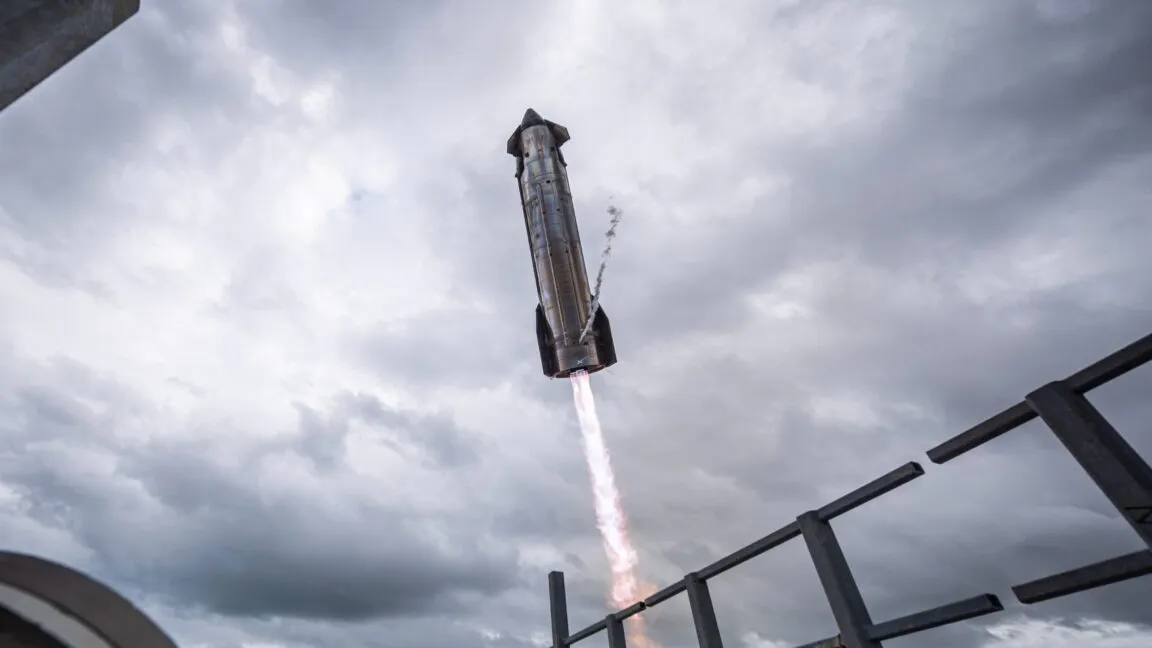
SpaceX recovered its Starship rocket mid-air last weekend, clearing a major hurdle on NASA's path to the Moon and setting up a long-delayed orbital refueling demonstration next year. For decision-makers, the takeaway is that NASA's lunar timeline now rides on one company's launch cadence, factory throughput, and ability to prove in-orbit refueling on schedule.
SpaceX caught its Starship rocket out of the air last weekend, and the recovery cleared a major hurdle on NASA's path to the Moon. For SpaceX, the mid-air catch is a data play: engineers get to study how to rapidly reuse Starships, the single biggest lever on launch cost and flight rate. For NASA, the payoff is indirect but decisive. A higher launch cadence means more flights, more flights mean faster learning, and faster learning is what SpaceX needs to develop the deep space version of Starship that is meant to ferry astronaut crews to the surface of the Moon.
The next milestone is the one that actually decides the schedule: an all-important, long-delayed orbital refueling demonstration planned for next year. That is the piece NASA has been waiting on. Starship cannot get a crew to the lunar surface and back without refueling in orbit, and large-scale propellant transfer between vehicles in orbit has historically never been routine. The technical debate around it is not settled. As the reporting puts it: "We tend to have a lot of technical discussion and debate. That point will continue to be debated."
SpaceX is not waiting on that debate to build. Early next year, the company plans to bring online a second Starship launch site at Kennedy Space Center in Florida. A second Starship factory is also under construction at Kennedy, joining SpaceX's existing production line at Starbase, Texas. Two pads and two production lines is the configuration that gives SpaceX the pieces in place to take the next leap with Starship, and it is the reason the catch last weekend reads less like a stunt and more like a capacity announcement.
Here is the plain-English version of why refueling is the hinge. A rocket leaving Earth has to carry every drop of propellant it will ever burn, plus its payload. Sending a crewed lander to the lunar surface and back demands far more propellant than a single launch can lift. The workaround is to stage propellant in orbit: fly tanker after tanker to fill a depot, then top off the lander before it departs for the Moon. That converts a rocket-science problem into a logistics problem, and logistics problems are solved with cadence. Which is exactly why a mid-air catch, a second pad, and a second factory all point at the same number: flights per year.
Follow the money and the cadence argument repeats. SpaceX expects the catch to help engineers learn how to rapidly reuse Starships, and that should expedite deployment of its newest generation of Starlink internet satellites. Starlink, the company's internet constellation, is the commercial business that runs alongside the deep space work, so every increment of reuse compounds twice: once in launch economics, once in satellite deployment speed. That is the flywheel NASA is implicitly renting. The agency is not simply buying rockets; it is buying a company's learning curve, and the learning curve gets steeper every time a vehicle comes back.
The uncomfortable part for NASA is concentration. Its Moon plan now runs on one company's manufacturing tempo, one company's pad schedule, and one company's ability to solve orbital refueling on a timeline the agency does not control. When a program depends on a single provider, the provider's bottlenecks become the program's bottlenecks, and a long-delayed demo is a schedule risk that no amount of contract language fully transfers. NASA's stated view is that a higher launch cadence will lead to faster learning. That is a bet on iteration speed, and it only pays if the iterations keep happening.
Three things to watch from here. First, the orbital refueling demo next year, the gate that everything downstream waits behind. Second, the second Starship launch site at Kennedy coming online early next year, which is what turns cadence from an aspiration into a schedule. Third, the second factory at Kennedy, which signals SpaceX expects to need the throughput. For executives outside aerospace, the pattern is the one worth stealing: SpaceX is not trying to win a debate about the hardest technical question. It is building the capacity to answer it by flying.
The strategic lesson for anyone running a capital-intensive program is about dependency. If your roadmap rests on a partner's unproven milestone, you own the milestone's risk whether or not you own the milestone. NASA's Moon plan is now a cadence story, and cadence is a manufacturing story, and manufacturing is a factory-and-pad story. SpaceX just checked one box, is building two more, and still has to prove the refueling that makes the whole thing work. The debate continues. The buildout does not wait for it.
This story's Key Insights and Take-aways are locked.
Create a free account to unlock Executive Actions for one credit.
Register to UnlockAlways free for Executives Club members. Join the Club
More in Technology

Anthropic mathematician claims Claude helped crack the Riemann hypothesis
If the proof holds, AI has toppled math's most famous open problem; if it does not, it is a case study in announcing breakthroughs before anyone verifies them.

AI's $4 Trillion Wipeout Erases Nasdaq's Gains for the Year
A brutal week took roughly $4 trillion off the AI sector and left the Nasdaq flat for the year, and the damage ran the full length of the supply chain.

Anthropic mathematician says AI proved the Riemann hypothesis. Verification will take time.
A single unverified claim from inside Anthropic now sits against more than 160 years of open mathematics, and the gap between asserting a proof and surviving peer review is the entire story.