

SpaceX's 'chopsticks' caught a Starship part falling back to Earth
The mechanical arms nicknamed 'chopsticks' pulled off a historic catch, and the payoff is a rocket you fly again instead of throwing away.
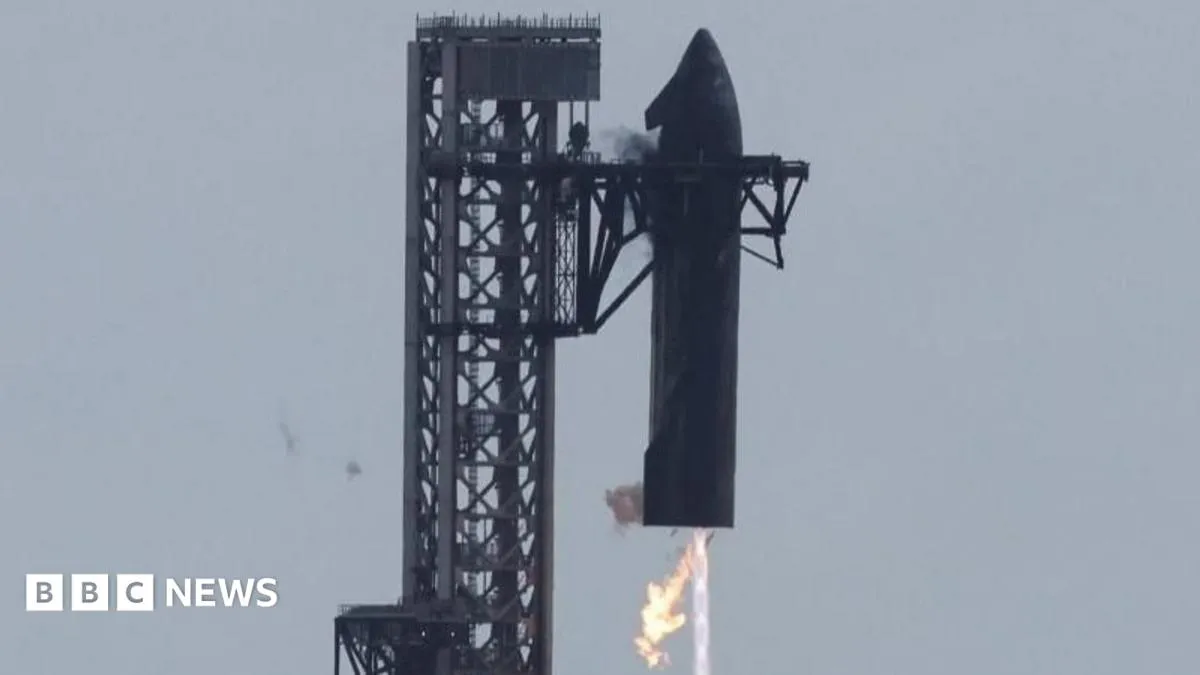
SpaceX has performed a historic catch of part of its Starship rocket as it returned to Earth, using mechanical arms nicknamed 'chopsticks.' For decision-makers, the milestone matters because reliable recovery is the hinge on which launch economics, turnaround time, and every business that depends on cheap orbital access turn.
SpaceX has caught part of its Starship rocket as it returned to Earth, using mechanical arms nicknamed "chopsticks." It is being called a historic catch, and the word is doing real work here. This was not a splashdown, not a parachute drifting into the ocean, not a barge waiting offshore. It was a pair of giant robotic arms reaching out and grabbing falling hardware out of the sky, then holding on. For an industry that has spent most of its history treating rockets as expensive, single-use fireworks, that is the difference between a spectacle and a business model.
The headline fact is the whole story, and it is worth stating plainly: SpaceX performed the catch, and the mechanical arms nicknamed "chopsticks" did the work. Everything else that follows, the cost curve, the launch cadence, the satellite constellations, the defense and intelligence applications, flows from one question. Can the trick be repeated, reliably, at a rate that turns an engineering marvel into a routine line item?
Start with why catching beats landing. Historically, the economics of space have been brutal because the hardware is thrown away. A rocket that flies once and ends up at the bottom of the ocean is, financially speaking, an airline that scraps the plane after every flight. SpaceX spent years proving that a first stage could come back and fly again, and that single idea reshaped the launch market by pushing the cost of getting mass to orbit down and the cadence up. The catch extends that logic to a vehicle the company has positioned as its next-generation system, and it does so in the most literal way possible: instead of recovering hardware from the sea and refurbishing it, you grab it at the tower and get it back on the ground.
That distinction matters because recovery at sea is a logistics problem as much as an engineering one. Salt water is corrosive, retrieval takes ships and time, and every step between splashdown and the next launch adds cost and delay. A tower catch, if it works consistently, compresses that loop. The arms are the mechanism; the real product is turnaround time.
Starship is a bigger bet than a booster. SpaceX has long framed it as a fully reusable system, and full reusability is the part of the pitch that changes the math for everyone else. If the vehicle and its components come back, the marginal cost of a flight is no longer dominated by building a new rocket. That is the scenario in which launch stops being a scarce, budgeted event and starts being infrastructure, the way freight or bandwidth became infrastructure.
The second-order effects are where executives outside aerospace should pay attention. Cheap, frequent access to orbit reprices anything that depends on getting hardware upstairs: Earth observation, communications constellations, navigation, scientific instruments, and a growing list of defense and intelligence applications. It also reshapes the competitive field. Rivals in the launch market have been chasing reuse for years, and a successful catch raises the bar for what counts as a credible roadmap. Suppliers, insurers, and satellite manufacturers all inherit a new baseline.
There is an operational and regulatory layer too. High-cadence launch operations typically run into airspace management, range scheduling, and environmental review, and those constraints do not disappear because the engineering works. Regulators and local communities tend to care about noise, debris, and closures, and a vehicle that returns to a tower rather than an ocean adds new questions about safety zones and site management. The technical milestone and the permission to repeat it at scale are two different problems, and the second one is often slower.
For leaders watching from adjacent industries, the strategic question is not whether to admire the catch. It is what happens to your cost structure if orbital access keeps getting cheaper and more frequent. Companies whose unit economics assume expensive, infrequent launches should stress-test the opposite case. Boards that treat space as a niche should ask which of their assumptions, from supply chain visibility to connectivity to insurance pricing, quietly depend on the old cost curve.
What to watch next is repeatability. A historic catch is a milestone; a schedule is a business. The signal that matters is whether this becomes routine enough to be boring, because boring is what infrastructure looks like. SpaceX has now shown the arms can do it. The next chapter is whether they can do it again, and again, and fast enough to matter.
This story's Key Insights and Take-aways are locked.
Create a free account to unlock Executive Actions for one credit.
Register to UnlockAlways free for Executives Club members. Join the Club
More in Science

Anthropic's I.P.O. Made Rank-and-File Researchers Worth Tens of Millions
Researchers who joined just a few years ago are now worth tens of millions, and the windfall resets the pay benchmark for every private A.I. lab still paying in paper.

NASA's Mars relay lost a wheel, and Perseverance lost both radios
Odyssey's backup wheel stopped spinning with only months of hydrazine left, while Perseverance's primary and backup radios are both sidelined, pausing science on the surface.

Three Hours With Elizabeth Holmes, and Not One Question About the Fraud
Nathan Fielder's 'You Can See Everything' bets that eye contact can out-truth a fraud conviction, and the Guardian's critic argues that is an insult to objective truth.