
Thousands Protest Colombia's President Over Plan to Tax Workers, Spare Companies
A second nationwide demonstration targets President Abelardo de la Espriella's economic package, where higher costs for workers sit right next to a corporate tax cut.
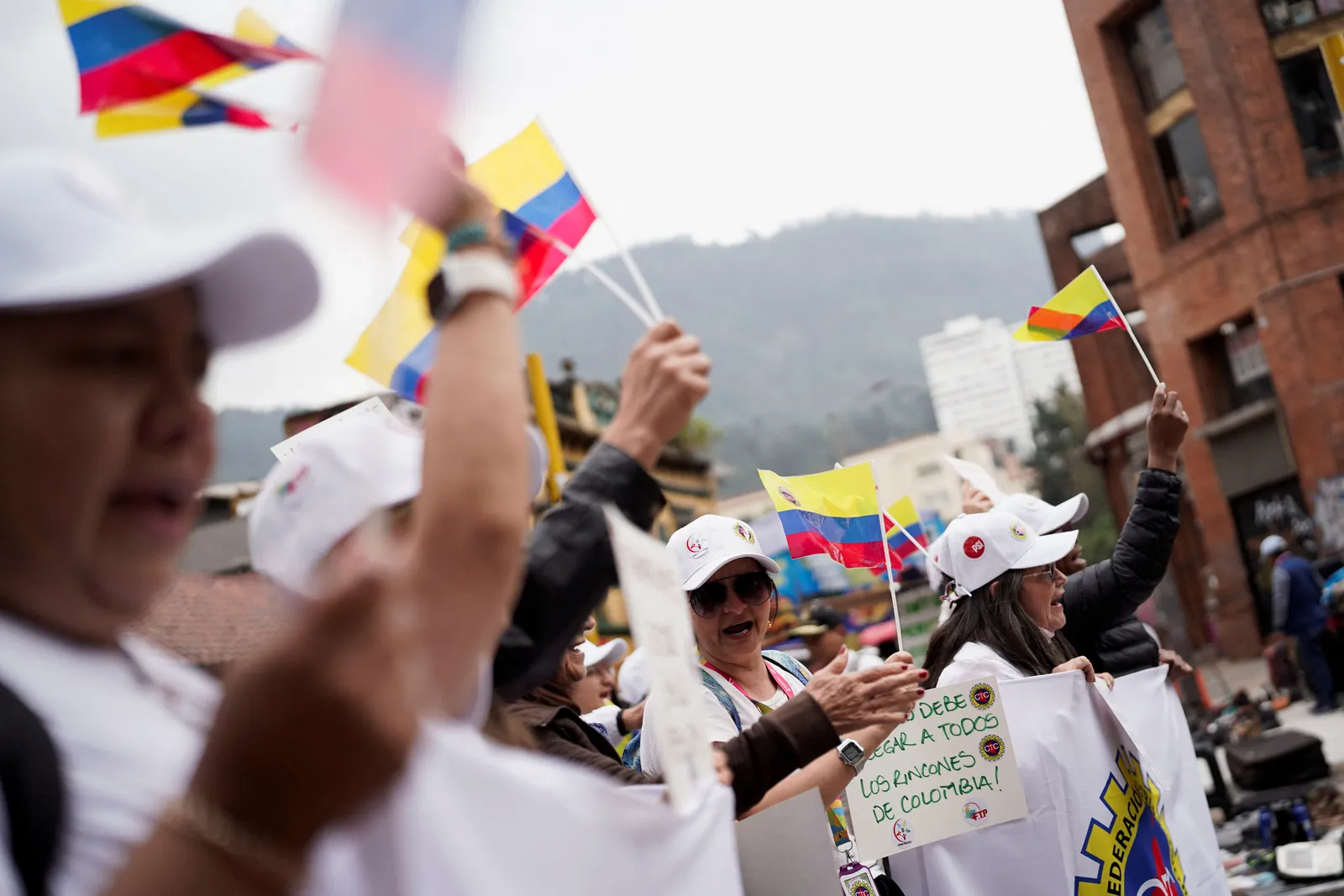
Colombian trade unions and opposition parties staged a second nationwide demonstration on Thursday against President Abelardo de la Espriella's economic proposals, which include lowering the income tax threshold, raising health care contributions, and cutting corporate income tax. The repeat turnout signals a durable opposition coalition, and the package's mix of higher household costs with a corporate rate cut is the fault line that will decide whether the reform survives.
Colombia's President Abelardo de la Espriella got his second nationwide protest on Thursday, and this one was about money. Trade unions and opposition parties turned out thousands of people across several cities to demonstrate against his economic agenda, Arab News reported, with the crowds targeting three specific proposals: lowering the income tax threshold, making people chip in more for health care, and reducing corporate income tax, among other measures.
The word that matters most in that sentence is "second." This was not a one-off burst of anger. A repeat nationwide demonstration means the coalition of unions and opposition parties that organized it has found a rhythm, and that it can pull crowds into the streets on demand. For a president trying to move a contentious package, that is the difference between a bad news cycle and a structural problem that compounds every time he proposes something new.
Unpack the three proposals, because the mix is the story. Lowering the income tax threshold means more Colombians start owing income tax, typically pulling lower and middle earners into the net. Asking people to contribute more for health care raises the cost of being covered. Cutting corporate income tax does the opposite for companies: it shrinks their bill. Read together, the package asks workers to pay more and businesses to pay less. That is a trade any government can defend in a spreadsheet and almost none can defend on a podium.
The message from the street was blunt. "A large part of Colombia feels vulnerable," read one line captured in the coverage, and the same passage pointed at who protesters believe is winning: the rich. That framing is the political core of the fight. It does not matter whether the government's economists can show that a lower corporate rate eventually lifts investment and wages. What matters is that the visible, immediate effect lands on household budgets, while the visible, immediate benefit lands on corporate balance sheets. Voters feel the first one this month. They read about the second one.
For context, tax and pension overhauls have historically been the flashpoint for mass mobilization in Colombia, and proposals that shift costs onto households tend to draw the largest crowds. That is why the sequencing here is so dangerous for the government. A second nationwide demonstration, focused squarely on the economy, tells opposition parties that the coalition they built for round one still has energy for round two. It also gives unions a recruiting tool: every worker who calculates a higher tax bill or a bigger health care contribution has a reason to show up next time.
Now the part that matters for anyone with capital exposed to Colombia. A corporate tax cut is normally a straightforward positive signal for equities and for companies operating in the country, and it is the kind of reform that usually travels through legislatures with business lobbies pushing hard in its favor. But a tax cut that cannot survive the street is worth nothing in a discounted cash flow model. The risk is not that the corporate rate stays high. The risk is that the whole package gets slowed, split, or traded away to buy political peace, and that the corporate cut is the piece sacrificed because it has the weakest constituency at the ballot box.
There is a second-order cost too. If the health care contributions are payroll-linked, employers typically absorb part of the increase, which quietly raises the cost of formal employment in a labor market where informality is already a live policy concern. That is the kind of detail that never makes a protest sign but does show up in hiring plans.
What to watch from here is simple. Does a second nationwide demonstration become a third? Does the government split the package and try to pass the popular pieces first? And does the corporate income tax cut survive contact with the street, or does it become the concession that ends the standoff? For executives weighing investment in Colombia, the answer to that last question is the one that moves the model. Political risk stops being an abstraction when it is standing in the plaza outside the finance ministry.
This story's Key Insights and Take-aways are locked.
Create a free account to unlock Executive Actions for one credit.
Register to UnlockAlways free for Executives Club members. Join the Club
More in Politics

Fifth Circuit Kills Pregnant Workers' Law Over Pandemic Proxy Votes
A procedural ruling, not a policy one, has blocked a federal pregnancy-accommodation law and put every pandemic-era statute in the crosshairs ahead of an expected Supreme Court appeal.

Measles kills a Virginia child under 5, the state's first death of 2026
Virginia's health department confirmed the death but withheld the child's vaccination status, leaving schools, clinics and employers to plan around the one detail that would explain the most.

Former Brazilian President Bolsonaro Hospitalized with Intestinal Obstruction
The health status of the former far-right leader raises immediate questions about political stability and the trajectory of Brazil's conservative movement.