
Trump Hugs Xi in China, Skips the Nvidia Spy Case That Toppled Huang
The red carpet and the embrace were the easy part; the open question is what Washington's silence on the espionage case that brought down Nvidia's chief executive costs the companies caught between the two capitals.
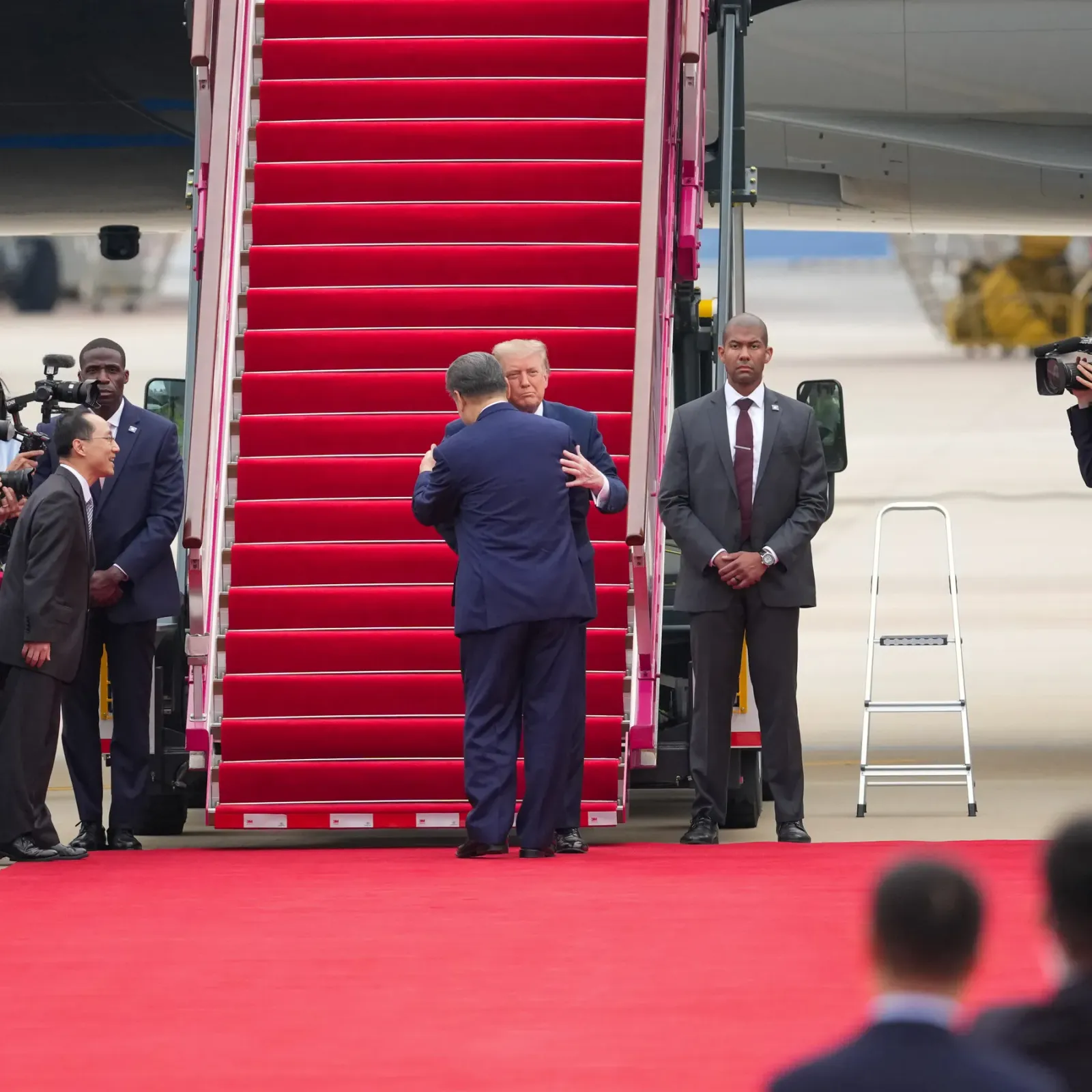
President Trump arrived in China focused on friendship with President Xi Jinping, who greeted him with a hug and a red-carpet welcome, and Trump avoided discussing the espionage case that brought down Nvidia's Jensen Huang. For executives with exposure to both Washington and Beijing, the omission signals that the political relationship is being managed separately from the corporate crisis underneath it.
President Trump arrived in China with a deliberately narrow priority: friendship with Xi Jinping. Xi met him with a hug and a red-carpet welcome, the kind of choreography a host reserves for a leader he wants close. And the espionage case that brought down Jensen Huang, the chief executive of Nvidia, did not come up. Trump avoided it.
That avoidance is the story. In statecraft, the agenda is the message, and what a president chooses not to raise in a room he traveled to enter tells you where the risk actually sits. Trump and Xi put the warmth on full display. The corporate crisis sitting underneath the relationship, an espionage case tied to the most strategically important chip company on the planet, was left outside the door.
For anyone running a company with exposure to both capitals, that image is the entire operating environment compressed into one handshake. Nvidia, for context, sits at the center of the artificial intelligence buildout. It designs the chips that train and run the large language models behind the current AI wave, which makes it less a normal vendor and more a piece of infrastructure that governments treat as strategic. When a company like that loses its chief executive, the ripple does not stop at the boardroom. It moves through customer roadmaps, supplier contracts, capital allocation plans, and, increasingly, diplomatic cables.
Historically, advanced semiconductors have been one of the sharpest edges in the US-China relationship. Washington has spent years tightening restrictions on what cutting-edge chips and chipmaking equipment can be sold into China, and Beijing has answered with its own countermeasures. Chip policy is one of the rare subjects that generates genuine bipartisan agreement in Washington, which is precisely why the topic is radioactive in a bilateral meeting. Raising the Huang case would have forced Trump to choose between the friendly framing he came for and a confrontation over technology, espionage, and corporate accountability. He chose the framing.
The mechanics of the visit matter as much as the optics. A red carpet costs a host nothing. A hug is free. What a summit actually produces is measured in deliverables: signed agreements, tariff relief, export licenses, enforcement commitments, or explicit silence. Here, the deliverable was silence on the case that removed the leader of the most valuable franchise in the AI supply chain. Beijing gets a warmer public posture with Washington. Trump gets the imagery of a relationship he can call friendly. Neither of those wins resolves the question still hanging over Nvidia.
That leaves the harder work where it always lands: with boards, operators, and investors. A leadership change at a company this central is never a personnel matter. Customers with multi-year deployment plans need to know who signs off on allocations. Suppliers need to know who honors commitments. Governments that treat the company as strategic infrastructure need a counterpart they can call. And every peer running a business that depends on cross-border technology flows now has to model a scenario it might have dismissed a year ago: that a single legal or intelligence matter can decapitate a leadership team faster than any competitive threat.
The second-order lesson is about asymmetry. Personal diplomacy between heads of state can move faster than institutional processes, and it can also outrun them. When leaders prioritize chemistry over cases, the unresolved file does not disappear. It waits. It waits for a court, a regulator, a congressional hearing, or a news cycle to drag it back into the open, usually at the worst possible moment for the company named in it. Executives who assume a warm summit photo means the risk has been absorbed are reading the wrong signal. Warmth at the top is often a sign that the difficult conversation has been deferred, not settled.
So watch three things. First, whether the case resurfaces through legal or legislative channels now that the diplomatic stage has been cleared. Second, how Nvidia's leadership question resolves, and whether the answer comes from inside the company or from outside pressure. Third, whether the warmth Trump and Xi displayed converts into anything concrete on technology policy, or whether it stays what it looked like on arrival: a hug, a carpet, and an avoided subject. For every operator with a foot in both markets, that third question is the one that sets next year's budget.
This story's Key Insights and Take-aways are locked.
Create a free account to unlock Executive Actions for one credit.
Register to UnlockAlways free for Executives Club members. Join the Club
More in Politics

Fifth Circuit Kills Pregnant Workers' Law Over Pandemic Proxy Votes
A procedural ruling, not a policy one, has blocked a federal pregnancy-accommodation law and put every pandemic-era statute in the crosshairs ahead of an expected Supreme Court appeal.

Measles kills a Virginia child under 5, the state's first death of 2026
Virginia's health department confirmed the death but withheld the child's vaccination status, leaving schools, clinics and employers to plan around the one detail that would explain the most.

Former Brazilian President Bolsonaro Hospitalized with Intestinal Obstruction
The health status of the former far-right leader raises immediate questions about political stability and the trajectory of Brazil's conservative movement.