
Trump, in China, tells stockpiling Americans to 'relax' on outages
The president called the outages 'individual events' and said 'everything's good' - a claim about correlation that every risk model quietly depends on.
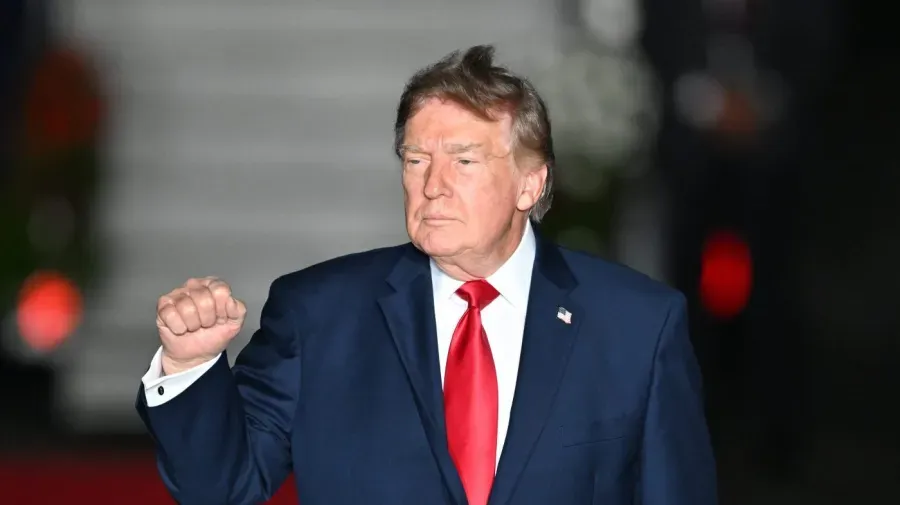
President Trump, in a Wednesday interview with Fox News's Jacqui Heinrich in Shenzen, China, told Americans stockpiling canned food and water amid a recent series of major outages to 'relax' and described the incidents as 'individual events.' That framing is a claim about whether the disruptions are independent or correlated, which is the variable that determines how cheaply utilities, insurers, and operators can absorb them.
President Trump told Americans who are buying up canned food and water in response to a recent series of major outages to 'relax,' saying 'everything's good.' The comment came Wednesday in an interview with Fox News's Jacqui Heinrich, conducted in Shenzen, China, where the president downplayed concerns over the outages and described them as 'individual events.'
That last phrase is the one that carries weight. 'Individual events' is a risk-management claim, not a vibe. It asserts that the outages were separate, unconnected incidents rather than symptoms of one underlying failure. If that is right, calm is the correct response: independent events do not compound, they do not signal a systemic fault, and they do not justify a run on the canned-goods aisle. If it is wrong, the same sentence becomes the kind of reassurance that ages badly. The source does not name the outages, their causes, or their locations, so the news here is not a diagnosis. It is a framing, delivered by the president, about a run of disruptions serious enough that Americans are stockpiling for them.
Start with the behavior, because it is the part with a paper trail. Stockpiling is a vote of no confidence cast with a shopping cart. Households do not typically buy canned food and water in bulk because they read a press release; they do it because something in their own experience, whether a dark block, a boil-water notice, or an empty shelf, told them the normal systems might not hold. For operators, that is the useful signal: the public's threshold for 'normal' is set by what people lived through, not by what officials say afterward. Once that threshold moves, it tends to stay moved for a while. Pantries stay stocked. Emergency kits get bought. The behavioral overhang outlasts the event that created it.
The venue adds its own charge. A president telling Americans to relax about domestic disruptions while speaking from Shenzen, China, is a particular kind of split screen: reassurance about home, delivered from away. The source does not detail the purpose of the trip, so the message itself has to carry the weight. What it does tell you is that the question followed him abroad. When a president is asked about stockpiling during a foreign interview, the anxiety has already traveled far enough to require a public answer.
'Relax' is a loaded instruction. Officials reach for it when they want to short-circuit a feedback loop: public anxiety drives hoarding, hoarding drives shortages, and shortages justify the anxiety. Breaking that loop is a legitimate goal. But reassurance only works when it is paired with specifics, and what we have here is a broad characterization rather than a list. There is no named cause, no timeline, no entity identified as responsible. For a household deciding whether to fill a second shelf, 'individual events' answers the question of whether the incidents are linked. It does not answer the question of whether they will keep happening.
That gap is where the operator-level stakes live. Consider the sectors sitting closest to the source of the anxiety: utilities and grid operators, water systems, telecoms, logistics providers, insurers, and the retailers watching basket sizes shift. For each, the operative question is not whether the president is right about causation. It is whether their own risk models treat these disruptions as independent or correlated. Independent risk is comparatively cheap to insure and easy to absorb. Correlated risk is the opposite: it stacks losses, burns through reserves, and turns a bad week into a solvency question. A public claim that events are 'individual' is, in effect, a claim about correlation. Boards that accept it without testing it are taking someone else's word for their own exposure.
There is a communications lesson too. Telling people to relax without giving them something to hold onto rarely lands. The organizations that handle these moments well tend to do the opposite of a slogan: they publish status, they name what failed, they give a timeline, and they let the specificity do the calming. The ones that handle it badly repeat that everything is fine until the repetition itself becomes evidence that it is not. For any executive who has to send a holding statement this quarter, the president's answer is a useful stress test. Strip the name off it and ask whether your own stakeholders would accept it.
What to watch from here is simple, and it is the thing the source leaves open. Either the outages are subsequently shown to be unconnected, in which case 'individual events' was the correct read and the stockpiling was a temporary scare, or a pattern emerges that ties them together, in which case the phrase becomes the first line of a much harder story. The tell will not be another interview. It will be the data: outage frequency, restoration times, retail demand for shelf-stable food, and whether the buying fades once the lights come back on. Until then, the president's message to Americans is the one he gave: relax, everything's good.
This story's Key Insights and Take-aways are locked.
Create a free account to unlock Executive Actions for one credit.
Register to UnlockAlways free for Executives Club members. Join the Club
More in Politics

Fifth Circuit Kills Pregnant Workers' Law Over Pandemic Proxy Votes
A procedural ruling, not a policy one, has blocked a federal pregnancy-accommodation law and put every pandemic-era statute in the crosshairs ahead of an expected Supreme Court appeal.

Measles kills a Virginia child under 5, the state's first death of 2026
Virginia's health department confirmed the death but withheld the child's vaccination status, leaving schools, clinics and employers to plan around the one detail that would explain the most.

Former Brazilian President Bolsonaro Hospitalized with Intestinal Obstruction
The health status of the former far-right leader raises immediate questions about political stability and the trajectory of Brazil's conservative movement.