
Trump, Putin and Xi Leave With No War Treaty, No Nuclear Deal, No AI
A three-power summit ended without a single binding agreement on war or nuclear weapons, and the AI race that will define the next decade never made the agenda.
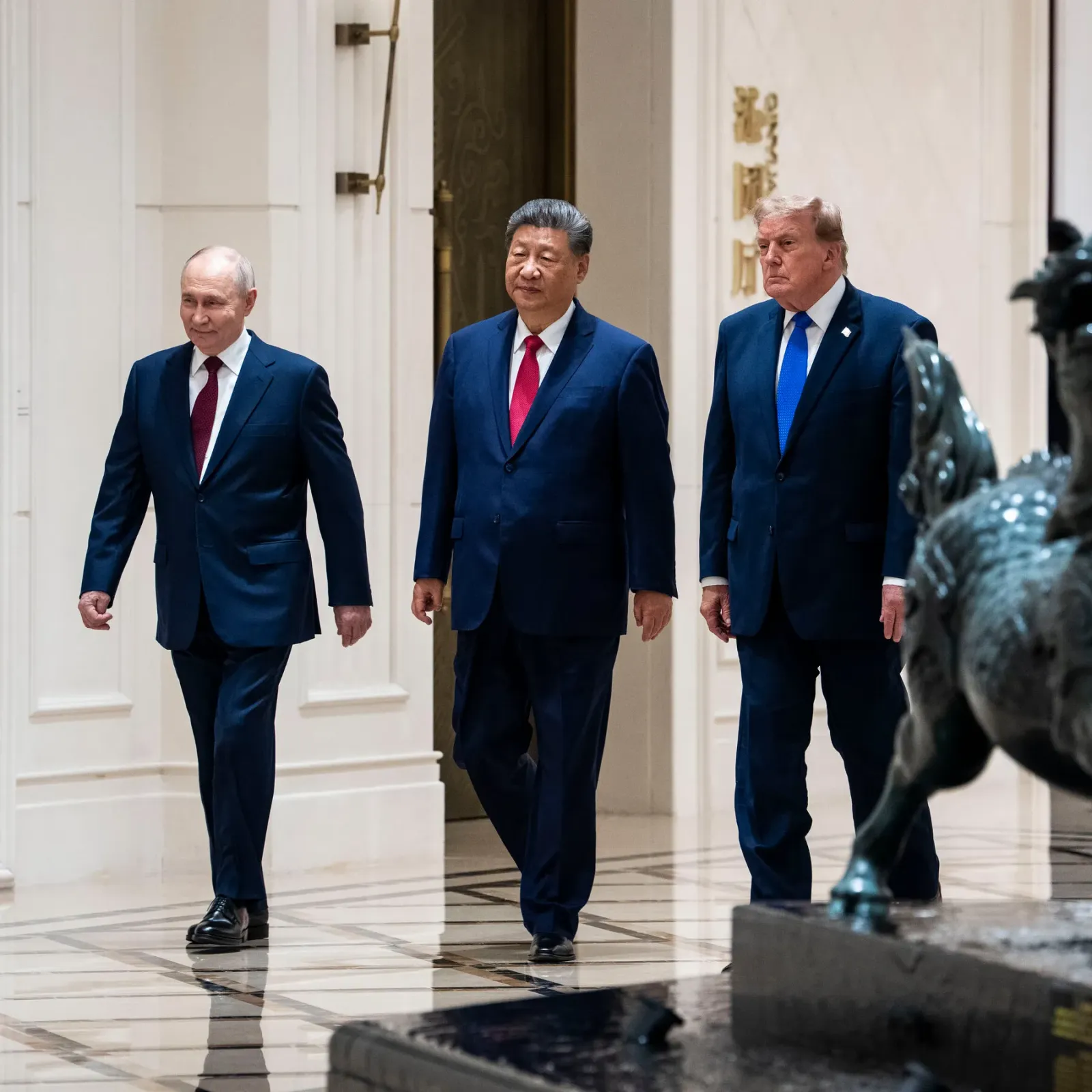
The leaders of the United States, China and Russia met and produced no treaties on war or nuclear weapons, while the artificial intelligence race was left off the agenda entirely. For executives in defense, semiconductors, energy and cross-border capital, the empty readout is itself a signal: the frameworks that would govern the next decade of great-power competition are not being written yet.
Three of the most consequential leaders on the planet met, and nothing was signed. The summit among the leaders of the United States, China and Russia produced no treaties on war and no treaties on nuclear weapons. The artificial intelligence race, the competition now shaping chips, data centers, energy demand and military capability, was not even on the agenda. That is the whole readout, and it is a bigger story than the thinness suggests. When the governments whose militaries and technology sectors set the terms of global risk sit down together and commit to nothing on either file, the absence of an agreement becomes the most important thing that happened.
For decision-makers, the practical question is not what was said but what was left undone. Two of the three files that most reliably move markets and board agendas, nuclear risk and AI, went unaddressed in the same room. Defense contractors plan multi-year backlogs around arms control assumptions. Semiconductor and cloud companies plan capital expenditure around the assumption that export controls and compute access will stay predictable. Energy developers plan data center buildout around the assumption that AI demand keeps compounding. A summit that touches none of it leaves every one of those assumptions exactly where it was, which is to say unresolved.
History is a useful yardstick here. The landmark arms control agreements of the past century, from the SALT talks through START and the INF Treaty, were not born in a single afternoon. They came out of years of technical negotiation, verification protocols, inspection regimes and domestic ratification fights. A leaders' summit has typically been the moment that launches or blesses that work, not the moment that completes it. Judged against that standard, the bar for this meeting was never a signed treaty. The bar was a mandate: a working group, a framework, a stated intention to keep talking about the weapons that could end the conversation permanently. By the source's account, that did not materialize.
The AI omission is the more revealing one. Over roughly the past three years, artificial intelligence has moved from a research curiosity to a national security file in its own right. The policy levers around it are concrete: export controls on advanced semiconductors, access to leading-edge compute, the electricity and water required to run large data centers, and the talent pipeline that concentrates in a handful of cities. Historically, new strategic technologies get pulled into great-power dialogue once their military and economic consequences become undeniable, whether through bilateral hotlines, test bans, or informal norms. Leaving AI off the agenda suggests either that the three governments have no shared vocabulary for it yet, or that they prefer to compete without one.
Either way, the market read is the same: no new constraint, no new certainty. If anything, an empty summit reinforces the case for the spending already underway. Nuclear modernization programs in several countries have been funded on multi-decade timelines. Defense budgets have been rising on the assumption that strategic competition is durable. AI capital expenditure has been justified by the assumption that no one is going to slow down voluntarily. A meeting that produces no framework does nothing to interrupt any of those trends. It may quietly validate them.
Watch the follow-on tracks rather than the plenary. Diplomacy typically continues in working groups, bilateral channels and technical committees long after the cameras leave, and the real signal is whether any of those get stood up. Watch also for the next bilateral meeting between any two of the three, since two-party conversations have historically been where arms control actually advances. And watch the language. Vague communiques that mention strategic stability or responsible use are the raw material from which future frameworks get built, or from which they get quietly buried.
The strategic stakes are straightforward. Great-power competition without rules is not the absence of a game; it is a game with no referee, where misreading an adversary's intent is the most expensive mistake available. That risk is not abstract for companies. It shows up as sudden export control changes, supply chain relocations, insurance costs, and the discount rate applied to any business with exposure to Taiwan, to rare earths, or to cross-border data flows. Executives who treat geopolitics as a background variable tend to discover it as a line item.
So the takeaway from a summit that produced no treaties and skipped AI is not that nothing happened. It is that the frameworks governing the next decade of competition are still unwritten, and the people who will write them have not started. For founders, operators and investors, that is both the risk and the opening. The companies that build durable positions in compute, energy and defense-adjacent infrastructure are, in effect, placing a bet that the vacuum persists. It is a bet worth stress-testing before the next summit, not after.
This story's Key Insights and Take-aways are locked.
Create a free account to unlock Executive Actions for one credit.
Register to UnlockAlways free for Executives Club members. Join the Club
More in Politics

Fifth Circuit Kills Pregnant Workers' Law Over Pandemic Proxy Votes
A procedural ruling, not a policy one, has blocked a federal pregnancy-accommodation law and put every pandemic-era statute in the crosshairs ahead of an expected Supreme Court appeal.

Measles kills a Virginia child under 5, the state's first death of 2026
Virginia's health department confirmed the death but withheld the child's vaccination status, leaving schools, clinics and employers to plan around the one detail that would explain the most.

Former Brazilian President Bolsonaro Hospitalized with Intestinal Obstruction
The health status of the former far-right leader raises immediate questions about political stability and the trajectory of Brazil's conservative movement.