
Trump renews 'wipe them out' threat to Iran over dirty bomb claim
Trump's answer to a Fox News question about a dirty bomb threat against Washington was a promise to 'wipe them out,' reviving a deterrence message that energy, defense, and risk desks cannot ignore.
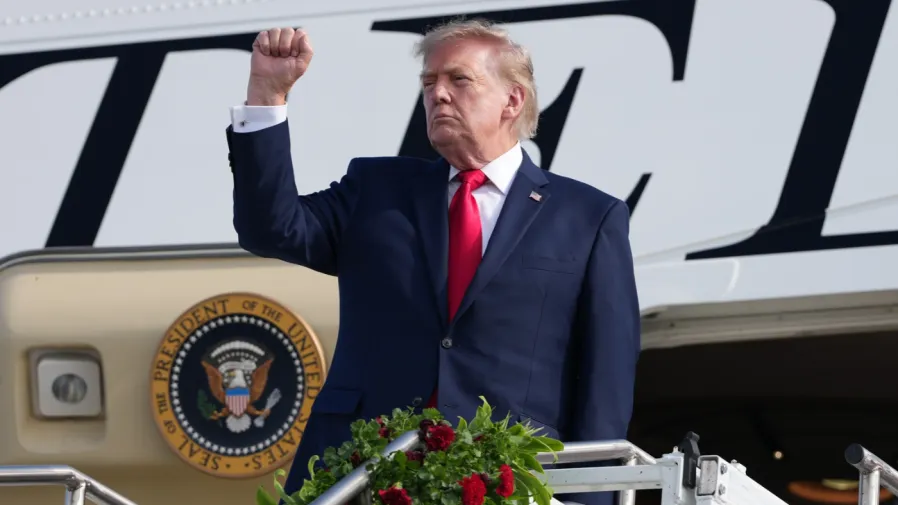
President Trump on Wednesday renewed his threat to annihilate Iran if it carries out a reported plan to detonate a dirty bomb on US soil, telling Fox News's Jacqui Heinrich at the APEC summit in Shenzhen, China, that 'we'll wipe them out.' For executives, the exchange is a reminder that geopolitical tail risk, not quarterly guidance, is the variable most likely to reprice energy, defense, and supply-chain exposure overnight.
President Trump on Wednesday renewed his threat to annihilate Iran if it follows through on what the source describes as a reported plan to detonate a dirty bomb on US soil. The exchange happened in Shenzhen, China, where Trump was attending the Asia-Pacific Economic Cooperation summit, and the question came from Fox News's Jacqui Heinrich, who asked whether residents of Washington, D.C., should worry about Iran launching a radiological attack. Trump's answer was blunt: "we'll wipe them out." That is the whole of it. No new intelligence was released, no timeline was given, and no official confirmed the plot itself. What changed on Wednesday was not the facts on the ground but the volume of the warning.
Start with the phrase, because it does a lot of work. A dirty bomb, formally a radiological dispersal device, pairs conventional explosives with radioactive material. It does not produce a nuclear detonation. Historically, security analysts have treated these devices as weapons of mass disruption rather than mass destruction: the blast is limited, but the contamination, evacuation, cleanup bill, and psychological shock can paralyze a city for months. That distinction matters for anyone pricing risk. The source does not detail the intelligence behind the reported Iranian threat, and it does not say whether US agencies have corroborated it. Readers should hold both facts at once: the rhetoric is confirmed, the plot is described only as reported.
The setting is not incidental. APEC is a trade and economic forum, historically a venue for tariff talk, supply-chain diplomacy, and photo ops. Trump took a national-security question in an economic room and answered it in the language of annihilation. For the executives in the room and the ones watching from trading desks, that collision is the story. The Asia-Pacific is where a huge share of the world's manufacturing capacity sits, and it is also where the energy chokepoints sit. When a US president answers a dirty-bomb question at a trade summit, the two agendas stop being separable.
"Wipe them out" is deliberately imprecise, and that is the point. Deterrence historically works through the credibility of a response, not the specificity of it. The source does not say what action would trigger the retaliation beyond the reported dirty bomb plot, nor does it describe any diplomatic channel opened or closed. Ambiguity can deter; it can also be misread. That is the permanent tension in coercive signaling, and it is why defense analysts watch the words as closely as the deployments.
For markets, the practical question is transmission. A credible threat against Washington would not move oil directly, but the retaliation it invites would run straight through the Gulf. A large share of seaborne crude typically transits the Strait of Hormuz, and war-risk insurance premiums for tankers tend to reprice within hours of an escalation headline, not days. Defense contractors historically see bid interest on this kind of news. Safe-haven flows into Treasuries and gold are the standard reflex. None of that is a prediction; it is the map of where a shock would travel first.
The useful executive response is not to trade the headline but to check the exposure map. Which revenue lines touch Gulf shipping, Gulf energy, or Gulf counterparties? Which suppliers sit in the path of a regional escalation? Does the crisis-comms plan have a geopolitical trigger, or only a cyber and weather one? Most boards have run a pandemic scenario and a cyber scenario. Far fewer have run a radiological-attack scenario with a named state actor, even though the tail is now being discussed on live television by the president of the United States.
The deeper point is about repetition. This was a renewal of a threat, not a first utterance, and repetition is how red lines get hardened in public. Once a president says "we'll wipe them out" on camera, the statement becomes a benchmark that allies, adversaries, and markets all price against. For leaders in energy, logistics, defense, and any business with a Gulf footprint, the takeaway is unglamorous: the geopolitical tail is no longer a footnote in the risk section. It is a standing agenda item, and Wednesday put it back on the front page.
This story's Key Insights and Take-aways are locked.
Create a free account to unlock Executive Actions for one credit.
Register to UnlockAlways free for Executives Club members. Join the Club
More in Politics

Fifth Circuit Kills Pregnant Workers' Law Over Pandemic Proxy Votes
A procedural ruling, not a policy one, has blocked a federal pregnancy-accommodation law and put every pandemic-era statute in the crosshairs ahead of an expected Supreme Court appeal.

Measles kills a Virginia child under 5, the state's first death of 2026
Virginia's health department confirmed the death but withheld the child's vaccination status, leaving schools, clinics and employers to plan around the one detail that would explain the most.

Former Brazilian President Bolsonaro Hospitalized with Intestinal Obstruction
The health status of the former far-right leader raises immediate questions about political stability and the trajectory of Brazil's conservative movement.