
Trump's First Trilateral Summit Ended With Zero Deals on Nukes, Ukraine, AI
Trump called Putin a "friend" and praised China's welcome, but the summit produced no breakthrough on nuclear control, Ukraine, or AI, leaving allies and markets to price in the status quo.
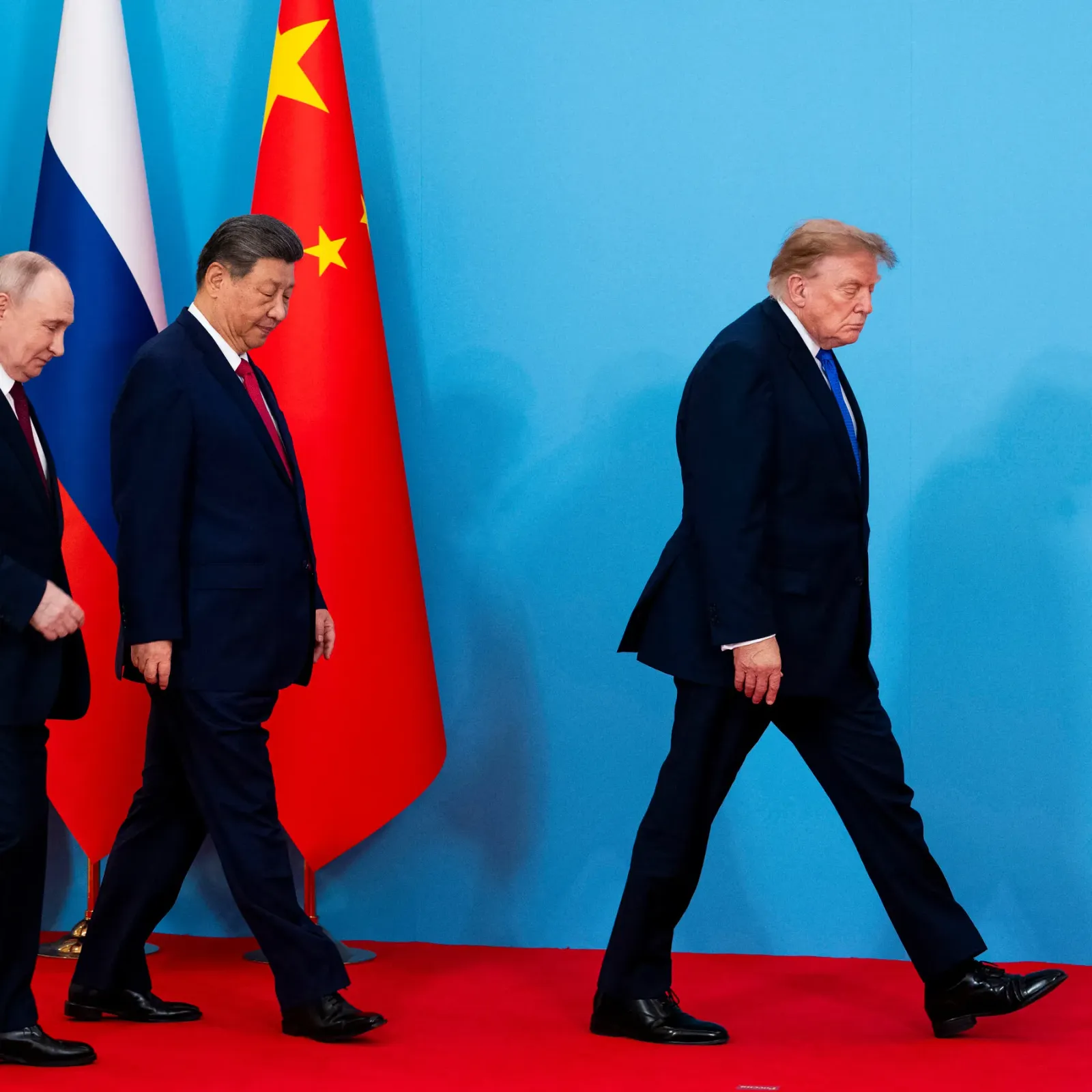
President Trump called Russia's Vladimir Putin his "friend" and marveled at China's warm welcome at his first-ever trilateral summit, but the meeting produced no breakthroughs on nuclear control, the war in Ukraine, or AI. For executives and boards, the absence of any framework means sanctions, export controls, defense budgets, and supply-chain risk all stay on their current, elevated baseline.
President Trump called Russia's Vladimir Putin his "friend" and marveled at the warmth of China's welcome at his first-ever trilateral summit. Then came the part that actually moves the world: no breakthroughs on nuclear control, the war in Ukraine, or artificial intelligence. Three of the highest-stakes files on any leader's desk, one stage, and nothing signed that changes the math.
That gap between atmosphere and outcome is the story. Summits are typically judged by what they produce: frameworks, verified commitments, timelines, working groups with deadlines. By that standard, this one produced warmth. The account of the meeting is blunt about it: camaraderie on display, little to show for it on the three issues that would genuinely shift the risk calculus for governments, militaries, and the companies that sell to them.
Start with nuclear control, because it is the file where the absence of a deal is most measurable. For context, US and Russian strategic arsenals have been governed for decades by a treaty architecture that caps deployed warheads and, critically, includes verification and on-site inspection. Verification is what turns a promise into a fact. When that architecture goes without a successor, the two largest nuclear powers operate with less mutual visibility than the framework was designed to provide, and less visibility historically means more room for miscalculation. A friendly word across a table is not a verification regime, and it does not outlast the people who said it.
Ukraine is the second missing deliverable. A breakthrough there would look like a ceasefire, a negotiating framework, or a monitored pullback. None of that came. The war has been running since February 2022, and in that time it has reshaped European defense budgets, rerouted energy flows, and repriced the cost of capital for anything with exposure to the region. For operators, no deal means the sanctions map, the logistics detours, and the insurance premiums stay exactly where they are. A frozen status quo is not neutral. It is a standing cost line that shows up in procurement, in freight, and in the discount rate.
Then there is AI, the newest file to land on a head of state's desk and the least governed of the three. Washington has spent years tightening controls on advanced semiconductors and the equipment needed to make them, while Beijing has pushed hard to close the compute gap. A summit that produces no movement on AI means no shared guardrails, no incident hotline, and no clarity on where the export-control line moves next. For anyone building on top of frontier models, that ambiguity is not an abstraction. It is a planning input, and it is currently unresolved.
None of this means the optics were worthless. Personal rapport between leaders can lower the temperature and keep channels open, and historically, summits that produced little on paper still shifted atmospherics, which can move defense procurement, diplomatic calendars, and market sentiment. The problem is durability. Rapport depends on the individuals in the room rather than on institutions that outlast them, which is precisely why allies in Europe and Asia tend to hedge when they see warmth without structure. Hedging usually shows up as higher domestic defense spending and duplicated supply chains.
So what are the second-order effects if all three files stay frozen? Nuclear planners on both sides keep working with thinner transparency. European and Indo-Pacific defense budgets stay elevated. Chip export controls remain the primary lever in the US-China technology contest, which means semiconductor supply chains keep being redrawn by policy rather than by demand. And companies with Ukraine exposure keep pricing in a long war. That is not a forecast. It is the arithmetic of no change.
The tell for what comes next is not the next photo op. It is the next document: a negotiating framework, a verification annex, a technical working group with a named deadline. Until one of those appears, the summit's output is a mood. For decision-makers, the practical move is to plan against the baseline that exists today rather than the breakthrough that did not arrive, and to treat any future thaw as upside rather than as the base case.
This story's Key Insights and Take-aways are locked.
Create a free account to unlock Executive Actions for one credit.
Register to UnlockAlways free for Executives Club members. Join the Club
More in Politics

Fifth Circuit Kills Pregnant Workers' Law Over Pandemic Proxy Votes
A procedural ruling, not a policy one, has blocked a federal pregnancy-accommodation law and put every pandemic-era statute in the crosshairs ahead of an expected Supreme Court appeal.

Measles kills a Virginia child under 5, the state's first death of 2026
Virginia's health department confirmed the death but withheld the child's vaccination status, leaving schools, clinics and employers to plan around the one detail that would explain the most.

Former Brazilian President Bolsonaro Hospitalized with Intestinal Obstruction
The health status of the former far-right leader raises immediate questions about political stability and the trajectory of Brazil's conservative movement.