
Trump said colleges would 'go to hell very quickly.' Foreign enrollment fell 18%
New international enrollment dropped 18% after the visa crackdown, costing schools at least $1.5 billion in tuition and forcing job cuts from DePaul to Boston University.
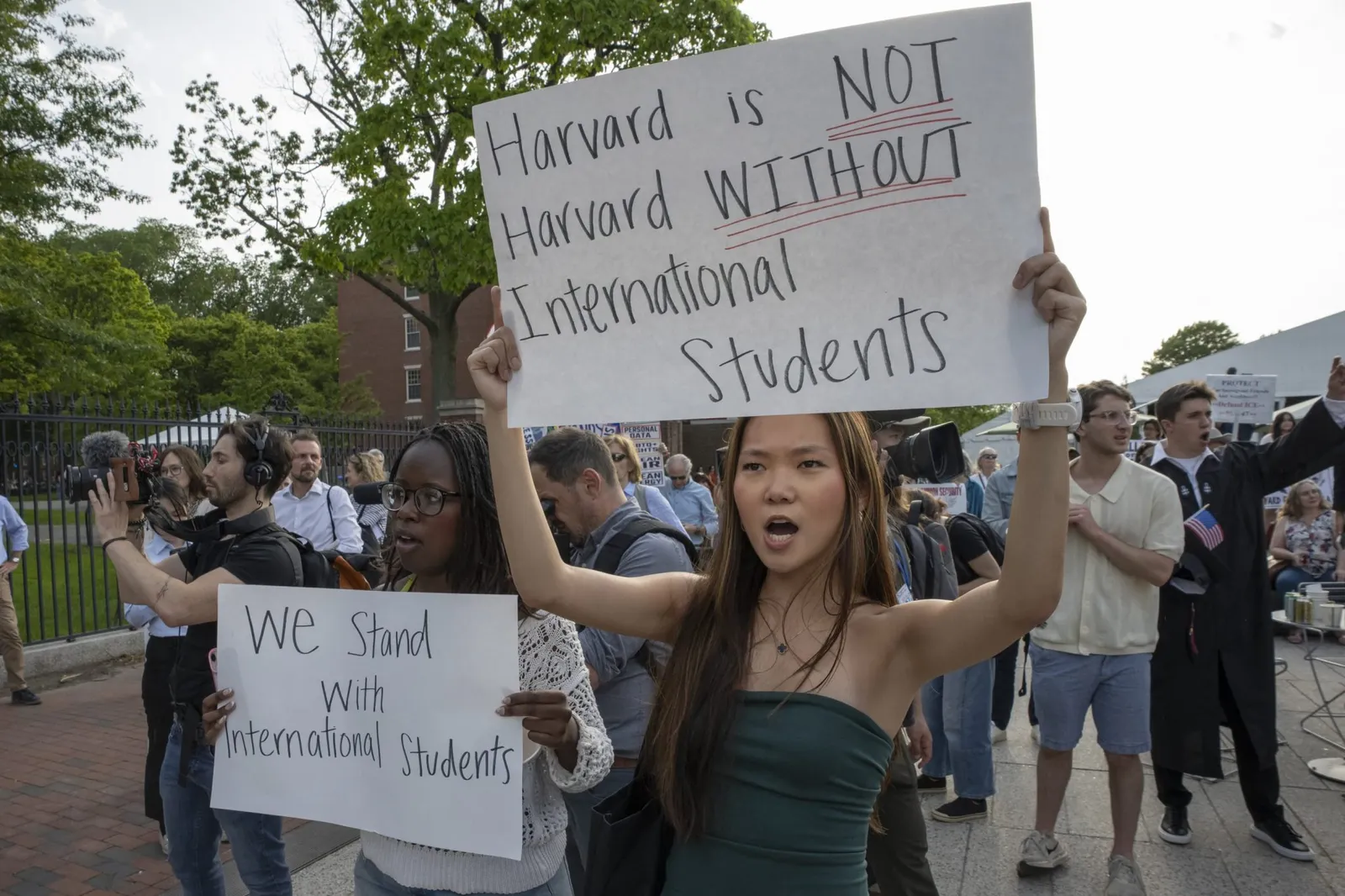
President Trump warned in August 2025 that U.S. colleges would 'go to hell very quickly' without foreign students; new international enrollment then fell 18% in 2025-26 to 228,123, per the Institute of International Education's Open Doors report. The decline is concentrated in master's programs, costing an estimated $1.5 billion or more in tuition and driving layoffs, program cuts and domestic tuition hikes at schools from the University of North Texas to USC.
New international students at U.S. colleges fell 18% this school year, to 228,123, the Institute of International Education said Monday in its annual Open Doors report. It is the second straight drop, and the early read on next fall is worse: in IIE's snapshot of more than 800 schools, new international enrollment fell another 15%. President Trump saw it coming. At an August 2025 cabinet meeting, defending a plan to admit 600,000 Chinese students, he said that without them "our college system would go to hell very quickly and it wouldn't be the top colleges. It would be colleges that struggle on the bottom." His own administration then moved the other way.
The bill is arriving now. Fortune's math puts lost tuition at $1.5 billion to $1.8 billion as a floor, based on roughly 73,000 fewer tuition-paying students and University of North Texas President Harrison Keller's estimate that each admitted master's student who did not enroll would have brought his school $20,000 to $25,000. UNT is public; private schools charge international students far more. NAFSA, the trade group for international educators, estimates international students' total economic contribution, including rent, food and health care, fell 7% in 2025-26 to $39.9 billion, about $3 billion less than the year before. It puts this fall's decline at another $2.4 billion and 31,000 jobs.
The headline total hides the damage. IIE counted 1,146,163 international students, down just 3%, but that includes 335,785 graduates on Optional Practical Training, the post-degree work program, up 14%, and paying no tuition. Strip OPT out and the number enrolled in classes fell about 8%, by Fortune's math. The losses concentrated in one corner of campus: graduate students fell 13% to 423,078, master's students fell 22%, doctoral students rose 3%, and undergraduates slipped 0.3%. Indian graduate students, the biggest group, fell 34%.
Policy did the pushing. The State Department paused student visa interviews in May 2025, then restarted them with expanded social media vetting. A travel ban that began with 19 countries grew to 39 plus the Palestinian territory on Jan. 1. In July, DHS finalized a rule replacing open-ended student status with a fixed four-year limit, calling it the end of "foreign student visa abuse"; a federal judge in Massachusetts blocked it in September. Among schools reporting declines this fall, 88% blamed the visa application process and 70% blamed travel restrictions, per IIE's snapshot. Trump's base had pushed back hard: Rep. Marjorie Taylor Greene said that if keeping Chinese students out made some schools fail, "these schools should fail anyways because they are being propped up by the CCP." IIE President and CEO Jason Czyz said the data "reaffirms the enduring importance of international education to the United States."
The money hurts more than the headcount implies, because these students pay more than their share. Princeton research cited by the Hechinger Report found international students made up 6% of enrollment but 12% of college revenue; they usually pay close to full price and get little aid. In IIE's survey, 60% of institutions said they recruit them partly for their "financial contributions." For most schools the loss is absorbable. Moody's found in 2025 that a 15% drop in international tuition would barely affect operating margins at 77% of the universities it rates. But 15% of rated universities have more than 15% international students, and some have more than 30%. Under a 20% drop, Moody's said, 15 universities could lose 2 to 8 points of operating margin. Moody's and S&P carry negative outlooks on higher education for 2026; Fitch calls the outlook "deteriorating." "We see revenue growing for the sector next year, but not as much as expenses," Moody's analyst Patrick Ronk told The Bond Buyer.
Trump's "bottom" turned out to include Denton, Texas. UNT projected a $45 million shortfall as international enrollment fell, on top of a $32 million cut in state funding over two years, and eliminated 71 academic programs, the Hechinger Report found. "About 60% of UNT's growth over the last few years has been in international graduate students," Keller told the board in August 2025. "We're overexposed compared to other institutions." UNT had more than 1,300 fewer international students this fall. The list is mostly private universities in big cities: DePaul reported a $12.6 million budget shortfall "driven in part by declines in international enrollment" and laid off 114 staff in December after new international graduate students fell 62%. Illinois Tech, where international students were 42% of enrollment, cut about 160 jobs this summer, citing lost international students and research funding. Boston University is running $42 million short of budget, CFO Nicole Tirella said, after cutting about 120 jobs last year and citing declining graduate enrollment. USC and Northwestern cut nearly 1,000 and 425 positions respectively, listing falling international enrollment among several reasons.
Public flagships are not immune. International enrollment fell 15.6% at Indiana this fall, 12.7% at Ohio State and 12% at Pitt. Domestic students are covering part of the gap: Syracuse, Northwestern, USC and the New School all raised tuition 3% to 4% while losing international students, Hechinger found. "It leaves a really big hole in the budget, which has to get filled one way or another," UC Santa Barbara economist Dick Startz told the outlet.
So far the response has been cuts, not closures, and those are two different animals. Hampshire College in Amherst, Mass., will close at the end of this semester after enrollment fell by almost half since 2015 and it could not refinance a $21 million bond. It is one of nine colleges set to close in 2026, by The College Investor's count. Huron Consulting Group says more than 440 of the country's 1,700 private nonprofit four-year colleges are at risk as the number of 18-year-olds starts to shrink. The schools that close are mostly small undergraduate colleges with few international students; the schools losing international master's students are bigger and cut jobs and programs instead. Public institutions "hardly ever close," Higher Ed Dive noted, citing a Philadelphia Fed model. Fortune reported in August that the high school graduating class is projected to shrink 13% by 2041, so both squeezes land at once. This year, the OPT boom kept the total from looking like a crisis. That is the program the administration went after next: on Oct. 8, DHS proposed making schools pay $70,000 the first time they recommend a student for OPT and $30,000 for each recommendation after that, costs schools could pass on to students or employers. In IIE's survey, 95% of institutions said prospective students would look elsewhere if OPT were restricted. In the fall snapshot, OPT fell 6%, its first decline in five years. The full count for this fall arrives in next November's Open Doors report.
This story's Key Insights and Take-aways are locked.
Create a free account to unlock Executive Actions for one credit.
Register to UnlockAlways free for Executives Club members. Join the Club
More in Business

S&P 500 Enters Correction, Down 10% From Its High on AI Worries
The index's slide past the 10 percent line is a symbolic verdict on investor mood, and the AI trade that powered the rally is now the thing testing it.

Dow and S&P 500 enter correction as Nasdaq logs worst week since 2020
All 11 S&P 500 sectors fell more than 1% in the same week for the first time since April 2025, a breadth signal that matters more than any single index level.

Chip stocks lose $2.3 trillion in a week, worst run in 25 years
A $2.3 trillion weekly wipeout in semiconductors is forcing every board with an AI story to ask whether it owns a thesis or just a crowded trade.