
UK and EU eye three deals in Brussels: food, energy, young workers
Chris Mason's read on the potential agreements on food, energy and youth mobility, and what each one would change for British exporters, energy buyers and employers.
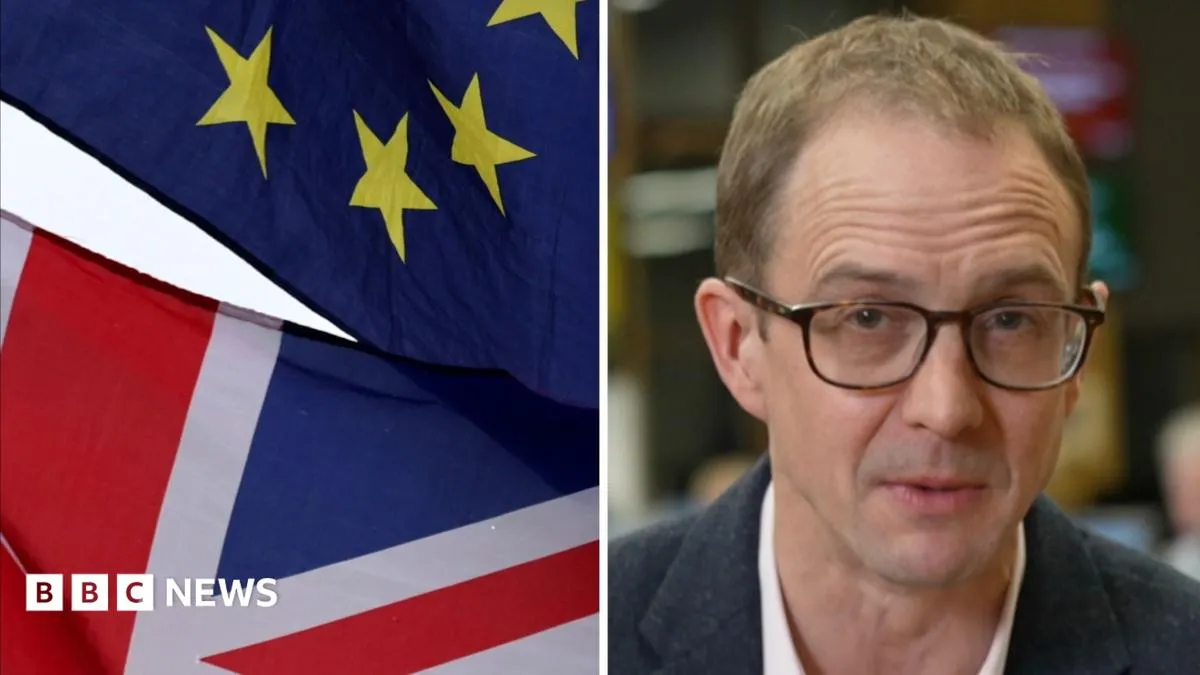
BBC political editor Chris Mason is examining the potential agreements between the UK and the EU that could be reached at the Brussels summit, covering food, energy and youth mobility. For decision-makers, those three files are the realistic frontier of the post-Brexit reset, and each carries a different mix of compliance cost, market access and labour supply consequences.
Three files are on the table in Brussels, and each one lands on a different part of everyday life in Britain: food, energy and young workers. That is the frame BBC political editor Chris Mason puts around the potential agreements between the UK and the EU that could be reached at the summit, and it is a useful one for anyone trying to work out where the post-Brexit relationship is actually heading. The three areas are not equally advanced, not equally charged politically, and not equally valuable to the UK economy. Taken together, though, they sketch the outline of a deal that would be narrow, technical and quietly consequential.
The first thing to hold onto is that these are potential agreements, not signed ones. Mason's read is that food, energy and youth mobility are the live candidates for progress. Nothing on that list touches the single market, the customs union or the jurisdiction of the European Court of Justice, which have been the UK's stated red lines since it left. That is exactly why these three files are the ones moving. They are the places where mutual self-interest is strong enough to survive the politics.
Food is the file with the widest blast radius. Since the Trade and Cooperation Agreement took effect, moving food across the Channel has typically meant paperwork: export health certificates, veterinary sign-off, rules of origin checks and physical inspections at border posts. For a small producer shipping cheese or chilled meat, that stack of costs can be the difference between selling into Europe and giving up on it. A sanitary and phytosanitary agreement, the technical name for a food and farming deal, would typically reduce or remove much of that friction by recognising each side's standards as equivalent. The catch is that equivalence usually comes with alignment: if the UK wants to sell freely into the EU's food market, it generally has to keep its rules close to Brussels'. That is a trade-off about sovereignty as much as about sausages, and it is why this file has stalled before.
Energy is the file where the money is largest and the politics quietest. The UK and its neighbours have been physically linked by electricity interconnectors for years, and power has flowed both ways across those cables. What changed after Brexit was the trading and pricing architecture around them, not the copper. For context, closer cooperation would typically mean better coordination of wholesale electricity markets, shared planning on renewables and more predictable flows at times of peak demand. The strategic risk for the UK is being a rule-taker on energy without a seat at the table where the rules are written, particularly as the EU reshapes its own market and its carbon border regime. The strategic prize is cheaper, more secure power at a moment when energy costs are a live political wound.
Youth mobility is the file that will generate the loudest headlines and the smallest economic numbers. The EU has previously floated a scheme, typically framed around fixed-term stays for younger people, and the UK has historically been wary of anything that looks like free movement by another name. For operators in hospitality, agriculture, care and parts of the tech sector, though, the practical question is labour: where the next cohort of workers comes from when domestic supply is tight. Universities and language schools have a parallel interest, since short-term mobility feeds student pipelines. A deal here would not reopen free movement. It would create a defined, capped channel, and the design details, age bands, duration, whether it is reciprocal, will decide whether it matters.
Why now? Both sides have reasons to want a win. The UK government has made growth the organising principle of its economic story, and trade friction is one of the few levers it can pull without spending money. The EU, for its part, is focused on competitiveness and on keeping its neighbourhood stable. The constraint is sequencing and trust: each file has its own technical track, its own lobbying pressure and its own capacity to be derailed by a single political row. Summits produce communiques; agreements produce text, and text has to be ratified.
For executives, the sensible posture is preparation without over-reading. If a food deal lands, exporters should be ready to move on labelling, certification and logistics contracts quickly, because the benefit accrues to whoever is first through the door. If energy cooperation deepens, procurement and hedging assumptions for the late 2020s deserve a second look. If youth mobility opens, hiring plans for seasonal and early-career roles can be rebuilt around a channel that did not exist. None of that requires betting the company on a Brussels headline.
The deeper point is about what kind of relationship this is becoming. The agreements most likely to be reached are the ones that avoid the hardest questions, which means the UK and the EU may keep converging in the technical trenches while diverging in the political ones. That is an uncomfortable place to run a business from, but it is a workable one, provided you read the summit for what it is: a set of narrow doors opening, not a grand bargain.
This story's Key Insights and Take-aways are locked.
Create a free account to unlock Executive Actions for one credit.
Register to UnlockAlways free for Executives Club members. Join the Club
More in Politics

Fifth Circuit Kills Pregnant Workers' Law Over Pandemic Proxy Votes
A procedural ruling, not a policy one, has blocked a federal pregnancy-accommodation law and put every pandemic-era statute in the crosshairs ahead of an expected Supreme Court appeal.

Measles kills a Virginia child under 5, the state's first death of 2026
Virginia's health department confirmed the death but withheld the child's vaccination status, leaving schools, clinics and employers to plan around the one detail that would explain the most.

Former Brazilian President Bolsonaro Hospitalized with Intestinal Obstruction
The health status of the former far-right leader raises immediate questions about political stability and the trajectory of Brazil's conservative movement.