
USS George Washington exits Middle East, leaving just two US carriers
A Japan-based carrier peeling out of Centcom's waters drops the American count to two, thinning the margin for any crisis that flares in the Gulf, the Red Sea or the Pacific at once.
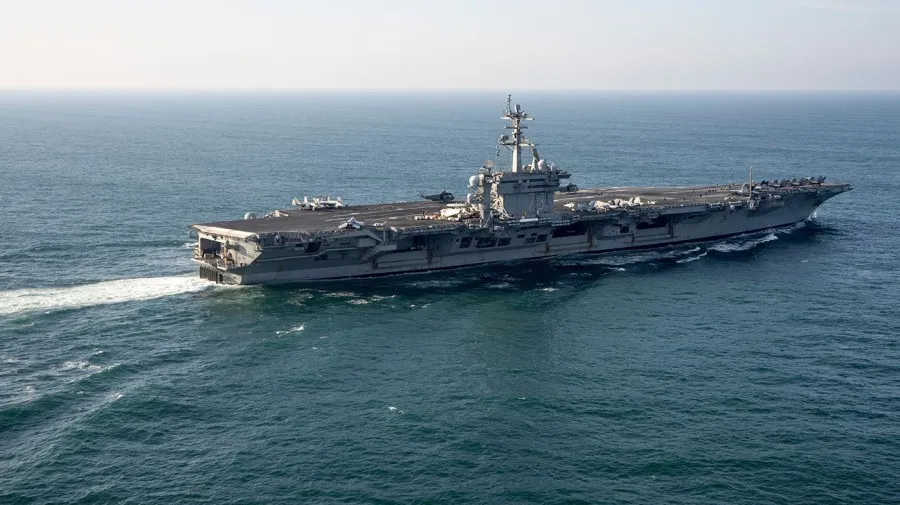
The USS George Washington, a Japan-based aircraft carrier, has departed the Middle East, leaving the U.S. military with two aircraft carriers in U.S. Central Command's region, according to a military official. For anyone with exposure to Gulf shipping, energy prices or defense demand, the move is a live reminder that American presence abroad is a rotation, not a fixture, and every hull pointed at one theater is a hull not pointed at another.
The USS George Washington has left the Middle East. The Japan-based aircraft carrier's departure leaves the U.S. military with two aircraft carriers in the U.S. Central Command region, according to a military official, as reported in The Hill's Defense & National Security newsletter. That is the entire official record: a hull moved, a count changed. But carrier counts are the closest thing the defense world has to a live ticker, and this one ticked down. Centcom is the combatant command that covers the Middle East and Central Asia, which means the Arabian Peninsula, the Gulf, the Red Sea and the chokepoints that stitch them together. Three carriers in that box reads as a statement. Two reads as a schedule.
The difference matters because a carrier is not a symbol that happens to float. It is a sovereign airfield that can be repositioned in days rather than months, carrying its own escorts, its own fuel and its own strike range. When Washington wants to signal resolve without writing a treaty or firing a shot, it moves a carrier. When it wants to signal that a crisis has cooled, it moves one out. Allies, adversaries and, increasingly, freight insurers treat the count as a leading indicator, because it is one of the few pieces of force posture that is visible without a security clearance. A carrier leaving is never just logistics. It is a sentence in a conversation that never stops.
For context on why two is a number worth noticing: carrier presence in the Centcom region has historically been tied to the Gulf's twin responsibilities, deterring a larger war and keeping commercial traffic moving through narrow water. The Strait of Hormuz and the Bab el-Mandeb have for years been the two places where a single incident, a seized tanker or a drone strike, can move insurance premiums and reroute ships within a week. Carriers do not escort every vessel, but their presence changes the risk calculus for everyone who does. Historically, a heavier carrier presence in the region has coincided with periods of elevated tension, and a lighter one with periods when planners feel the balance is manageable.
The arithmetic of two is where this gets interesting. Defense planners have typically treated three carriers in a theater as the point at which a continuous, high-tempo presence becomes sustainable, because at any given moment one is on station, one is in transit and one is working through maintenance or training. Two carriers gives you presence, but it compresses the margin for error. A single unscheduled maintenance issue, a change in orders, or a second crisis in a different time zone can flip the math fast. That is the quiet cost of a drawdown: not that capability disappears, but that flexibility does.
Then there is the ship itself, and this is the part most likely to be misread. The George Washington is a Japan-based carrier, meaning its home port and its maintenance rhythm sit in the Indo-Pacific. Its presence in the Middle East was always a loan, not a permanent posting. Pulling it out returns a Pacific asset to the Pacific, which is worth watching for anyone tracking the broader redistribution of American naval power. The U.S. carrier fleet is finite and heavily scheduled, and every deployment is a trade: a hull covering the Gulf is a hull not covering the South China Sea, and a hull parked in one theater is a hull unavailable for a surge somewhere else. The Hill's report does not say where the George Washington is headed next, and that blank space is doing real work.
So what should you actually take from a carrier count? Three things. First, treat presence as a signal but not a verdict. A drawdown of one hull does not mean the U.S. is disengaging from the Middle East; it means the Pentagon is rebalancing a finite inventory against competing demands, and the remaining two carriers still represent substantial capability. Second, watch the chokepoints rather than the headlines. Shipping rates, war-risk premiums and rerouting decisions around Hormuz and Bab el-Mandeb respond to perceived risk, and perceived risk responds to visible force posture. Third, remember that carrier movements are one of the few genuinely public reads on military priorities. Budgets are opaque, procurements take a decade, but a ship either turns left or turns right, and you can see which.
For the reader running a business, a portfolio or a supply chain, the practical translation is straightforward. Energy and freight exposure in the Gulf is sensitive to exactly this kind of quiet rebalancing, because the moments when presence thins are the moments when a small incident carries more weight. Defense demand, meanwhile, does not soften when a carrier leaves; the maintenance, munitions and readiness bills follow the fleet wherever it goes. And for anyone watching the Indo-Pacific, the more interesting story may be the one not being told: a Japan-based carrier heading home is a Pacific reinforcement dressed up as a Middle East withdrawal. That is the thing about carrier counts. The number tells you where the attention is. The direction of travel tells you where it is going.
This story's Key Insights and Take-aways are locked.
Create a free account to unlock Executive Actions for one credit.
Register to UnlockAlways free for Executives Club members. Join the Club
More in Politics

Fifth Circuit Kills Pregnant Workers' Law Over Pandemic Proxy Votes
A procedural ruling, not a policy one, has blocked a federal pregnancy-accommodation law and put every pandemic-era statute in the crosshairs ahead of an expected Supreme Court appeal.

Measles kills a Virginia child under 5, the state's first death of 2026
Virginia's health department confirmed the death but withheld the child's vaccination status, leaving schools, clinics and employers to plan around the one detail that would explain the most.

Former Brazilian President Bolsonaro Hospitalized with Intestinal Obstruction
The health status of the former far-right leader raises immediate questions about political stability and the trajectory of Brazil's conservative movement.