
Voyager 1 goes silent one light-day out, and every reply takes 48 hours
NASA's Canberra dish can still hear the probe's carrier signal, but the science data has stopped and the 2023 rescue playbook now has to run at a two-day delay.
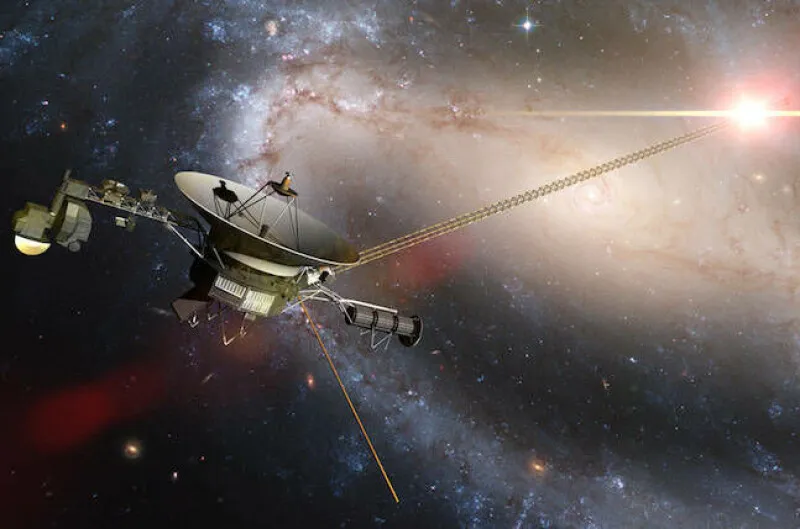
NASA's Voyager 1 team lost the spacecraft's science and engineering data on November 14, four days before the probe crossed one light-day from Earth, and is now hunting a fault it cannot reach in less than a 48-hour round trip. For operators of any distant hardware, the incident is a live case study in why autonomy and fault protection have to be designed in at the start, not retrofitted.
On November 18, Voyager 1 put a full light-day between itself and Earth, roughly 26 billion kilometers or 16 billion miles out, the distance light itself covers in 24 hours. It marked the milestone the way it has marked most recent milestones: by going quiet. On November 14, the mission team noticed the spacecraft had stopped returning science and engineering data. A Deep Space Network antenna in Canberra, Australia, could still pick up its carrier signal. It just was not carrying anything.
That distinction is the whole ballgame. The carrier signal is the bare hum of a working transmitter pointed the right way, proof that Voyager 1 can still hold its antenna on Earth and operate its transmitting equipment. What is missing is the payload: the science and engineering readings that make the spacecraft useful rather than merely alive. Something may be amiss in the system responsible for collecting and collating data from the probe, and until engineers work out what, the most distant object humanity has built is an expensive beacon.
They have been here before, which is the one genuinely encouraging detail. In 2023 Voyager 1 went through a comparable stretch of silence. It took months of troubleshooting before engineers coaxed a response, and by June 2024 NASA was delighted to announce the spacecraft was back in action. The culprit turned out to be a faulty computer chip, and the fix was a software update that worked around the defective hardware - a workaround written for a machine launched in the 1970s and now far beyond any hope of a service call. That experience, as NASA notes, will stand the team in good stead this time around.
October adds a wrinkle. Communications with Voyager 1 briefly dropped out that month, possibly because the spacecraft fell into safe mode after a thruster failover. Engineers are investigating whether the two incidents are connected, a reasonable suspicion when the same aging hardware keeps throwing symptoms weeks apart. If they are linked, the diagnosis narrows fast. If they are not, the team is chasing two ghosts across 26 billion kilometers.
The real adversary here is not the fault. It is the clock. At one light-day out, a command takes more than 24 hours to reach the spacecraft, and the answer takes more than 24 hours to come back. Every hypothesis becomes a two-day experiment: send, wait, listen, wait again. The same physics that makes the milestone historic is what makes the bug almost impossible to chase in a hurry. The 2023 fix took months. This one could take weeks or longer for exactly that reason - the team cannot iterate faster than light.
What keeps the mission alive is fault protection designed in when the spacecraft were built, ahead of their 1977 launches. The Voyagers carry an impressive amount of it: autonomous safeguards that have helped them keep flying, keep pointing and keep talking with nobody on the line. It is the reason a pair of probes closing in on half a century in 2027 are still working machines rather than museum pieces, and the reason a silence like this one reads as a puzzle rather than an obituary.
NASA expects to confirm on November 19 that Voyager 1 was still operating when it reached one light-day from Earth on November 18, using its carrier signal and trajectory calculations. Read that twice. Confirmation of a Monday event lands Tuesday, computed from a tone, because the telemetry is precisely what broke. That is what operating at the edge of the solar system actually looks like.
For anyone running hardware that has to survive far from a technician - satellites, offshore rigs, deep-sea equipment, anything whose maintenance window is measured in weeks - Voyager 1 is the cleanest case study on the shelf, and it offers three transferable lessons. Autonomy is not a feature you bolt on later; the fault protection written decades ago is the only reason there is still a mission to argue about. Latency is a design constraint, not an operational annoyance; a two-day feedback loop forces you to build systems that can diagnose themselves. And patience costs real money, because the 2023 rescue consumed months of scarce engineering time on a spacecraft long past any warranty.
Voyager 1 is 48 years old, flying hardware no one can reach, on a mission that has already outlived every reasonable expectation. Glitches at this age are not a crisis; NASA's own framing is that they are understandable and likely. The question was never whether something would break. It is whether the thing was built with enough slack, and the team with enough memory of last time, to bring it back. On both counts, Voyager 1 has a record worth betting on.
This story's Key Insights and Take-aways are locked.
Create a free account to unlock Executive Actions for one credit.
Register to UnlockAlways free for Executives Club members. Join the Club
More in Technology

Anthropic mathematician claims Claude helped crack the Riemann hypothesis
If the proof holds, AI has toppled math's most famous open problem; if it does not, it is a case study in announcing breakthroughs before anyone verifies them.

AI's $4 Trillion Wipeout Erases Nasdaq's Gains for the Year
A brutal week took roughly $4 trillion off the AI sector and left the Nasdaq flat for the year, and the damage ran the full length of the supply chain.

Anthropic mathematician says AI proved the Riemann hypothesis. Verification will take time.
A single unverified claim from inside Anthropic now sits against more than 160 years of open mathematics, and the gap between asserting a proof and surviving peer review is the entire story.