
Voyager 1 is now one light-day away. A flashlight message took 24 hours
On Nov 18 at 10:16:07 UTC, the 1977 probe became the first human object a full day of light from Earth, and the fans who flashed its call sign into the sky waited exactly that long.
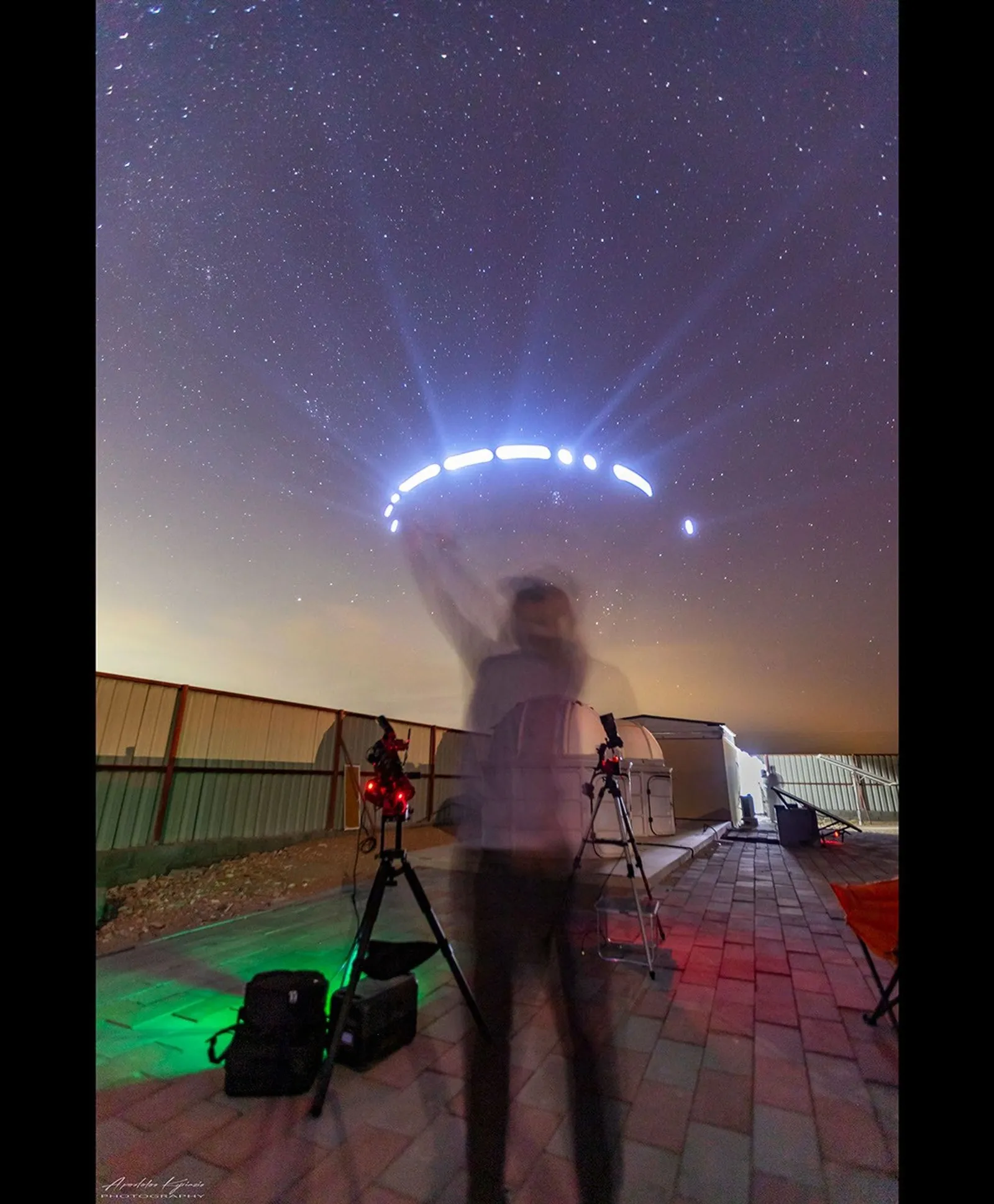
NASA's Voyager 1, launched in 1977, was confirmed on November 18 at 10:16:07 UTC to have reached one light-day from Earth, roughly 26 billion kilometers, after fans at the Emirates Astronomical Observatory flashed its Morse call sign V-G-R into the sky on November 17. For operators and boards, the milestone is a live case study in decision latency, long-horizon maintenance, and what it costs to run an asset you cannot reach in real time.
Voyager 1 is now one full light-day from Earth. NASA's Astronomy Picture of the Day confirmed the spacecraft hit the milestone on November 18 at 10:16:07 UTC, nearly 50 years after its 1977 launch. That puts humanity's most distant machine roughly 26 billion kilometers out, far enough that anything aimed at it, a radio command, a status ping, a flashlight blink, needs a full 24 hours of empty space to arrive. The timing was not an accident of the calendar. On November 17, fans of interstellar spaceflight around planet Earth were invited to shine a message into the night sky, and the answer to the question of how long that message took to reach Voyager 1 is exactly one day.
The message itself was low tech and high romance. Traced by a flashlight beam switched on and off, the dashes and dots of Morse code were captured in a time exposure from the Emirates Astronomical Observatory. Read them out and you get V-G-R, the call sign for Voyager 1. The image is credited to Apostolos Kyriazis, and it ran under the APOD banner with authors and editors Jerry Bonnell, Cecilia Chirenti, Robert Nemiroff and Keighley Rockcliffe, a service of the Astrophysics Science Division at NASA Goddard, NASA Science Activation and Michigan Tech. No budget, no launch vehicle, no ground station. Just a beam pointed up and a shutter left open.
A light-day is what it sounds like: the distance light covers in 24 hours. Light moves at roughly 300,000 kilometers per second, so a day of it stacks up to about 26 billion kilometers, which is where Voyager 1 now sits. For most of the mission's life, the lag was measured in hours. Now it is measured in days, and every instruction sent from Earth is a bet placed on a spacecraft that cannot ask a clarifying question. Engineers send a command, wait a day for it to land, then wait another day for telemetry to come back. A two-day round trip is the new normal for the farthest object we have ever built.
For extra credit, APOD invites the mathematically inclined to run the numbers. At one light-day per 50 years, Voyager 1 reaches one light-year, or 365 light-days, in about 18,250 years. Put that against a human frame: 18,250 years ago, recorded history had not started. The spacecraft will still be coasting through the galaxy long after every institution that built it, funded it, or argued about its budget has disappeared.
That is the part worth sitting with. Voyager 1 launched in 1977, the same year the Apple II went on sale and the first Star Wars film opened, and it has outlived the Cold War rivalry that produced it. For context, missions like this typically run on radioisotope power sources that decay year by year, and NASA has historically had to shut down instruments one at a time to keep the lights on. The Deep Space Network, the global antenna array that talks to it, is a shared asset juggling dozens of spacecraft at once. Every extra year of Voyager 1 is a year of deliberate, unglamorous maintenance by people who will never meet the version of the mission that finally goes quiet.
Strip away the poetry and the milestone is a lesson in latency. Distance is a cost, and it compounds. A team that can act in an hour has options a team that needs a day does not. Voyager 1's operators cannot debug in real time, cannot pivot on a hunch, cannot spot a problem and fix it in the same shift. They plan, they simulate, they send, and they wait. Anyone running a distributed system, a supply chain, or a satellite fleet knows the feeling. The further your assets sit from your decision loop, the more your process has to carry, and the less room you have for improvisation.
The flashlight message is the fun part, and it deserves to be. A group of people stood under the sky at the Emirates Astronomical Observatory and spelled out a spacecraft's call sign in Morse code, knowing full well that the light would take a day to reach it and that Voyager 1 would not read it, reply, or care. That is what fandom looks like at 26 billion kilometers. If anything ever answers back, the reply takes another day. Meanwhile the milestone clock keeps running, and the next one, one light-year, is roughly 18,250 years out. Somebody should start the countdown.
This story's Key Insights and Take-aways are locked.
Create a free account to unlock Executive Actions for one credit.
Register to UnlockAlways free for Executives Club members. Join the Club
More in Business

S&P 500 Enters Correction, Down 10% From Its High on AI Worries
The index's slide past the 10 percent line is a symbolic verdict on investor mood, and the AI trade that powered the rally is now the thing testing it.

Dow and S&P 500 enter correction as Nasdaq logs worst week since 2020
All 11 S&P 500 sectors fell more than 1% in the same week for the first time since April 2025, a breadth signal that matters more than any single index level.

Chip stocks lose $2.3 trillion in a week, worst run in 25 years
A $2.3 trillion weekly wipeout in semiconductors is forcing every board with an AI story to ask whether it owns a thesis or just a crowded trade.