
Warby Parker's $395 Google glasses land Nov. 12 to bury the 'glasshole' era
With new active customers up just 3.4% and Meta holding 69% of smart-glasses sales, the DTC pioneer is betting design, not specs, wins the face.
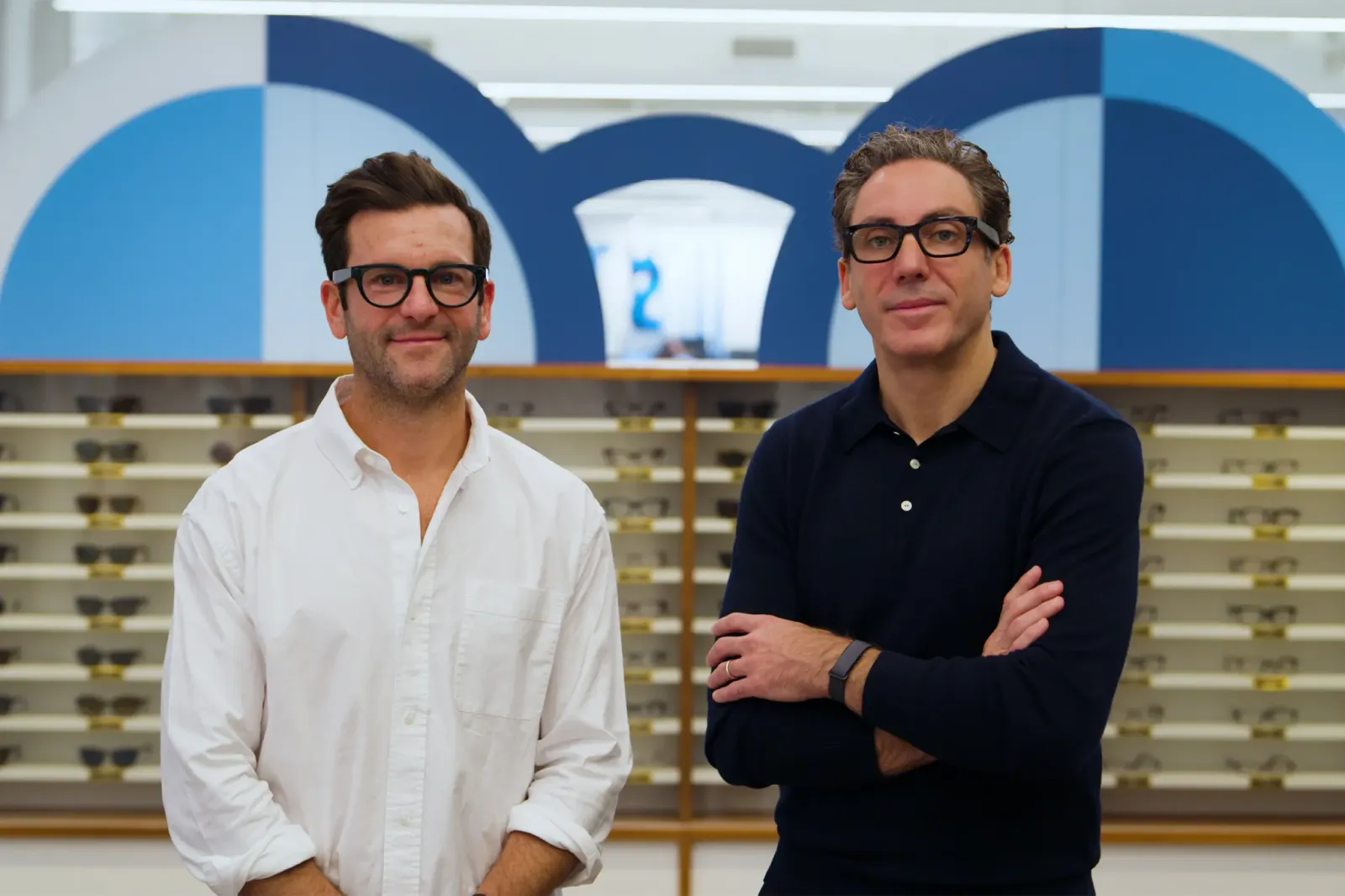
Warby Parker co-founders and co-CEOs Neil Blumenthal and Dave Gilboa are launching $395 AI glasses built with Google and Samsung technology on Nov. 12. The launch tests whether a brand with 1% of the U.S. eyewear market can convert slowing direct-to-consumer growth into a platform play against Meta and EssilorLuxottica.
Warby Parker's smart glasses start at $395 and hit the market on Nov. 12, built with Google, which supplies the AI technology alongside partner Samsung. The frames carry a high-resolution display tucked inside one lens, and wearers control it with a wristband or a watch. For context, Google's first attempt, Glass, debuted in 2013 at $1,500. The new price is roughly a quarter of that, and the styling is deliberately ordinary, which is exactly the bet: the tech has to disappear into a pair of glasses people would wear anyway.
Neil Blumenthal, Warby Parker's co-founder and co-CEO, frames it simply. "Glasses are the original wearable, right?" he says on Fortune's Behind the Business YouTube series, adding that the combination of form and function is something the company can bring to this new category, creating something with a ton of technology in it. His co-founder and co-CEO Dave Gilboa puts the design constraint even more bluntly: "But our north star is that someone has to want to put this on their face." That is the whole thesis. Warby Parker is not selling a gadget that happens to be eyewear. It is selling eyewear with a computer hidden inside.
The urgency is real. Warby Parker retains an empire of 360 stores and grew revenue 10% to $245 million in its most recent quarter, a notable run for a brand from the 2010s direct-to-consumer wave that also produced Allbirds, Away, and Casper. Many of those peers struggled or shut down. But new active customer growth came in at just 3.4% last quarter, against a sluggish eyewear market overall. Smart glasses are the company's answer: at its recent quarterly check-in with Wall Street analysts, where smart glasses dominated the discussion, Warby Parker said the category could contribute several percentage points to fourth-quarter growth.
The competition is not small. Meta's Ray-Ban smart glasses, designed and made with Italy's EssilorLuxottica, the largest eyewear company in the world, represented about 69% of smart glasses so far this year. EssilorLuxottica has said it sold 7 million pairs of AI-supported glasses last year. Warby Parker, by contrast, commands just 1% of the U.S. eyewear market. Yet that small share comes with something tech companies badly want, says Kate Winick, an analyst with Forrester Research. "Warby Parker is a small player, but it's the right player," she says. "It has stores in these zip codes that tech companies desperately want to reach."
That matters most to Google, which has a lot riding on this launch. Winick says the company needs Warby Parker to help it move past Google Glass, which flopped after its 2013 debut. Glass was bulky, its battery died quickly, and at $1,500 it was hard to justify. Worse, it made people uneasy: many bars, restaurants, and theaters banned it over fears of non-consensual recording, and its wearers earned a nickname, "glassholes." Google now wants its new version of smart glasses to prove that its technology can work at scale across other wearables. Winick expects tech giants to push the wearable tech inside glasses into other devices, such as Meta's Muse Charm, a pocket- and keychain-sized AI companion.
The Warby Parker frames are built to avoid a repeat of that backlash. The "smart" aspect is subtle: the cameras on the front of the frame could pass for a screw, wearers start filming or take a photograph by pressing a small button near the temple, and outward-facing lights illuminate whenever the user is recording. That last detail is the concession that matters, because it addresses the fear that drove the bans a decade ago. Blumenthal and Gilboa acknowledge the privacy concerns that smart glasses raise, but argue the devices could fix a modern habit: constantly reaching for our phones. "For the first time, you can have this accessory that enables you to leave your phone in your pocket to keep your attention in the real world," Gilboa says.
The commercial terms remain opaque. Google and Warby Parker have not disclosed the revenue sharing or intellectual property ownership details of their partnership, which leaves the long-run margin structure of the deal unproven even as the top line gets a near-term lift. Still, the strategic logic is clear on both sides. Google gets distribution and design credibility it could not manufacture alone. Warby Parker gets a second growth engine and a tech-forward reputation that leans on its actual strengths, design and retail, rather than chip specifications. And for every other consumer brand watching, the lesson is sharper than the product: in hardware, the winner is rarely the company with the best technology. It is the company whose product someone actually wants to wear.
This story's Key Insights and Take-aways are locked.
Create a free account to unlock Executive Actions for one credit.
Register to UnlockAlways free for Executives Club members. Join the Club
More in Business

S&P 500 Enters Correction, Down 10% From Its High on AI Worries
The index's slide past the 10 percent line is a symbolic verdict on investor mood, and the AI trade that powered the rally is now the thing testing it.

Dow and S&P 500 enter correction as Nasdaq logs worst week since 2020
All 11 S&P 500 sectors fell more than 1% in the same week for the first time since April 2025, a breadth signal that matters more than any single index level.

Chip stocks lose $2.3 trillion in a week, worst run in 25 years
A $2.3 trillion weekly wipeout in semiconductors is forcing every board with an AI story to ask whether it owns a thesis or just a crowded trade.