
Xi Tells Albanese China Ties Have 'Turned Around' at APEC Summit
Australia's prime minister gets the phrase he wanted from Beijing's top leader, but his follow-up meeting with Premier Li Qiang is where trade access actually gets decided.
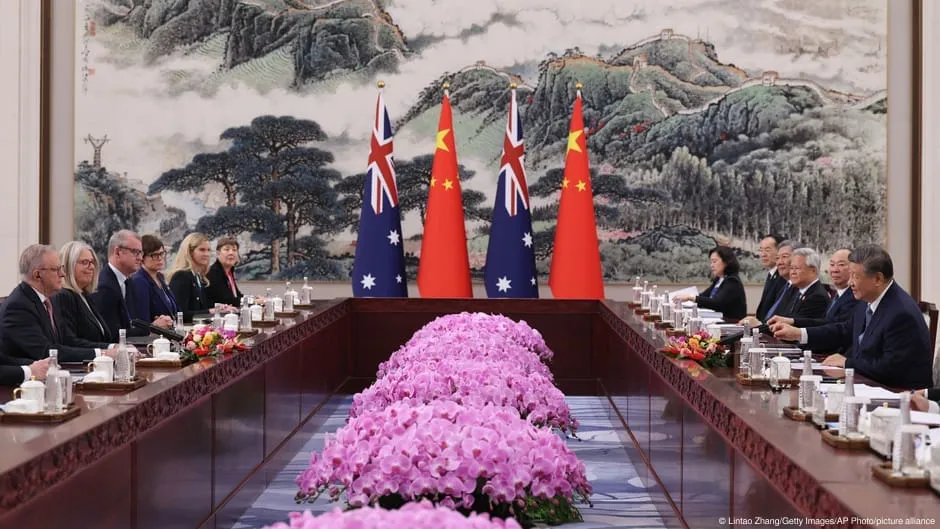
Chinese leader Xi Jinping told Australian Prime Minister Anthony Albanese that the relationship between the two countries has 'turned around' during talks on the sidelines of the APEC summit, with Albanese also slated to meet Chinese Premier Li Qiang. For exporters, miners, farmers and investors with Australian exposure, the rhetorical thaw is a leading indicator on commodity flows and market access, but the concrete deliverables will come from the economic portfolio Li Qiang controls.
Xi Jinping told Anthony Albanese that the relationship between China and Australia has "turned around," using that word during talks held on the sidelines of the APEC summit. The Australian prime minister is also slated to meet Chinese Premier Li Qiang, according to the readout of the leaders' schedule. That single word, "turnaround," is the story. It is the kind of phrase that would have been unthinkable in 2020, when the two governments had effectively stopped speaking and Beijing was methodically squeezing Australian exports. Now it is being said out loud, by Xi, at a summit, with the world watching. For a prime minister who has spent his term trying to stabilize the relationship without appearing to capitulate, it is the headline he wanted.
The stakes are not abstract. China is Australia's largest trading partner, and the relationship runs through iron ore, coal, liquefied natural gas, beef, wine, barley and lobster. When ties were at their worst, those flows became leverage. So a public "turnaround" from Xi is not just diplomatic mood music; it is a signal to exporters, shippers, miners, farmers and the investors who price their shares. Australia's economy is small enough that a single bilateral relationship can move its currency and its budget. That is why a phrase uttered at a summit matters more in Canberra than it would in most capitals.
For context, the rupture was fast and deliberate. In 2020, after Canberra called for an independent inquiry into the origins of COVID-19, Beijing responded with a series of trade measures targeting Australian goods, including barley, wine, beef, coal and lobster. Ministerial dialogue stopped. Diplomatic contact thinned to almost nothing. Australian exporters scrambled to find new markets, and in some cases never fully replaced the Chinese ones. Historically, Australia had managed to keep its security ties with Washington and its commerce with Beijing in separate lanes. That arrangement broke down, and repairing it has been the central project of the current government.
The thaw has been incremental rather than dramatic. Albanese's government, elected in 2022, made stabilization a priority, and the two leaders met on the margins of a G20 summit that year, the first such encounter in years. Since then, several of the trade barriers have been lifted in stages, and detained Australians have returned home. Each step has been small, reversible and heavily negotiated. Which is precisely why Xi's use of the word "turnaround" carries weight: it suggests Beijing now wants the improvement to be visible, not merely technical.
It does not, however, resolve the hard part. Australia is a member of AUKUS, the trilateral pact with the United States and the United Kingdom that will deliver nuclear-powered submarines, an arrangement Beijing has criticized repeatedly. Canberra screens foreign investment, including Chinese bids, through a national security lens. Critical minerals, the Pacific islands, and military encounters in the South China Sea all remain live points of friction. A "turnaround" in tone does not rewrite those files. Executives who read the headline as a green light for unrestricted Chinese capital or uncontested strategic alignment will be reading it wrong.
That is why the second meeting matters. Albanese is slated to sit down with Premier Li Qiang, and premiers in China's system run the economic portfolio. If Xi sets the political temperature, Li's desk is where the commercial detail lives: market access, quarantine rules, investment approvals, and the unglamorous technical work that determines whether a lobster shipment clears customs. Watch for what comes out of that room, not just the warm words from the first one. Trade normalization in this relationship has always been delivered in increments, and it has always been reversible.
The second-order effect is a template. Middle powers from Tokyo to Seoul to Ottawa to Brussels have been trying to work out how to reduce dependence on China without severing it, a policy usually described as de-risking rather than decoupling. Australia is the most advanced test case, because it took the hardest hit first and has spent the longest climbing back. If Canberra can convert a rhetorical "turnaround" into durable, predictable market access while keeping its security arrangements intact, that becomes the playbook others cite. If the thaw stalls, it becomes the cautionary tale.
For executives, the practical read is this: diplomatic language is now a leading indicator for commodity flows, freight rates and sector-level earnings. Companies with Australian exposure should treat the Xi-Albanese meeting and the Li Qiang sit-down as a pair, and watch for concrete deliverables rather than atmospherics. Boards weighing China-linked supply chains should stress-test for the possibility that access improves and then reverses again, because that has been the pattern for five years. And anyone in a peer economy should note the asymmetry on display: a single sentence from Xi moved the narrative further than months of technical negotiation. That is the price of concentration, and the reason diversification keeps showing up in board packs.
This story's Key Insights and Take-aways are locked.
Create a free account to unlock Executive Actions for one credit.
Register to UnlockAlways free for Executives Club members. Join the Club
More in Politics

Fifth Circuit Kills Pregnant Workers' Law Over Pandemic Proxy Votes
A procedural ruling, not a policy one, has blocked a federal pregnancy-accommodation law and put every pandemic-era statute in the crosshairs ahead of an expected Supreme Court appeal.

Measles kills a Virginia child under 5, the state's first death of 2026
Virginia's health department confirmed the death but withheld the child's vaccination status, leaving schools, clinics and employers to plan around the one detail that would explain the most.

Former Brazilian President Bolsonaro Hospitalized with Intestinal Obstruction
The health status of the former far-right leader raises immediate questions about political stability and the trajectory of Brazil's conservative movement.