
42 cancers, one shared script: the tumour's neighbourhood may be the target
A Nature analysis of 42 cancer types finds shared gene-activity patterns in the tumour microenvironment, hinting at therapies that could work across histologies instead of one at a time.
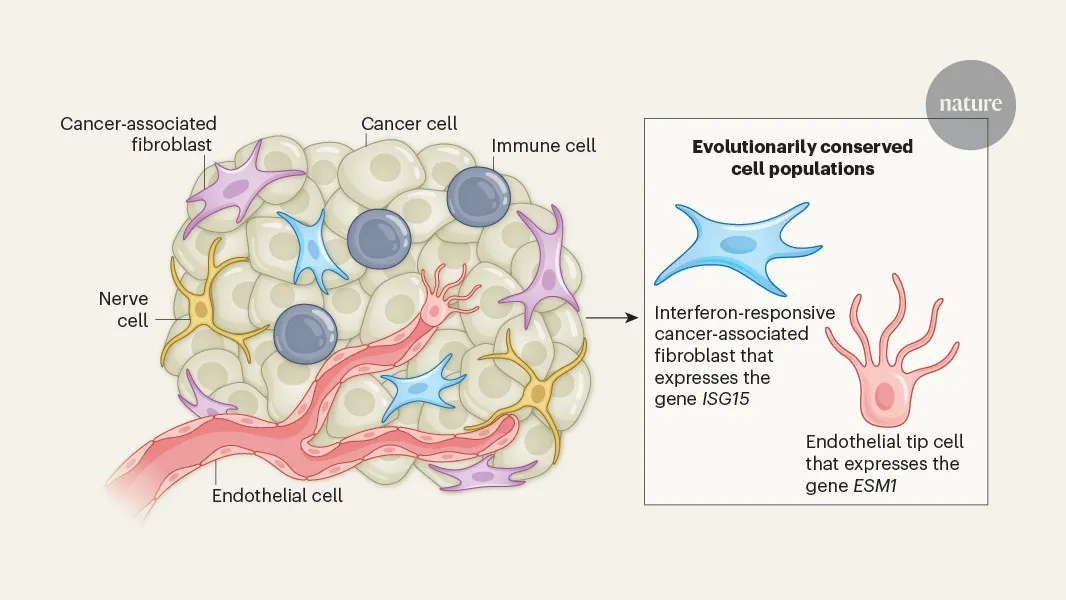
An analysis of 42 cancer types, published in Nature on 19 November 2026, reports shared patterns of gene activity in the tumour microenvironment, the tissue surrounding a tumour, which might point to treatments that work across a range of cancers. For pharma R&D chiefs, biotech founders and investors, the implication is a potential shift from tumour-by-tumour drug development toward pan-cancer targets, with the caveat that this is an analysis, not a validated therapy.
Forty-two. That is how many cancer types an analysis published in Nature on 19 November 2026 lined up side by side, and the result is the sort of finding that makes oncology researchers stop scrolling: the tumours shared patterns of gene activity in their microenvironment. The tumour microenvironment is the ecosystem surrounding a cancer, the immune cells, fibroblasts, blood vessels and signalling molecules that a tumour recruits and rewires to survive. The analysis suggests that this surrounding tissue, not only the mutated cancer cell at the centre, runs on a common script across diseases that medicine has long treated as separate.
The payoff, if it holds, is enormous. Shared biology is the precondition for shared medicine. If a meaningful slice of the gene activity in the space around a tumour is the same across dozens of cancer types, then a single drug aimed at that programme could, in principle, be tested and eventually used across all of them, instead of being developed one histology at a time. Nature's summary is careful with its language: the patterns might point to treatments that work across a range of cancers. Might is doing real work in that sentence, and it should.
For context, oncology drug development has been organised around where a cancer starts. A trial enrols patients with a specific tumour type, regulators approve the drug for that type, and the label expands only as separate studies report out. Tissue-agnostic approvals, where a drug is cleared for any solid tumour carrying a particular molecular marker regardless of where it began, exist but are historically the exception rather than the rule. Each one has been treated as a landmark. That is the backdrop against which a 42-cancer shared signature lands.
Gene activity is not the same thing as a driver. Two tumours can switch on the same genes for entirely different reasons, and a shared pattern can reflect a generic response to stress, damage or immune attack rather than a vulnerability worth attacking. The analysis identifies commonality; it does not, on its own, prove that hitting that commonality shrinks tumours. Historically, the gap between a compelling expression signature and an approved therapy has swallowed years and enormous sums. The value of this work is that it narrows the search space and hands drug hunters a shorter list of programmes to interrogate.
The economics explain why this matters beyond the lab. Oncology trials are expensive, slow and increasingly hard to enrol, because each histology is a smaller pool of patients. A pan-cancer hypothesis changes the arithmetic: one programme, many indications, larger addressable populations, and a stronger case for a basket trial that enrols by molecular profile rather than by organ of origin. For a biotech with a single asset, that is the difference between a niche label and a platform. For big pharma, it is a reason to revisit shelved compounds that failed in one tumour type.
It also puts diagnostics in the frame. A shared signature is only useful if you can test for it, which means companion diagnostics, sequencing workflows and pathology infrastructure capable of classifying a patient by the state of their tumour microenvironment rather than by the organ it came from. And it is worth noting what kind of science produced this: an analysis, which typically means re-mining data that already exists. Cheap computation on expensive samples is now one of the highest-leverage activities in biology.
What to watch next is validation. The questions that matter are whether the shared patterns predict response to any existing or experimental therapy, whether they hold in prospective patient cohorts rather than retrospective datasets, and whether regulators would accept a tissue-agnostic filing built on a microenvironment signature. None of that is settled by one paper. But the direction of travel is clear: oncology's organising principle has been drifting from the organ to the molecule for a decade, and a 42-cancer common thread in the tissue around the tumour pushes that drift further.
For executives, the practical read is this. If you run R&D, ask your teams where your pipeline's targets sit relative to microenvironment biology, because that is where cross-indication leverage may now be hiding. If you invest, watch which groups move first to test a pan-cancer hypothesis in humans. If you are simply curious, remember the headline number: 42 cancers, one shared pattern of activity around them. That is a hypothesis worth a lot of money, and it is still just a hypothesis.
This story's Key Insights and Take-aways are locked.
Create a free account to unlock Executive Actions for one credit.
Register to UnlockAlways free for Executives Club members. Join the Club
More in Science

Anthropic's I.P.O. Made Rank-and-File Researchers Worth Tens of Millions
Researchers who joined just a few years ago are now worth tens of millions, and the windfall resets the pay benchmark for every private A.I. lab still paying in paper.

Sea Lion Culling Strategy Fails: New Model Says Killing Them Won't Save Salmon
The latest research from AAAS overturn a long-held conservation assumption, forcing policymakers to rethink critical resource allocation in marine ecosystems.

Microplastics do more than pile up: they react with water to damage cells
Scientists have found that plastic particles can generate highly reactive molecules in water, a mechanism that could explain links to heart attacks, strokes, and neurological disorders.